


Ultimate Guide: Transfer Salesforce Attachments to a File Server
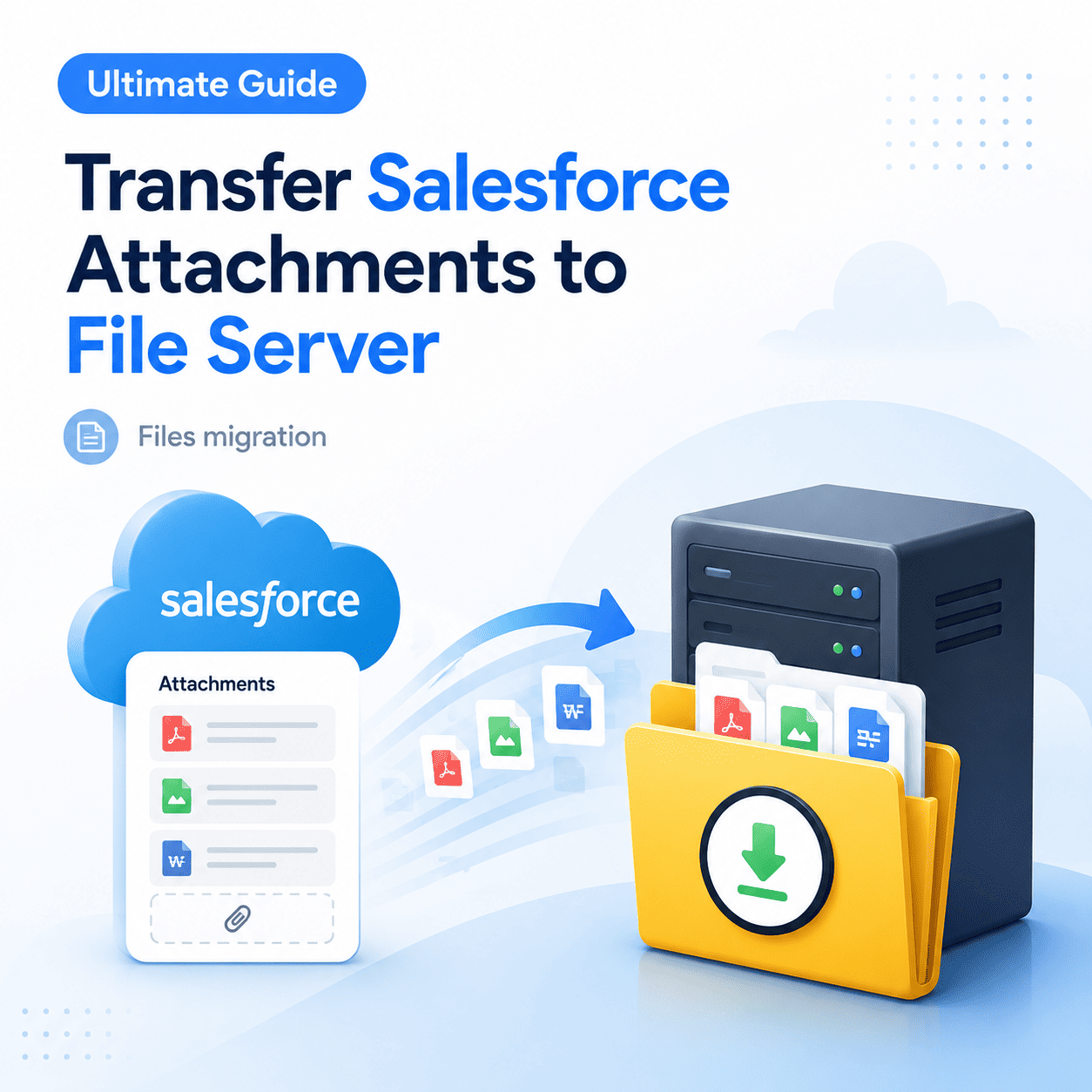
Organizations Transfer Salesforce Attachments to File Server for a number of reasons: to manage storage costs, for compliance archiving, to integrate with on-premises systems, or to consolidate all corporate documents into one central repository.
Thank you for reading this post, don't forget to subscribe!Unlike cloud-to-cloud migrations—which connect Salesforce to third-party SaaS platforms Transfer Salesforce Attachments to File Server involves moving data directly into your organization’s internal infrastructure. Before settling on an approach, it is crucial to understand how Salesforce handles file storage and the strategies available for execution.
How Salesforce Stores Files Before You Migrate Them
Before, Transfer Salesforce Attachments to File Server it helps to know exactly where those files live within the platform’s database structure:
Salesforce Files (
ContentVersion): This object stores the actual document data, file size, and extension. Every upload or modification creates a newContentVersionrecord.The Parent Record (
ContentDocument): This represents the overarching file envelope. It acts as the parent object linking all versions together.The Relationship Link (
ContentDocumentLink): This junction object securely links aContentDocumentto specific Salesforce records (such as Accounts, Contacts, or Cases), users, or Chatter groups.Legacy Attachments (
Attachment): Older Salesforce orgs often still hold files in the legacy Attachment object, which relies on a completely different, flat data model.
Why This Matters
If your org contains a mix of legacy Attachment records and newer Salesforce Files, your extraction process must address both data models simultaneously. Accounting for only one will result in incomplete migrations and orphaned data to Transfer Salesforce Attachments to File Server
Methods to Migrate Salesforce Attachments to a File Server
Because Salesforce does not feature a native “export to local server” button, teams choose from a few distinct architectural paths based on their technical resources and data volume:
1. Manual Export and Upload
The most basic approach involves utilizing Salesforce’s native Data Export Service or Data Loader to request a bulk backup. Salesforce packages these files into a massive compressed archive. From there, an administrator manually extracts the zip file and copies the contents over to the target the Transfer Salesforce Attachments to File Server
Downside: This is acceptable for one-off, small-scale extractions, but it does not scale. Native backups offer zero selective filtering, requiring you to download your entire file library just to extract a few specific files.
2. Custom Apex and REST API Integrations
If your target file server supports SFTP, FTP, or has a dedicated REST-based file upload endpoint, your development team can build a custom integration script. This script queries the Salesforce REST or Bulk APIs to programmatically download ContentVersion binaries and push them straight to your internal server.
Downside: This gives you total control over precise filtering, automated scheduling, and error handling, but it demands significant developer hours to build and maintain.
3. Integration Platforms & Middleware (iPaaS)
Enterprise middleware tools like MuleSoft, Boomi, and Workato feature out-of-the-box Salesforce connectors. These platforms can be configured to listen for Salesforce events (e.g., a Case being closed) or run on a cron schedule, automatically pulling associated attachments and routing them to Transfer Salesforce Attachments to File Server
Downside: While iPaaS tools drastically minimize custom code and offer exceptional reliability, they come with steep licensing fees and their own learning curves.
4. Enterprise ETL Tools
If you are Transfer Salesforce Attachments to File Server as part of a much larger data pipeline, data integration platforms designed for broader ETL (Extract, Transform, Load) workflows can handle file migration as a single step in a larger process—particularly if you want to move files concurrently with structured relational data.
Key Considerations for File Server Migrations
When designing your extraction workflow, keep these critical operational factors in mind:
Selectivity and Screening
Native bulk export utilities do not support targeting individual subsets of files. To avoid downloading gigabytes of irrelevant data, you should write a custom SOQL query against the ContentVersion, ContentDocumentLink, or Attachment objects. Filter your query by parameters like Object Type, Date Range, Record Owner, or Custom Fields to extract only what is needed.
Preserving Metadata
A major pitfall of basic manual downloads is the total loss of context. Once a file is extracted as a raw binary, its relationship to the Salesforce ecosystem vanishes. A robust integration strategy maps and preserves vital metadata—such as the original creator, parent record ID, and creation date—either directly into the file server’s indexing system or within a companion manifest file (like a CSV or JSON file).
Proactive Storage Relief
Salesforce file storage space comes at a premium. As file volume balloons, organizations frequently encounter the disruptive “File Storage Limit Exceeded” warning. Implementing a scheduled, automated script to Transfer Salesforce Attachments to File Server enables you to safely purge older files from the CRM, liberating storage capacity without losing access to historical documentation.
Access Control and Security
Connecting Salesforce directly to your internal infrastructure requires careful credential management. As a best practice:
Provision a dedicated integration user with tightly scoped API privileges.
Ensure all data is heavily encrypted both in transit (TLS 1.2+) and at rest on the file server.
Mirror your Salesforce sharing rules on the target file server so that sensitive documents remain restricted to authorized personnel.
Common Enterprise Migration Scenarios
Most organizations choose to Transfer Salesforce Attachments to File Server during one of these key milestones:
Storage Cost Management: Relieving the financial burden of purchasing additional premium CRM storage by offloading large document libraries to Transfer Salesforce Attachments to File Server
Compliance and Records Management: Meeting strict regulatory mandates. Certain industries legally require corporate documentation to be retained inside a fully audited, air-gapped internal system under corporate control, rather than within a multi-tenant cloud application.
System Decommissioning: Extracting and safeguarding historical file assets before a Salesforce org is retired, consolidated, or migrated to a brand-new platform application.
On-Premises Legacy Integration: Feeding downstream enterprise systems. When an organization relies heavily on an on-premises Document Management System (DMS), a legacy ERP, or an isolated, secure network, syncing cloud-to-cloud isn’t viable. Automatically Transfer Salesforce Attachments to File Server bridges the gap between your cloud CRM and your internal software stack.