


Salesforce to AWS S3 Export Files Full Guide
If you’ve ever tried to do a Salesforce to AWS S3 file export using native tools, you know the drill: you hit export, Salesforce spits out one big zip file, and now you’re digging through hundreds of randomly named folders just to find the records your engineering team actually needs.
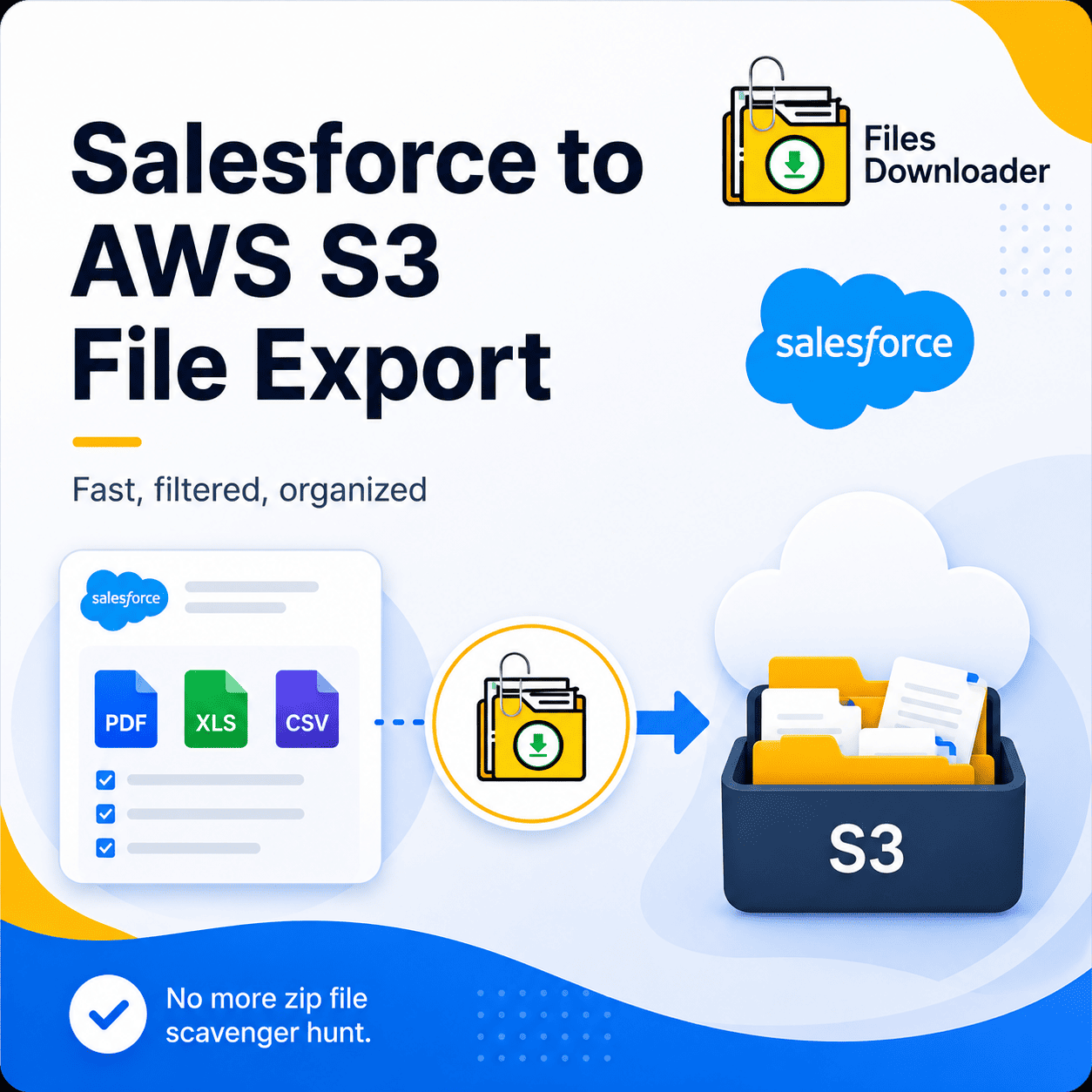
Thank you for reading this post, don't forget to subscribe!This is the “Zip File Scavenger Hunt,” and it is the single biggest time-waster for admins running a Salesforce to AWS S3 file export. Files Downloader was built to solve exactly this problem by providing a faster, more selective way to complete a Salesforce to AWS S3 file export in the exact format you need.
Why Exporting Files from Salesforce to AWS S3 Is More Difficult Than It Should Be
Native Salesforce export tools were never built for complex file management. They were designed for system backups, not for operational teams running a routine Salesforce to AWS S3 file export as part of a modern data pipeline.
There Is No Selective Filtering
Standard data export tools give you rigid, all-or-nothing options. You can’t easily pull “only files attached to closed-won opportunities in Q1” — instead, you get every single ContentVersion record and every attachment, whether your data pipeline needs it or not.
The “File Storage Limit Exceeded” Alert
The more files your organization accumulates, the more likely you are to hit that dreaded “File Storage Limit Exceeded” warning. Archiving older files on a regular basis to an external cloud infrastructure takes that pressure off before storage limits disrupt your production environment.
Manual Sorting Consumes Your Week
Even if an export eventually succeeds, someone still has to rename files, match them back to records, and manually rebuild folder structures before they can ever be uploaded to an Amazon S3 bucket. That turns a simple export into days of manual cleanup that no one budgeted for.
Bulk Export from Any List View with One-Click
Files Downloader supports both standard and custom list views, allowing you to export mass files and attachments directly from the object lists you use every day.
Run Your Own Custom SOQL Query Export
Want something more specific? Personalize and run your own SOQL Query Export to filter and extract only the files relevant to your exact criteria in a single step. Get the latest data instantly with no waiting on IT, then execute your Salesforce to AWS S3 file export on your own schedule.
Keep Formats, Metadata, and Folder Structure
Download files and attachments from Salesforce in the exact same format they were uploaded — PDFs, images (.jpg, .png), docs, and spreadsheets. The original file names and folder structures are kept completely intact, and critical metadata (such as owner, object type, and record association) remains attached to each file throughout the export process.
A Must Have File Exporter for Salesforce Admins and Data Teams
Files Downloader makes it easy to download complex data by selecting exactly the objects and fields you want, whether you are managing a single department or an entire enterprise org. Built for a Salesforce to AWS S3 file export at scale, it also delivers:
Cross-Object Capabilities: Export bulk file data from both standard and custom objects.
Universal File Support: Full compatibility for all file types (PDFs, images, docs, etc.).
Downstream Flexibility: Enables easier import of Salesforce data to SQL Server or Excel after export.
Operational Efficiency: Massive time savings by eliminating manual data sorting.
Workflow Friendly: Works seamlessly with your existing Salesforce data export and file management workflows.
Use Cases: Migrations, Backup, and Auditing
Here are three common reasons why most data teams incorporate Files Downloader into their Salesforce to AWS S3 file export strategy:
Clean Migrations: Standardizing on AWS for cloud storage and data infrastructure? Before retiring old workflows, a clean export of files from Salesforce to AWS S3 gets everything moved over without losing historical file context.
Compliance Audits: Auditors don’t want a zip file scavenger hunt; they want organized, traceable files. Files Downloader exports data with original metadata fully intact so you stay audit-ready.
System Backups: Run a routine Salesforce to AWS S3 file export to offload older files to Amazon S3. This frees up premium CRM storage space without losing a single historical record, allowing you to avoid the “File Storage Limit Exceeded” wall entirely.