


Best Salesforce Data Loader Alternatives
Let’s be real – Salesforce’s Data Loader Alternatives gets the job done, but it’s far from perfect. If you’ve ever spent 45 minutes troubleshooting a Java dependency issue at 9 PM before a migration window, you already know the pain. The tool has its place, but in 2026, Salesforce admins have better options depending on what they’re actually trying to accomplish.
Thank you for reading this post, don't forget to subscribe!Whether you’re exporting bulk files, running sandbox migrations, or trying to stay within your API limits, there’s a smarter path for each use case. This guide breaks down the most practical Data Loader alternatives—and why the architecture behind each one matters more than most people realize.
Salesforce Data Loader Alternatives was designed for a specific purpose: moving structured record data in and out of Salesforce via CSV. It does that reasonably well. But the moment you need to handle binary files, attachments, Salesforce Notes, or anything that lives outside a standard object, it falls flat.
There’s also the ongoing concern about API consumption. Every operation Data Loader performs burns through your org’s daily API limits. For teams running frequent sandbox refreshes or large-scale data migrations, this can genuinely freeze workflows mid-operation not ideal.
Beyond limits, the external-server model introduces a subtler but more serious issue: your data has to travel somewhere to get processed. That “somewhere” may not be covered by your existing compliance framework, creating real headaches for teams subject to GDPR, HIPAA, or SOC 2 requirements.
The Security Gap Most Admins Don’t Think About
Here’s something worth sitting with: every time a file is sent to an external server for processing whether for zipping, transforming, or exporting it enters a new risk environment. You now have to trust that vendor’s encryption standards, their employee access controls, and their data retention policies.
For orgs running on Hyperforce EU or GovCloud, this gets particularly thorny. If your data is processed on a server outside your designated region, you may have already triggered a compliance event before the export is even complete.
Salesforce’s Spring ’26 release introduced native malware scanning for file uploads. Tools built entirely on the Salesforce platform can call these scanning services inline external tools simply can’t, because they operate outside the Trust Boundary.
This is the core argument for 100% native apps: they don’t add new “hops” to your data path. The processing stays on Salesforce’s own infrastructure, which your IT team already audits and trusts. If Salesforce Shield encryption is active on your org, a native app works within those existing keys no sharing required.
The Best Salesforce Data loader Alternatives
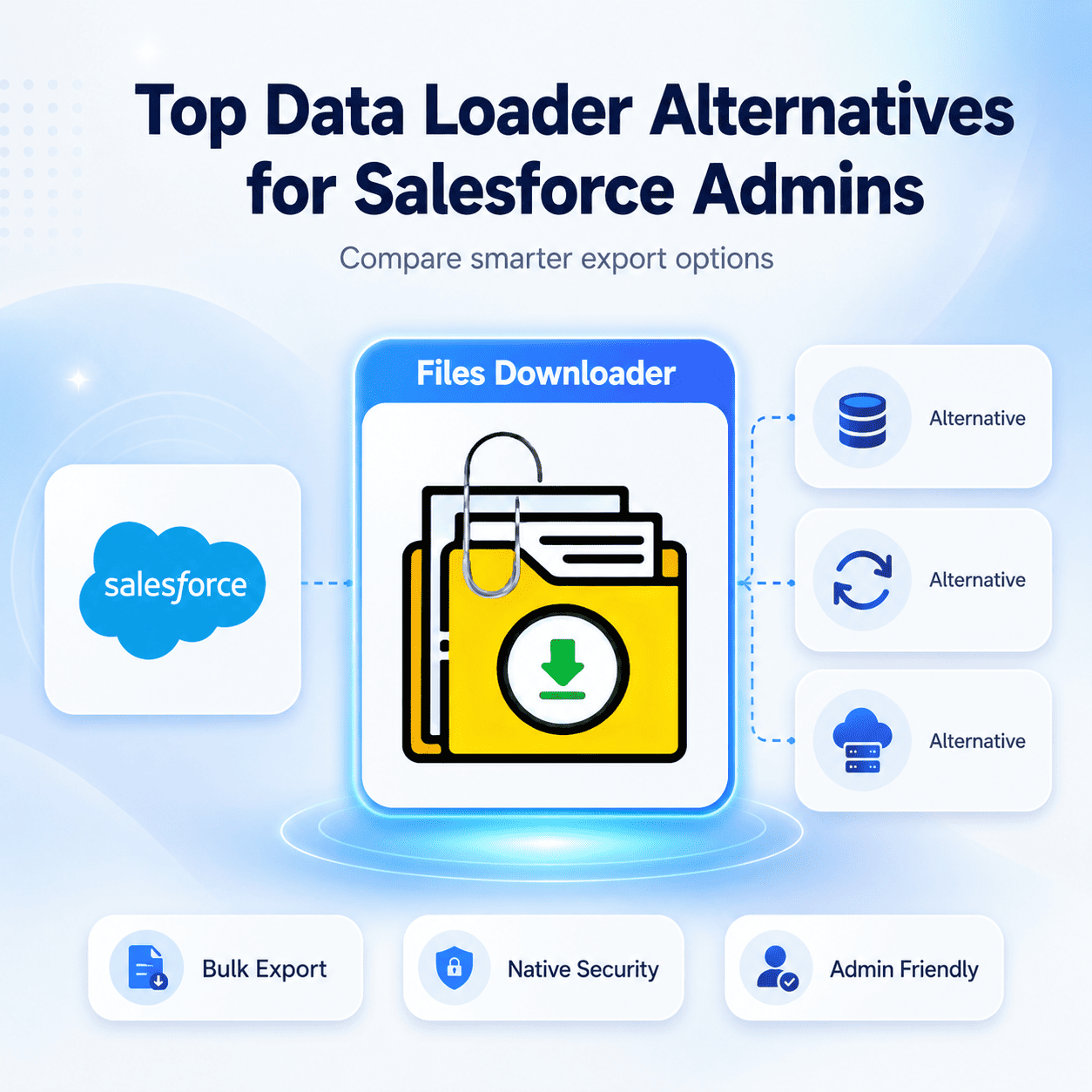
1. Files Downloader (Best for Bulk File & Attachment Exports)
If your primary need is exporting Salesforce Files, Attachments, ContentDocuments, or Notes in bulk, Files Downloader is in its own category. It’s built as a 100% native AppExchange app, meaning it runs entirely within your Salesforce environment using Apex, LWC, and standard Salesforce objects. No external server. No API middleman.
What makes this genuinely different from other dataloader alternatives is what doesn’t happen: your binary data never leaves the Salesforce Trust Boundary. For compliance teams, that’s not a nice-to-have it’s the entire conversation.
It also preserves relationship logic. When you export files linked to Accounts or Cases, those record relationships stay intact. For teams grounding Agentforce AI on real org data, that metadata preservation matters a lot.
2. Salesforce’s Own Data Export Service
Often overlooked, the built-in Data Export tool under Setup handles full org data backups well. It’s native, free, and requires zero configuration. The trade-off is flexibility: you’re limited to weekly or monthly scheduled exports, and you can’t target specific objects or relationships with any precision. It’s a solid backstop, not a surgical instrument.
3. Dataloader.io
Dataloader.io (by MuleSoft/Salesforce) is probably the most direct Data Loader replacement most admins reach for. The browser-based interface is a genuine improvement over the desktop client, and the scheduling features are useful for recurring imports and exports. That said, it is an off-platform tool. Your data passes through external servers, so you’ll want to revisit your compliance posture before using it to store sensitive records in regulated industries.
4. Jitterbit Data Loader
Jitterbit’s free Data Loader is lightweight and handles standard object import/export without the Java dependency headaches of the official client. It’s a decent option for smaller orgs doing straightforward record migrations. Like dataloader.io, it operates outside the Salesforce platform, so the same residency considerations apply.
5. Workbench
A favorite among developers and power admins, Workbench gives you direct access to Salesforce APIs REST, Bulk, Metadata, Streaming all from a browser. It’s especially useful for one-off queries and SOQL-driven exports. It’s not a polished end-user tool, but for technical admins comfortable with query language, it’s hard to beat for exploratory work.
Native vs. External: How They Actually Compare
| Security Feature | 100% Native App | External ETL / Connected App |
| Data Movement | None stays within Salesforce | Travels to external server |
| Encryption | Inherits Salesforce Shield | Requires separate configuration |
| Audit Requirement | Covered by Salesforce SOC2 | New vendor audit required |
| API Usage | Internal zero limit impact | High consumes daily limits |
| Data Residency | Guaranteed by Hyperforce region | Dependent on vendor infrastructure |
Why Architecture Matters More Than Features
It’s tempting to evaluate these tools purely on feature checklists scheduling, file formats, UI polish. But for Salesforce admins working in regulated environments, the more important question is architectural: where does your data actually go during processing?
External tools need OAuth tokens to stay connected. Those tokens represent a persistent tunnel into your org and if they’re compromised, the exposure is direct. Native apps use internal system permissions, which eliminates that entire attack vector.
For AI-driven workflows, this gets even more specific. Agentforce needs clean, grounded data to produce accurate outputs. Using a non-native tool to prepare that data often strips metadata in ways that are hard to detect and harder to fix. A native tool preserves the full relational context of your files the link between a document and the Account it belongs to, for instance which is exactly what large language models need to reason correctly about your org’s data.
Which Tool Should You Actually Use?
The honest answer depends on the job. For structured record data importing leads, updating contacts, mass deleting records Data Loader and its equivalents are still serviceable. For anything involving binary files, attachments, or bulk exports where compliance and data residency matter, a 100% native solution is the only architecture that doesn’t introduce new risk.
Files Downloader sits in a category that the standard dataloader alternatives simply don’t address: native, compliant, bulk file export that preserves record relationships and inherits your existing security configuration. If your org handles sensitive files at any scale, that’s the gap worth filling.
Don’t compromise your Trust Boundary for a connected solution.
Files Downloader is built as a 100% native Salesforce application all file processing happens directly within your Salesforce environment. Start your free trial today and experience the native-first standard for Salesforce file management.
[Book a Free Demo] | [View Pricing] | [Install on AppExchange]