


Salesforce Files Archive to SharePoint: Don’t Lose Your Metadata or Your Mind
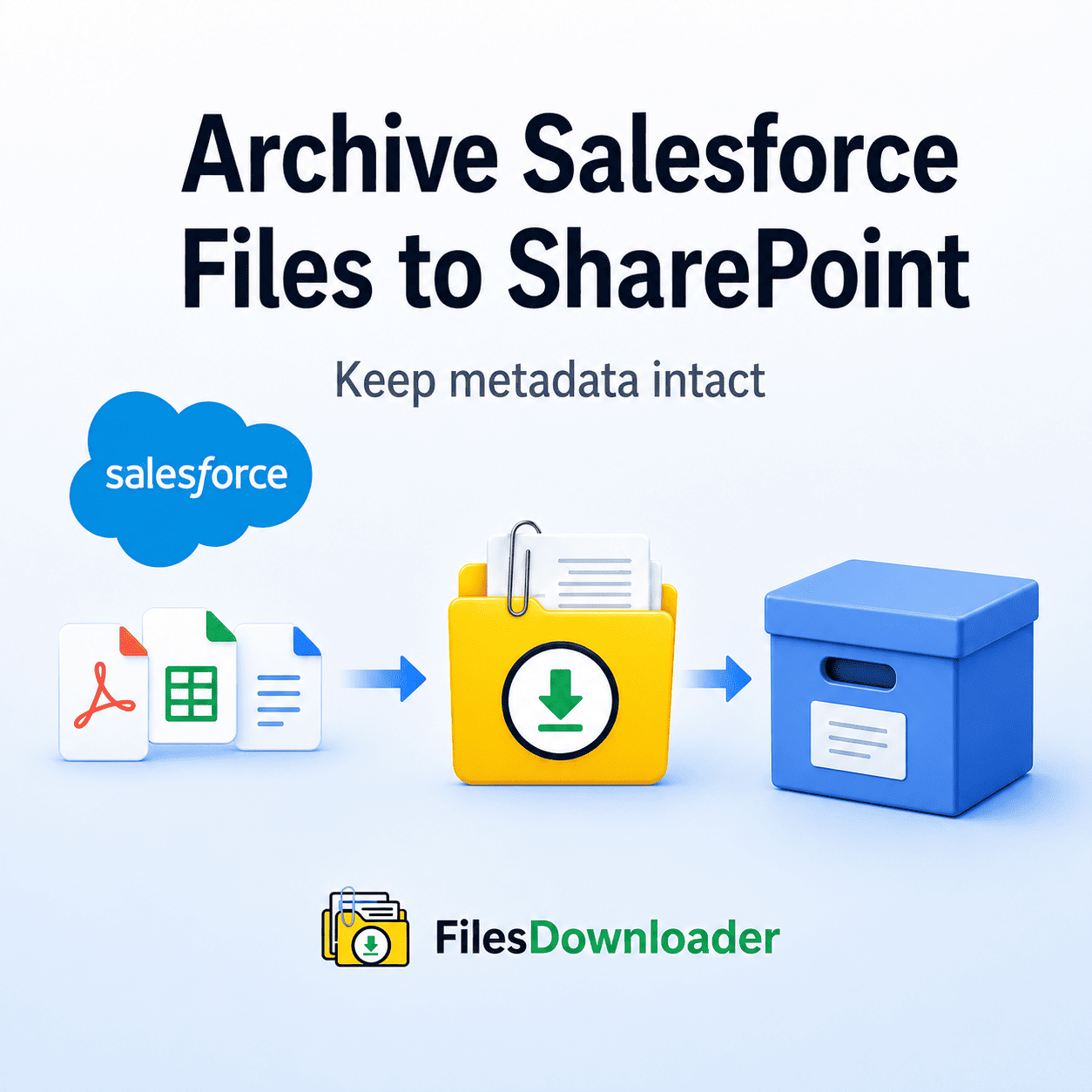
Every Salesforce Administrator will eventually encounter the dreaded “File Storage Limit Exceeded” warning. Salesforce’s default file storage costs can add up quickly, leaving teams with difficult decisions around data retention. When you want to Salesforce files archive to SharePoint, native tools often leave you stranded in a “zip file scavenger hunt” of unorganized folders, stripped metadata, and broken record associations.
Thank you for reading this post, don't forget to subscribe!Files Downloader removes the hassle from manual exports. If you want to free up space, get ready for a system audit, or speed up data migrations, our tool provides an easy, smooth way to Salesforce files archive to SharePoint, preserving your important file structures.
The Cost of Native Storage: Why You Should Archive Salesforce Files to SharePoint
Salesforce is a powerhouse for customer CRM data. But to use it as a primary cloud storage repository is inefficient and expensive. As your org grows, attachments, contracts, images and pdf uploads eat up costly storage allocations.
[Salesforce File Storage Alert] –> Storage Limit High Monthly Overages Fees –> Exceeded
Archive Salesforce Files to SharePoint
Salesforce Files archive to SharePoint gives you enterprise-grade file management at a fraction of the cost. But the standard Data Loader exports immediately hit bottlenecks:
The Zip File Scavenger Hunt: Native backups export files into arbitrarily named, unorganized zip archives that take hours to manually sort through.
Stripped Metadata: Standard exports often remove critical background information like record ownership, object type, and original creation dates.
Limited Targeting: You often only export everything or nothing, with no granular targeting options.
With a completely governed automated file exporter, you can Salesforce files archive to SharePoint easily and quickly without any manual work.
Main Features: Created for Admins and Data Teams
Files Downloader was designed to address enterprise file off loading challenges. It is a core bridge between your Salesforce ecosystem and external storage architectures.
1. One-Click Mass Action in Standard and Custom List Views
No more time wasted clicking into individual records. Files Downloader works directly in both standard and custom list view. Bulk export of mass files and attachments from standard and custom objects in a single click, saving you hours of painstaking work in manually extracting the files.
Pro Tip for Admins: Export and filter only the files that match your specific criteria in one step, no additional spreadsheet work needed.
2. Enhanced SOQL Query Export for Accurate Targeting
Looking for files related to closed-won opportunities in 2023? Run and customize your own SOQL Query Export and get latest data instantly This allows you to download complex data more easily by querying the underlying ContentVersion and ContentDocument objects directly, so you can target specific objects and fields.
3. Keep Original File Names, Metadata, and Folder Structure
When Salesforce files archive to SharePoint, context is everything. Files Downloader downloads files and attachments from Salesforce in the exact native format (PDFs, .jpg, .png, .docx and more). The key is that it keeps:
Original filenames
Folder structure and hierarchy
Metadata such as owner, object type, and record association
This makes it much easier to import SalesForce data into SQL Server or Excel after export for auditing or BI reporting.
How to Archive Salesforce Files to SharePoint: Step-by-Step Guide
Moving files from Salesforce to Microsoft SharePoint shouldn’t be complicated or require command line interfaces or days of developer time. Here is how simple the process can be:
[Select Target View / Run SOQL] → [Filter ContentVersion] → [Bulk Download] → [SharePoint Import]
Step 1: Choosing Your Source through List Views or SOQL Queries
Go to a standard or custom object list view in Salesforce. Or, perform a custom SOQL Query Export with our internal query builder to focus on specific record attachments.
Step 2: Use a Selective Filter
Before downloading delete unnecessary files. Extract only what you need by isolating target file types, date ranges or parent objects. No more manual sorting of data after export.
Step 3: Execute the Bulk Export
Download. Files Downloader bulk extracts target ContentVersion files and places them in structured local directories that maintain all parent-child record relationships.
Step 4: Move to SharePoint
Upload your structured folders directly to your target SharePoint document libraries. File names and folder hierarchies are preserved, so your document taxonomy remains perfectly intact.
You can test this process in your sandbox org by installing the package directly from the AppExchange.
Feature Comparison – Native vs. Files Export Downloader
| Feature/Functionality | Salesforce Native Backup | Files Downloader |
| List See Bulk Downloads | (N/A) | Standard & Custom List Views |
| Metadata & Folder Preservation | Striped / Corrupted | 100% |
| Custom SOQL Query Export | Needs Developer Tools | Instant & Native |
| Selective File Filter | All-or-nothing | Granular Criteria Matching |
| Fidelity | Bulk Zip | Native Original Formats |
For System Backups, Migrations & Audits
Regardless of whether you are doing a clean system migration, preparing for a compliance audit, or performing routine backups, keeping audit trails is essential.
When Salesforce files archive to SharePoint, you need to ensure data integrity. Files Downloader is a file exporter that every Salesforce admin and data team must have if they cannot afford to lose attachments or broken file references when working on transition projects.
[Book a Free Demo] | [View Pricing] | [Install on AppExchange]