


The Salesforce CLI vs Data Loader export attachments comparison is essential for administrators who need to extract files from Attachment and Content Version objects. When organizations need to migrate data, perform compliance audits, archive documents, or create backups, they often evaluate tools like Salesforce CLI and Data Loader.
Thank you for reading this post, don't forget to subscribe!However, exporting actual file binaries stored in the Attachment or ContentVersion objects requires more than just a CSV export. In this guide, we compare the three primary methods for bulk file extraction: Salesforce CLI, Data Loader, and the native Files Downloader app.
When evaluating Salesforce CLI vs Data Loader export attachments, the biggest difference lies in how each tool handles binary file extraction and metadata preservation.
Salesforce CLI for Exporting Attachments
Salesforce Command Line Interface (CLI) is used by developers and DevOps teams to interact with Salesforce orgs using APIs, SOQL queries, and automation scripts. It provides deep access to Salesforce objects and supports querying Attachment and ContentVersion records.
How Salesforce CLI Exports Files?
Using Salesforce CLI, you can:
- Execute a SOQL query against the Attachment or ContentVersion object.
- Retrieve fields such as Id, Title, Body, VersionData, ContentDocumentId, and LinkedEntityId.
- Use API endpoints to download the binary file data.
- Automate downloads using scripting languages like Node.js or Python.
However, exporting files through Salesforce CLI requires a multi-step technical workflow:
- Authenticate the org using OAuth.
- Run SOQL queries to retrieve file records.
- Extract the file download URL or API endpoint.
- Write a script to iterate through records.
- Programmatically download and store each file.
- Manually create folder structures if required.
Advantages of Salesforce CLI
- Provides full API-level access to Attachment and ContentVersion objects.
- Suitable for automated backup processes.
- Can be integrated into CI/CD pipelines.
- Allows advanced SOQL filtering for selective exports.
- Works well for large-scale scripted data operations.
Limitations of Salesforce CLI
- Requires strong technical knowledge of Salesforce APIs.
- No graphical user interface for administrators.
- Binary file extraction must be handled through custom scripting.
- Does not automatically preserve folder hierarchy based on object relationships.
- No built-in export dashboard or tracking mechanism.
- Error handling must be manually coded.
For organizations without development resources, this approach can become time-consuming and complex.
Salesforce Data Loader for Exporting Attachments
Salesforce Data Loader is a client application designed for bulk import, export, update, delete, and upsert operations using Salesforce APIs. It is commonly used by Salesforce administrators for record-level data management.
How Data Loader Handles Attachments?
Data Loader allows users to:
- Export records from the Attachment object.
- Export records from the ContentVersion object.
- Retrieve metadata fields such as Id, Name, Title, ContentDocumentId, FileType, CreatedDate, OwnerId.
However, Salesforce Data Loader does not automatically download the file binary stored in the Body or VersionData fields in a usable file format. Instead, it exports references or encoded data in a CSV file.
To retrieve actual files, users must:
- Parse the exported CSV.
- Build an API-based script.
- Authenticate separately.
- Download each file manually through REST or SOAP API calls.
Advantages of Data Loader
- Provides a graphical user interface for non-technical users.
- Allows bulk export of Attachment and ContentVersion records.
- Supports SOQL-based filtering.
- Suitable for metadata reporting and record analysis.
- Does not require programming for simple exports.
Limitations of Data Loader
- Cannot generate structured file folders automatically.
- Does not package files into downloadable ZIP archives.
- Does not provide record-to-file mapping in organized directory format.
- Requires additional development work to retrieve binary files.
- Not optimized for file-heavy enterprise environments.
- No built-in export history dashboard.
For enterprises handling thousands of ContentDocument records, this becomes inefficient and operationally risky.
The Core Challenge in Salesforce CLI vs Data Loader export attachments
When organizations need to export files for:
- Data migration between orgs
- Compliance audits and regulatory reporting
- Legal discovery processes
- Sandbox refresh preparation
- Long-term data archival
They require:
- Actual file binaries
- Proper object-level mapping
- Structured folder hierarchy
- Metadata preservation
- Audit tracking
Neither Salesforce CLI nor Data Loader provides a complete, admin-friendly, structured export solution out of the box.
Files Downloader: A Native Salesforce File Export Solution
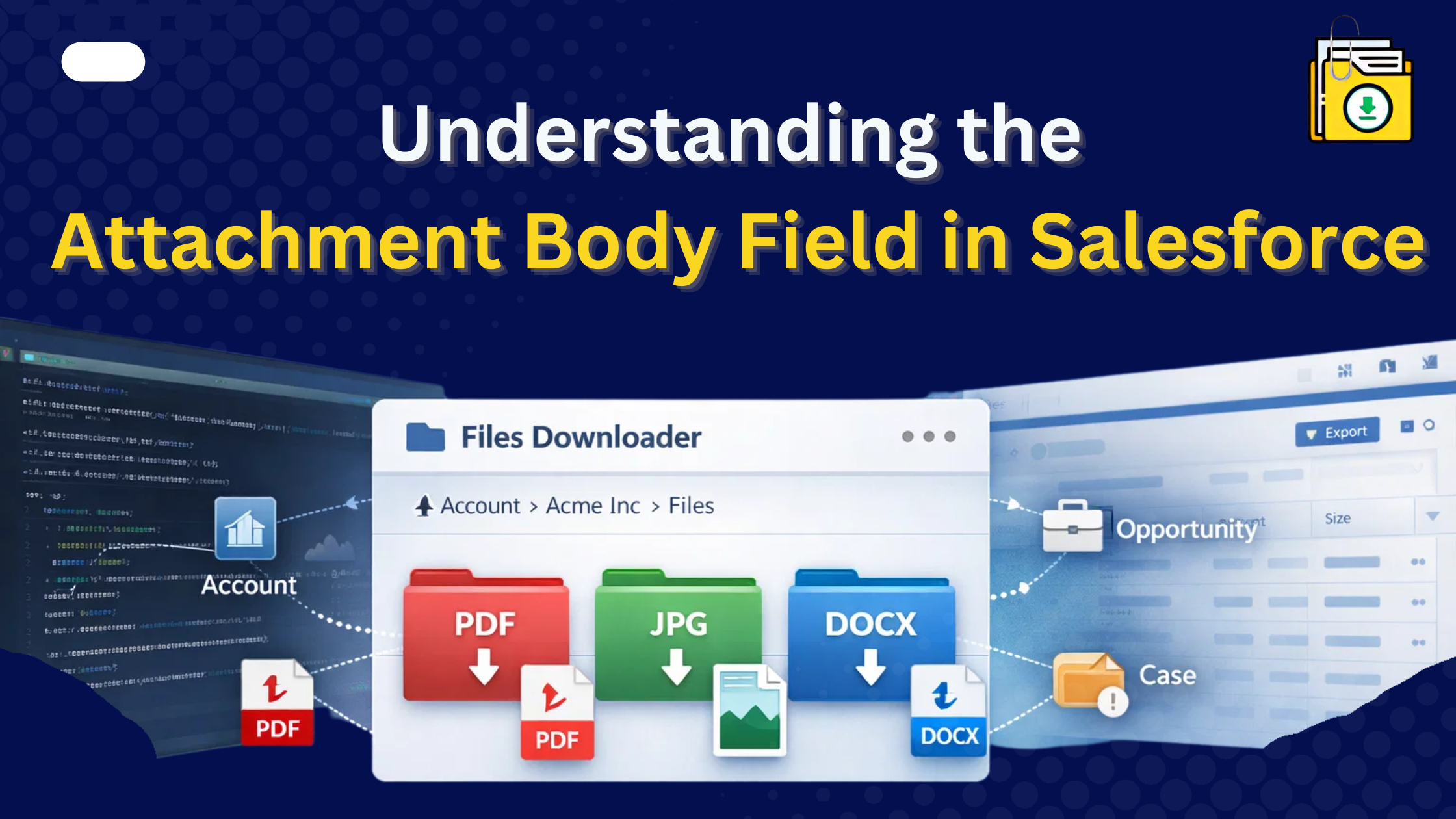
Files Downloader is a native Salesforce files exporter application designed specifically for bulk exporting files, attachments, and documents directly from Salesforce without scripting.
Unlike CLI-based approaches, it works entirely within the Salesforce environment and respects Salesforce security architecture.
Available on Salesforce AppExchange
Key Capabilities of Files Downloader
1. Download Directly from List Views
Files Downloader allows administrators to initiate mass file exports directly from Salesforce list views. Instead of writing SOQL queries manually, users can filter records using standard Salesforce list view filters and export associated files in bulk. This simplifies file retrieval for objects such as Account, Opportunity, Case, or custom objects.
2. 100% Native to Salesforce
The application is built entirely on the Salesforce platform. This ensures:
- Full compliance with Salesforce security standards.
- No external API token handling.
- No third-party file processing outside the org.
- Role-based access control through standard profiles and permission sets.
3. Bulk Export of Attachments and Files
Files Downloader supports Attachment object, ContentVersion object, ContentDocument relationships, & Files across standard and custom objects.
It retrieves both metadata and binary content, allowing organizations to export thousands of files in a structured format without additional scripting.
4. CSV Mapping with Record Association
Each export includes a detailed CSV file containing:
- Parent record Id
- Object API name
- File name and extension
- ContentDocumentId
- CreatedDate
- OwnerId
This ensures complete traceability between exported files and their originating Salesforce records.
5. Preservation of File Names and Folder Hierarchy
Files Downloader automatically organizes files into structured folders based on:
- Object type
- Record name or Id
- Custom-defined grouping logic
This eliminates the need to manually restructure exported files after download.
6. Dashboard and Export Tracking
The application provides reporting and dashboard capabilities to monitor:
- Export history
- Number of files exported
- User activity
- Export status and completion logs
This is especially valuable for compliance documentation and audit trails.
7. Enterprise-Grade Security and Compliance
Since Files Downloader operates natively within Salesforce:
- Data does not pass through external systems.
- API usage remains controlled.
- Access permissions follow Salesforce sharing rules.
- Sensitive document exports remain traceable.
Comparative Overview
| Capability | Salesforce CLI | Data Loader | Files Downloader |
|---|---|---|---|
| Extract Binary File Data | Yes (via scripting) | No direct support | Yes |
| Graphical User Interface | No | Yes | Yes |
| Automation | High (technical) | Limited | Built-in |
| Folder Structure Preservation | Manual | Not supported | Automatic |
| Export History Tracking | No | No | Yes |
| Admin-Friendly | No | Partial | Yes |
| Compliance-Ready Export | Custom-built | No | Yes |
Conclusion
Salesforce CLI is a powerful tool for developers who require automation and scripting flexibility. Data Loader is useful for exporting metadata and managing object records. However, neither tool provides a complete, structured, and scalable solution for bulk exporting attachments and Salesforce Files.
For organizations that need a secure, native, and admin-friendly approach to exporting large volumes of Attachment and ContentVersion records, Files Downloader delivers a purpose-built solution that removes technical complexity while preserving structure, compliance, and traceability. In summary, the Salesforce CLI vs Data Loader export attachments decision depends on technical capability, but both tools fall short of a fully native, structured export solution.