
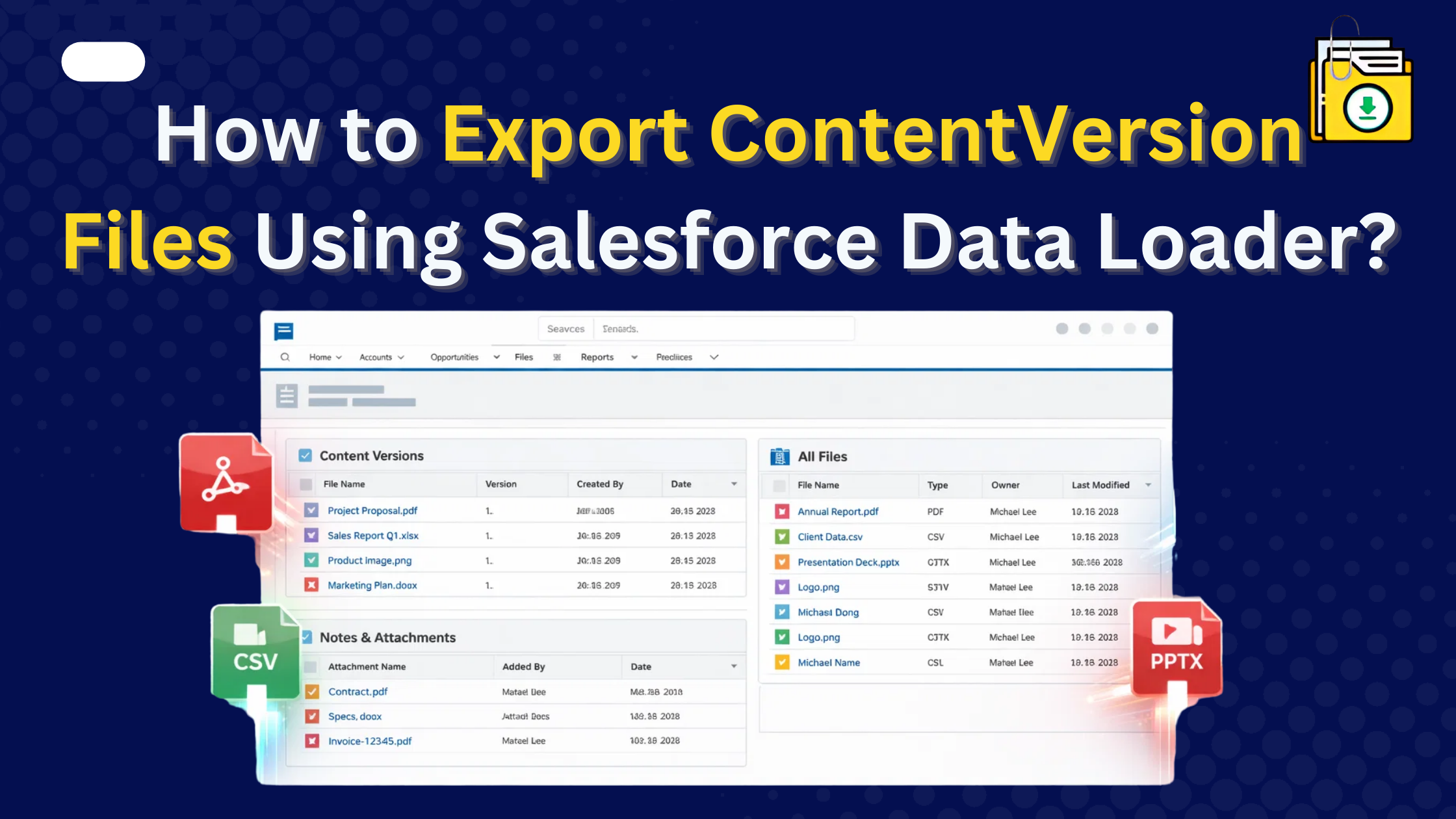


Organizations managing large volumes of Salesforce files often explore methods for download ContentVersion files salesforce using native utilities such as Salesforce Data Loader. While the platform provides technical mechanisms for extracting file metadata and binary references, most operational teams require scalable approaches that enable direct file export without complex post-processing.
Thank you for reading this post, don't forget to subscribe!Modern Native Salesforce files export tools like Files Downloader address this gap by allowing administrators to extract attachments, documents, and ContentVersion files directly from the CRM environment. Understanding how Data Loader exports work and where they fall short helps organizations choose the most efficient approach for bulk file handling.
This guide explains how ContentVersion exports function through Data Loader, outlines the limitations involved, and compares them with streamlined alternatives designed for enterprise-scale workflows.
Understanding ContentVersion in Salesforce
Salesforce Files are stored using a structured architecture centered around the ContentVersion object. Unlike legacy attachments, files are not stored as simple downloadable entities.
Core components include:
- ContentDocument– Represents the parent file record
- ContentVersion– Stores individual versions of files
- VersionData field– Contains binary file data
- ContentDocumentLink– Connects files to Salesforce records
When exporting using Data Loader, administrators interact primarily with ContentVersion. However, retrieving usable files requires processing binary data fields rather than downloading files directly.
This structure enhances version control and sharing flexibility but introduces complexity for bulk exports.
How Salesforce Data Loader Handles ContentVersion Exports?
Salesforce Data Loader enables administrators to query ContentVersion records and export associated datasets. Common uses include:
- Exporting file metadata
- Extracting version identifiers
- Accessing binary data references
- Generating CSV mappings
However, Data Loader operates as a data extraction tool, not a file download system. The output typically contains encoded datasets that require additional transformation before files can be reconstructed or accessed.
This distinction is critical when planning operational export workflows.
Limitations of Using Data Loader for File Exports
Although Data Loader is powerful for object-level data extraction, several limitations arise when working with file exports.
1. Binary Handling Complexity
Files stored in VersionData fields are encoded and require technical decoding processes outside Salesforce.
2. No Direct File Download
Exports provide references and structured datasets rather than immediately usable files.
3. Loss of Organizational Context
Folder hierarchy and naming consistency are not preserved.
4. Manual Relationship Mapping
Admins must manage object relationships and mappings independently.
5. Limited Monitoring
There are no dashboards or tracking capabilities for export operations.
6. Scalability Challenges
Large-volume exports can become time-intensive and operationally inefficient.
Because of these limitations, many organizations evaluate specialized tools built specifically for file extraction.
Exporting ContentVersion Files Using Files Downloader
For teams focused on operational efficiency, Files Downloader provides a Salesforce-native method for exporting files without handling binary processing manually.
Instead of extracting raw data fields, administrators can:
- Download files directly from list views
- Preserve original filenames
- Maintain folder structures
- Export CSV mappings alongside files
- Track export activities via dashboards
- Support standard and custom objects
This approach aligns with governance and security requirements while reducing manual workload, making it suitable for:
- Compliance audits
- Backup operations
- Migration preparation
- Reporting workflows
By simplifying file export mechanics, it transforms a technical process into an administrative workflow.
Data Loader vs Files Downloader- Comparison
| Capability | Data Loader | Files Downloader |
|---|---|---|
| Metadata Export | Yes | Yes |
| Direct File Download | No | Yes |
| Binary Processing Required | Yes | No |
| Filename Preservation | No | Yes |
| Folder Structure Retention | No | Yes |
| CSV Mapping | Manual | Built-in |
| Export Monitoring | No | Yes |
| Scalability | Limited | High |
| Native Salesforce Execution | Yes | Yes |
This comparison highlights the functional differences between data extraction utilities and file export-focused platforms.
Choosing the Right Export Approach
Use Data Loader When:
- Exporting structured datasets
- Supporting migration or ETL workflows
- Extracting object-level metadata
- Performing technical administration tasks
Use Files Downloader When:
- Exporting actual files or attachments
- Managing large-scale downloads
- Preserving file structure and naming
- Reducing manual processing
- Supporting operational workflows
Matching tool capabilities with workflow requirements ensures efficient Salesforce file management.
Conclusion
Exporting ContentVersion files using Salesforce Data Loader provides access to metadata and encoded binary references, but does not deliver an optimized file extraction experience. Manual processing requirements, mapping complexity, and scalability limitations can introduce administrative friction.
Salesforce-native export tools like Files Downloader provide a streamlined alternative by enabling direct file downloads while preserving organizational structure and offering export visibility. For organizations managing growing data volumes, this approach supports operational efficiency and long-term scalability.
Selecting the right export strategy ultimately depends on workflow goals, file volume, and governance requirements but understanding both methods enables informed decision-making for Salesforce administrators.
Export Salesforce files faster without manual complexity.
Try Files Downloader to bulk download ContentVersion files with preserved names, metadata, and structure directly inside Salesforce.
👉 Install it from Salesforce AppExchange today and simplify your export workflow.