


Salesforce AI Agent File Exports: No More Zip File Scavenger Hunts
Your Salesforce AI Agent is working around the clock, creating proposals, uploading call transcripts, and updating records. It’s quietly adding files to your org that no one has opened yet. Then someone requests “everything the Salesforce AI Agent touched last quarter” and the scavenger hunt begins: opening record after record, downloading one attachment at a time, renaming duplicates so nothing overwrites. No selective filtering, no bulk action, just wasted hours on a task that should take minutes. Files Downloader puts an end to the search for good.
Thank you for reading this post, don't forget to subscribe!Why Salesforce AI Agent Workflows Cause a File Export Issue
As Salesforce AI Agents are adopted by sales, service and operations teams, file volume grows in tandem. Your Salesforce AI Agent creates transcripts, documents and updates records which admins eventually have to manage, migrate or audit. Native Salesforce list views show these files, they were never built to be exported in bulk.
The ContentVersion Bottleneck
Most of the files that come out of a Salesforce AI Agent are ContentVersion records, not plain attachments. This structure is too much for standard tools, leaving admins with one by one downloads or brittle data loader scripts. And when storage fills up, you’re hit with a File Storage Limit Exceeded warning usually when you need to move fast, not troubleshoot.
How Files Downloader Solves It
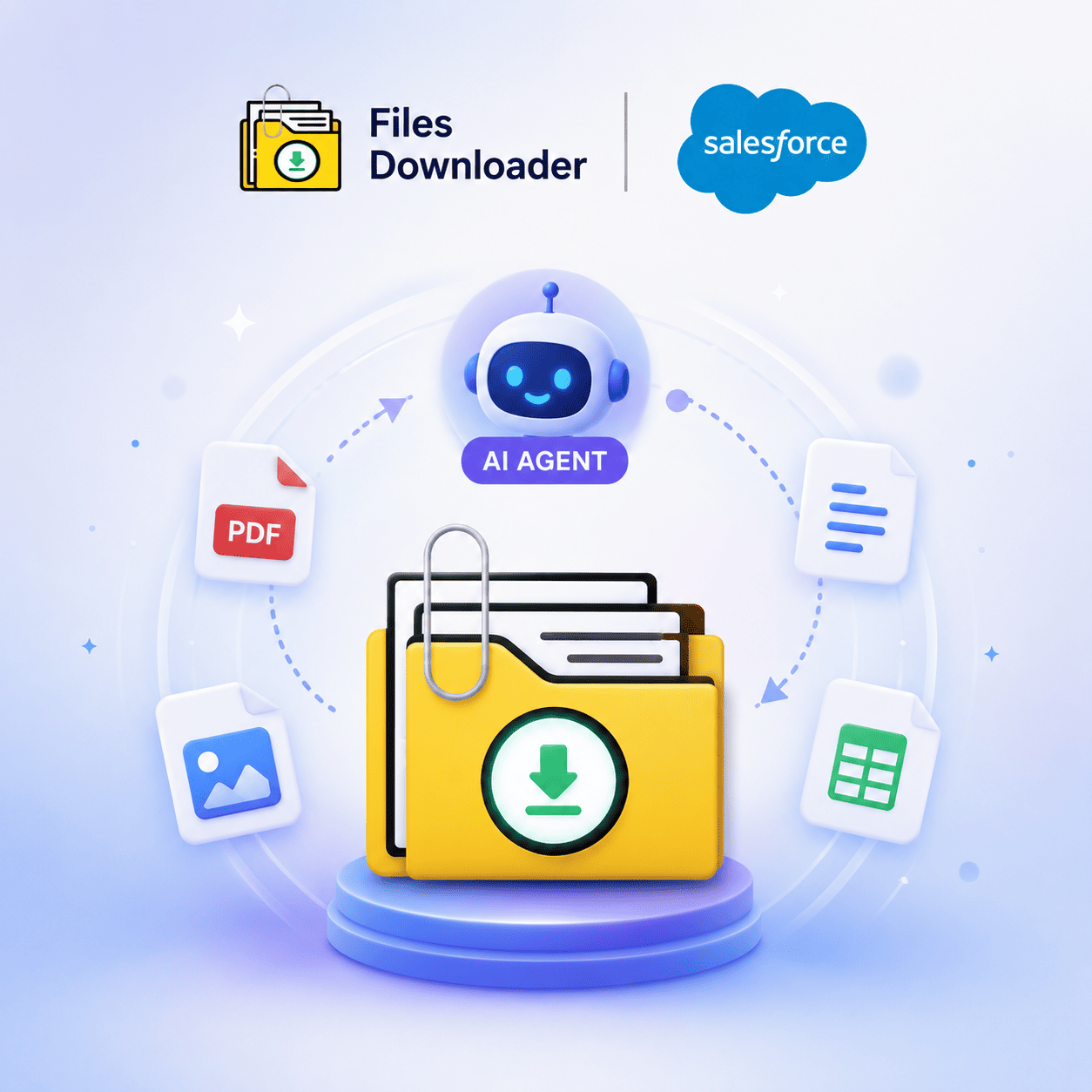
Export in bulk with a click, from any list view: Regardless of whether you use a standard list view or a custom view based on Salesforce AI Agent activity, Files Downloader exports files and attachments in bulk in a single pass. No manual clicking, no record by record downloading, no end of day backlog.
Exact form download, no mapping: Files get downloaded in their original format (pdfs remain pdfs, images remain images) and the original file names and folder structure are preserved in full. That’s important when your Salesforce AI Agent output needs to go straight into SQL Server or Excel without someone needing to reformat it.
Each object, each file type: Files Downloader pulls in bulk from standard and custom objects alike, supporting PDFs, images (.jpg, .png), docs and more. It’s become a must-have file exporter as admins and data teams grapple with the ever-increasing file growth Salesforce AI Agent creates.
File metadata associated with the file: Each export retains the owner, type of object and association to the record. That context is important for audits and clean migrations where you want to be able to trace a file directly back to the Salesforce AI Agent interaction that created it.
SOQL Query Export for Precise Targeting
Don’t export all or nothing. Export only the files that meet your criteria with your own SOQL Query Export – by date, object, owner, or any field related to Salesforce AI Agent activity. One step. Accurate answers. No sorting after manual. It’s the fastest way to export Salesforce files without wrestling with complicated third party tools.
Where This Fits In Your Salesforce Data Strategy
At some point, teams running a Salesforce AI Agent will have to migrate, audit, or back up everything it has touched. Files Downloader makes that easy by targeting specific objects and fields, rather than exporting your whole org wholesale.
For organizations scaling Salesforce AI Agent deployments, file management is not optional it’s part of basic data governance. Have a local backup not subject to Salesforce storage limits or get historical exports before you migrate. Do a quarterly audit. Head over to our compare plans and find the right one for your volume of data.
Built for Admins and Data Teams, Not Just Developers
You shouldn’t need a developer to extract your own files from your org. Files Downloader is for the people who actually have this problem. Salesforce admins and data teams need a reliable export, not a custom script. It’s the missing piece that perfectly complements your existing process for exporting Salesforce data and managing files not a replacement for what already works.
[Book a Free Demo] | [View Pricing] | [Install on AppExchange]