


File Storage Salesforce: The Complete Guide to Managing, Auditing, and Exporting Your Files
Work inside Salesforce long enough and file storage salesforce limits become your issue. Cases are piled with attachments. ContentVersion records are accumulated across Accounts and Opportunities. No one audits what’s being stored until the warning happens — at which point, you’re already scrambling. This guide will walk you through exactly what Salesforce file storage is, why it fills up faster than you might think, and how to take back control without losing a single file.
Thank you for reading this post, don't forget to subscribe!What is File Storage in Salesforce and Why Should You Care?
Salesforce divides storage into two buckets: data storage and file storage. Data storage covers records – Contacts, Accounts, custom objects. File storage includes all other things – attachments, documents, ContentVersion records, and any file uploaded directly to a record.
Each Salesforce org receives a baseline file storage allocation. For most editions that starts at 10 GB for the org plus 2 GB per user license. It sounds like a lot until you consider years of uploaded PDFs, scanned contracts, product images, and email attachments living on records across every object in your org.
The consequences are immediate once you hit your file storage salesforce ceiling. You can’t upload new files. Integrations that rely on file creation start failing. Documents that are auto-attached begin failing silently in their workflows. The org doesn’t crash — it just quietly stops working the way it’s supposed to.
Why Do File Storage Salesforce Limits Fill Up Faster Than You Think
It’s not one big file that’s the problem. It’s thousands of little ones that no one ever deleted.
Duplicate Uploads are the most frequent offenders. Users are attaching the same proposal, contract or image to multiple records. Salesforce stores each version individually. Over time, identical files take up a lot of storage in dozens or hundreds of records.
Legacy Attachment Objects from older Salesforce implementations store files on records directly using the classic Attachment object instead of ContentVersion. These don’t get deduplicated and can silently consume storage for years without showing up in standard file reports.
Auto-Generated Files from integrations, document generation tools, and email-to-case workflows automatically attach files to records. If there is no retention policy, then every generated PDF, every inbound email attachment and every auto-created document stays in storage forever.
ContentVersion Versioning — When a user uploads a new version of a file, Salesforce keeps the old version along with the new one. Three rounds of edits on one contract becomes four ContentVersion records – all consuming storage, only one being actively used.
No Default Cleanup Policy – Salesforce does not automatically clean up files when records are deleted, deactivated, or archived. You have three year old files from closed Cases still sitting in your org, consuming storage that your active team needs.
How to Audit Your Salesforce File Storage Usage?
But to solve a storage problem you have to see it clearly. Salesforce provides you with a few native ways to see where you stand.
Go to Setup, and search for Storage Usage. Salesforce will give you a breakdown of your total file storage consumed vs your allocation. It tells you how much is used – but not which records, objects or users are responsible for most of it. That’s where the gap is.
If you want to dig deeper, you’ll need to query the ContentVersion and Attachment objects directly using SOQL. A simple query against ContentVersion with file size, owner and linked record fields will show you where most of your storage resides. You can sort by file size or ContentDocumentId to get actionable targets for cleanup or export.
And this is where most admin teams hit a wall. The data exists, but pulling it out cleanly, at scale, and without a developer writing custom scripts demands a tool built for the purpose.
Salesforce File Storage Best Practices for Admins
To manage file storage salesforce limits long term, there are three habits to adopt: audit often, archive proactively, and export before you delete.
Audit Quarterly with SOQL queries on ContentVersion and legacy Attachment records. Track size by object, owner, upload date. See the trends before they become crises.
Define a Retention Policy for auto-created files, email attachments and integration outputs. Determine how long files linked to closed records should reside in Salesforce versus being archived externally.
Export Before You Delete each time. Bulk export files with full metadata (owner, record association, object type, original file name) before deleting them to free up space. This protects you during audits, migrations and compliance reviews.
Use ContentVersion instead of Legacy Attachments wherever possible. ContentVersion gives deduplication, version controls, and better reporting. If your org is still using Attachment-heavy workflows migrating them to ContentVersion will save you storage waste over time.
Don’t Store Big Files When external storage integrations are available, directly in Salesforce. Salesforce file storage is costly per GB when compared to external document management platforms. For large assets — videos, high-resolution images, large data sets — you can consider linking from Salesforce instead of uploading directly.
Salesforce Fastest File Export And Free File Storage
The problem is only half solved when you know which files to delete. The other half is getting them out clean before you delete them. This is not something that the native export tools in Salesforce are built to handle. They give you an unstructured zip archive with no file names, no folder structure, no record context — the opposite of what you need before a cleanup or migration.
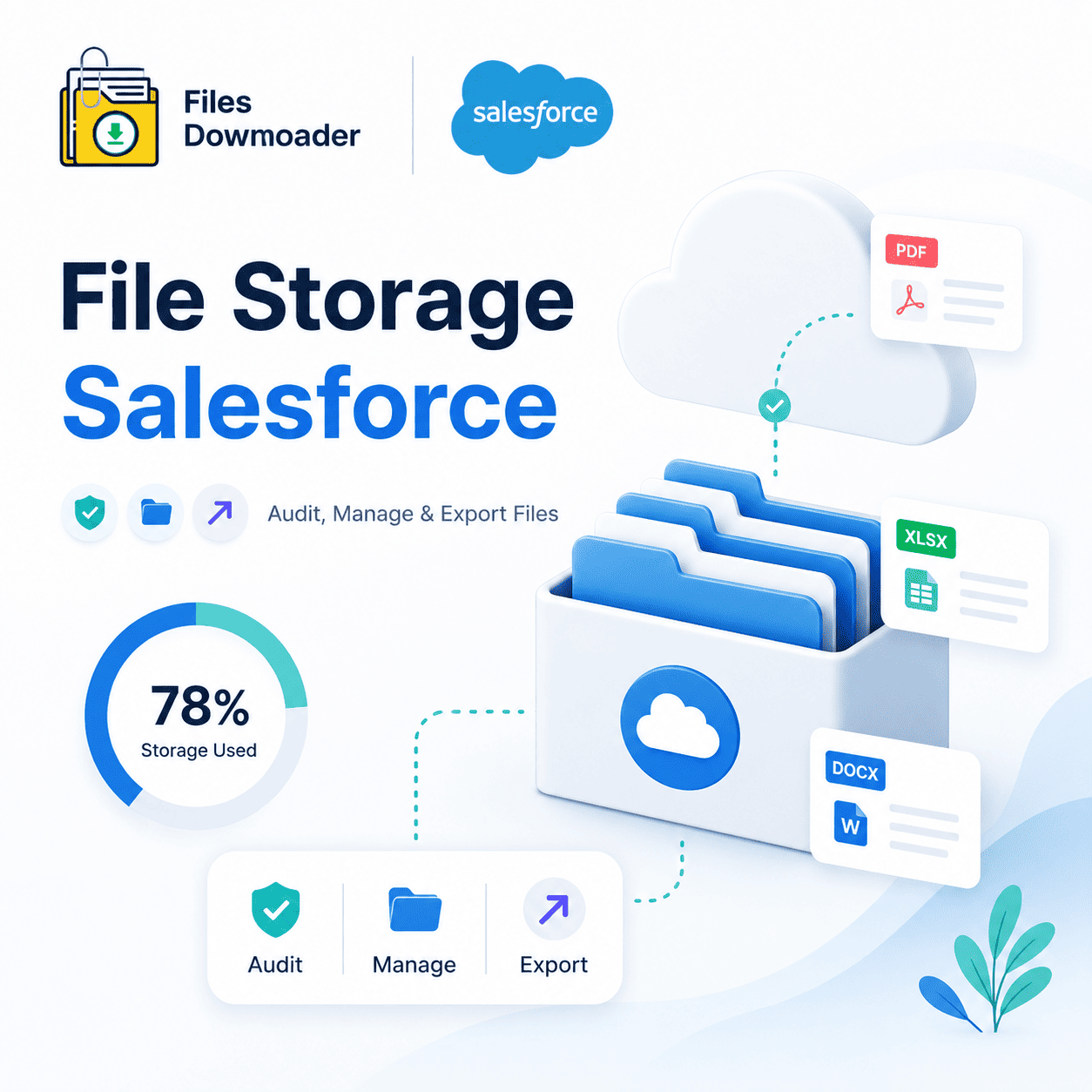
Files Downloader solves this head-on. Allows you to bulk export files & attachments from any standard or custom list view, preserving original file names, folder structure, and full metadata. You can target specific objects, filter by owner or record, or run a custom SOQL query to get exactly the ContentVersion records that are consuming the most storage.
Each file exports in its original format — PDFs, images, Word documents, spreadsheets — ready to be archived externally, imported into SQL Server or Excel, or handed off to a compliance team. Once your files are safely exported, you can free up file storage salesforce space with confidence, knowing that nothing was lost.
[Book a Free Demo] | [View Pricing] | [Install on AppExchange]