


The Fastest Way to Export All Cloud Documents from Salesforce
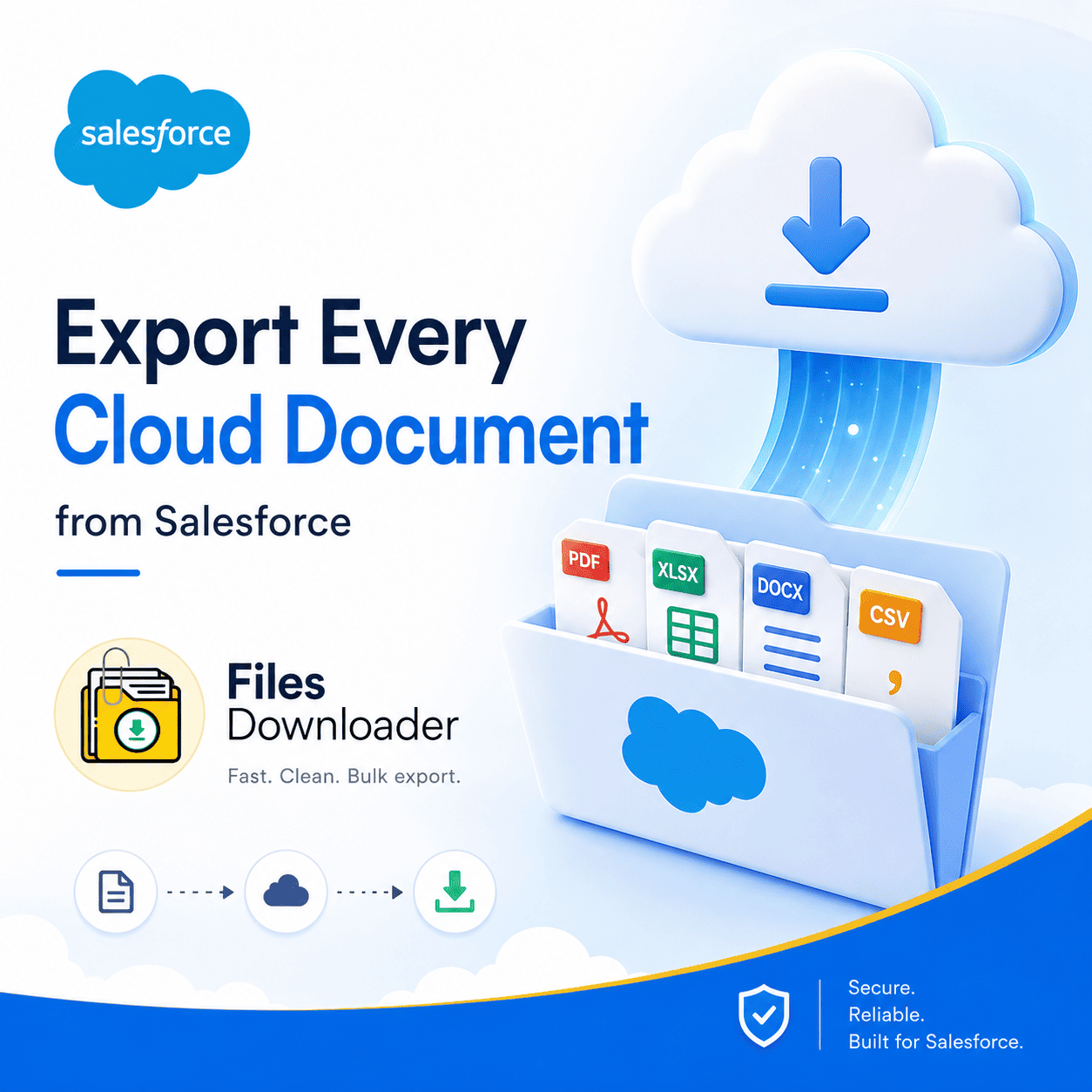
Don’t go on a scavenger hunt for zip files. If you’ve ever had to pull a cloud document out of Salesforce or a few hundred of them you know the pain. Files without titles. Corrupted directory structures. No context as to which record anything belongs to. Files Downloader solves that completely. It bulk exports every cloud document, attachment, and ContentVersion record in seconds, with no code, no complex tools, and no wasted afternoons.
Thank you for reading this post, don't forget to subscribe!Why Exporting a Cloud Document from Salesforce is Harder Than It Needs To Be
Salesforce is a great platform. But when it comes to getting your files out cleanly, it always lets admins down. The native export tool dumps everything into an unstructured zip archive without file names, folder logic, or record associations. You’re left to manually wade through hundreds of files to find the one cloud document you actually need.
And it gets worse. There is no native ability to filter by file type, object, date or record owner for exports. If you’ve ever experienced the File Storage Limit Exceeded error and tried to figure out which records are causing it, you know just how blind that process feels. And if you need to target specific ContentVersion records, you’re either scripting yourself, or waiting on a developer — neither of which is a good use of anyone’s time.
These are not edge cases. They’re daily pain points for Salesforce admins, data managers, and migration teams across all industries.
The Zip File Scavenger Hunt
The Zip File Scavenger Hunt is what happens when Salesforce exports dump everything into one unnamed archive. You download hundreds of gigabytes of files and spend hours trying to figure out where to put what. No metadata. No structure. No shortcut.
No Selective Filtering
No Selective Filtering means you cannot filter an export by file type, object, owner, or date range natively. To find one cloud document you download everything. That’s working harder, not smarter.
File Storage Limit Exceeded
File Storage Limit Exceeded warnings give you a number, not a roadmap. You know your storage is full, but without a good tool to perform a bulk export, you don’t know exactly what files are taking up your storage, and you can’t target or clean up the problem files.
Manual SOQL Query Export
Manual SOQL Query Export, meanwhile, locks out non-technical admins from targeting specific data altogether. Getting the right ContentVersion records shouldn’t take a developer ticket every single time.
Files Downloader: One-Click Export of Cloud Documents for Every Salesforce Team
Files Downloader is designed for the problem Salesforce does not solve natively – bulk cloud document retrieval that is fast, clean and completely under your control. It works directly inside your Salesforce org, requires zero setup beyond installation, and works on both standard and custom list views right out of the box.
The basic promise is simple: point at a list view, apply your filters and download. Every cloud document arrives in your folder intact with its original file name, folder structure, and metadata. No re-name. No sort. No clean up.
Export Any Cloud Document Type Without Conversion or Reformatting
Files Downloader supports all cloud document formats stored inside Salesforce’s ContentVersion object. PDFs, JPGs, PNGs, Word documents, spreadsheets, CSVs — whatever file type your org uses, it exports in the exact original format. You never have to convert a file, upload a corrected version or chase down a colleague to resend something in the right format. What’s in Salesforce is what you will get.
Bulk Export from Any List View means you pick records from a standard or custom list view and export all associated cloud documents in one shot. No need to open records individually, download files one at a time, or manually track what you’ve already grabbed.
Retain Original File Names and Folder Structures so each cloud document is delivered precisely as stored. Your export folder can be used immediately – for a migration, a handoff, an audit or archive – with no need to manually reorganize afterwards.
Retain Full Metadata on Every Export (owner, object type, and record association) This makes it easy to import Salesforce data into SQL Server or Excel after export, without spending hours recreating the context that should have come along with the file in the first place.
Precision Filtering & SOQL Query Export – Get only what you need. Filter by object, field, owner, or any other criteria relevant to your use case. Or, write and execute your own custom SOQL query right inside the app to get the freshest ContentVersion data, instantly — no Apex code, no developer dependency, no waiting.
Supports All Standard and Custom Objects (Accounts, Contacts, Cases, Opportunities, and any custom object your org is running). Files Downloader can export anything if Salesforce has it.
Three Steps from List View to Downloaded Folder
The whole process from selection to export is in three steps.
Begin by opening any standard or custom list view and apply your filters — or run a custom SOQL query to target the exact records and cloud documents you need.
Second, select the records you need and click on Files Downloader export button. No mapping, no scripting, no ticket to submit.
Third, get all cloud documents as native documents, with all metadata preserved, ready for use.
That’s it. The quickest way to export Salesforce files doesn’t involve complex tools, developer access, or a second cup of coffee while you wait.
The Teams Who Use Files Downloader Every Day
Files Downloader is a must-have file exporter for Salesforce admins and data teams who manage high file volumes, tight migration deadlines, and zero tolerance for data loss.
It’s perfect for:
Clean migrations of organizations when you need to retain every document in the cloud
Compliance audits that need complete metadata trails
Regular system backups
Prepping for SQL Server or Excel workflows prior to import
It also is the right tool for storage audits when you’ve hit the File Storage Limit Exceeded threshold and need to identify, export, and archive files by object or owner before you delete anything.
[Book a Free Demo] | [View Pricing] | [Install on AppExchange]