


Bulk Export Salesforce Attachments: The Fastest Way to Download Everything in One Go
If you’ve ever had to mass export Salesforce attachments bulk, then you know the process by default: open a record, click on Notes & Attachments, download a single file, repeat. This is known to admins as the “Zip File Scavenger Hunt” — hours spent clicking through records because Salesforce doesn’t have a native bulk option.
Thank you for reading this post, don't forget to subscribe!In this guide, we’ll explore why native tools can’t do a real bulk attachment export and how a purpose-built downloader can turn hundreds of manual clicks into a single action.
Why Salesforce Doesn’t Provide True Bulk Attachment Export
Salesforce’s native tools were not designed to export Salesforce attachments bulk all at once. Reports show metadata about attachments — file name, size, owner — but not the actual contents of the documents.
This leaves anyone looking to pull attachments at scale with a manual, record-by-record process. A few files is manageable, but for hundreds or thousands, it becomes a week-long effort.
Why “File Storage Limit Exceeded” Errors Make a Point
Storage limits are what compel teams to export Salesforce attachments bulk rather than ignoring the problem indefinitely. A File Storage Limit Exceeded warning appears with no clear breakdown of what’s really taking up space, leaving admins to guess what’s safe to remove.
Because there is no native bulk export option, teams either blindly delete attachments or ignore the warning until it impedes new uploads. A bulk export of everything solves both problems at once — providing a full backup and real insight into storage usage.
Bulk Export from Any List View with One Click
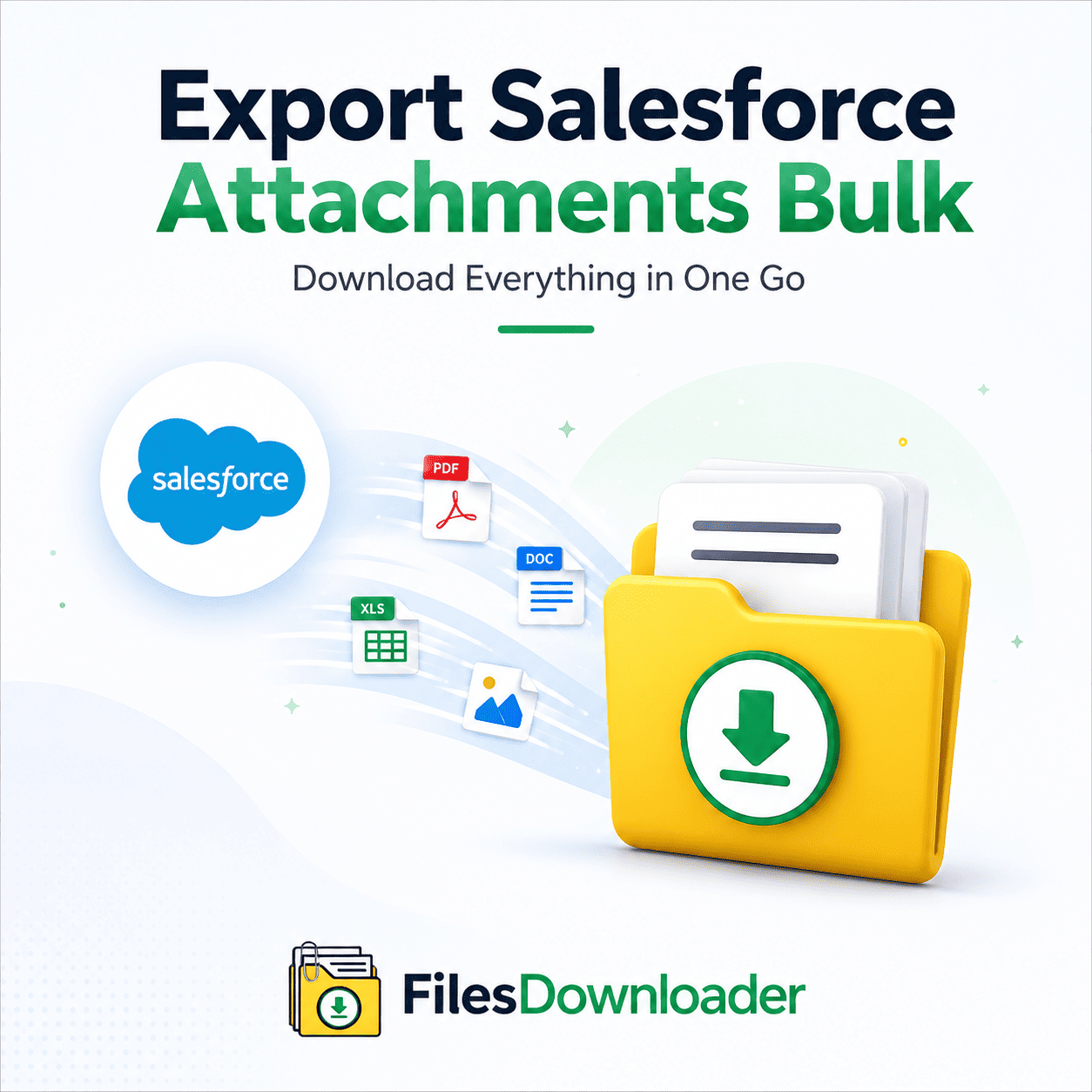
This is where a dedicated files downloader makes all the difference. You don’t have to open records individually. Work directly from any list view — standard or custom — and export Salesforce attachments in bulk in one go.
List View Compatibility: Works with standard and custom list views — no need to rebuild views just to export.
One-Click Download: Export attachments and mass files from any list view with one click.
Native Formats: Download files and attachments from Salesforce in the same format they were uploaded, with no conversion or loss of quality.
No Middleware Overhead: Easiest way to export Salesforce files without the headache of complex ETL tools or middleware.
Universal Format Support: Supports all file types — PDFs, images (.jpg, .png), docs, spreadsheets, and more.
This fully eliminates the manual bottleneck for admins and data teams that need to export Salesforce attachments bulk on a recurring basis.
Designed for ContentVersion Records, Rather Than Files
In modern Salesforce orgs, attachments are stored as ContentVersion records built on top of ContentDocument, not just the older legacy Attachment object. Many basic tools simply grab the surface-level file and lose the record association underneath. A downloader built for this architecture keeps that link intact when you bulk export Salesforce attachments bulk for audits or migrations.
SOQL Query Export Precision Exports
Bulk is not synonymous with “all, indiscriminately.” Sometimes you need to export Salesforce attachments bulk, but only for a specific subset — one object, one date range, or one record type. This is where SOQL Query Export comes in.
Live Query Execution: Run your own SOQL query to get the latest data immediately.
Targeted Extraction: Filter and pull out just the files that meet your criteria in one go.
Scoped Downloads: Make it easy to download complex data by targeting specific objects and fields.
This is especially useful for recurring exports where the same filtered criteria need to run weekly or monthly without rebuilding the process each time.
Metadata, Names & Folders — Preserved
A bulk export that dumps everything into one unsorted folder is hardly any better than the manual process it replaces. Every file must carry its context.
Context Retention: Attach metadata such as owner, object type, and record association to each file.
Directory Hierarchy: Export files without renaming or flattening, keeping original file names and folder structures intact.
Audit & Backup Ready: Perfect for clean migrations, audits, and system backups where traceability matters.
That is the difference between a real bulk export tool and a simple download script — you get nicely structured, traceable files, not just a big folder of loose attachments.
From Salesforce to SQL Server or Excel in Minutes
Once you export Salesforce attachments bulk, that data rarely stays in isolation. A well-structured export makes it easier to import the Salesforce data into SQL Server or Excel after the export because the file names, folders, and metadata already match your source records.
This saves data teams time they would otherwise spend manually sorting data before evaluating it. No more field re-mapping or hand re-labeling of files your export lands ready for the next system.
Who Should Bulk Export Salesforce Attachments?
For most orgs, this isn’t a one-off need — it has become a must-have file exporter for Salesforce admins and data teams that regularly work with attachment-heavy objects. It integrates smoothly with existing Salesforce data export and file management processes.
Common Use Cases
IT Teams: Getting ready for a system or platform migration.
Compliance Teams: Conducting regular audits of custom objects.
Data Teams: Building reporting pipelines outside of Salesforce.
System Administrators: Responding to storage limit warnings when under time pressure.
Visit the Salesforce AppExchange listing to view setup requirements and the most recent reviews from other admins who routinely export Salesforce attachments bulk.