
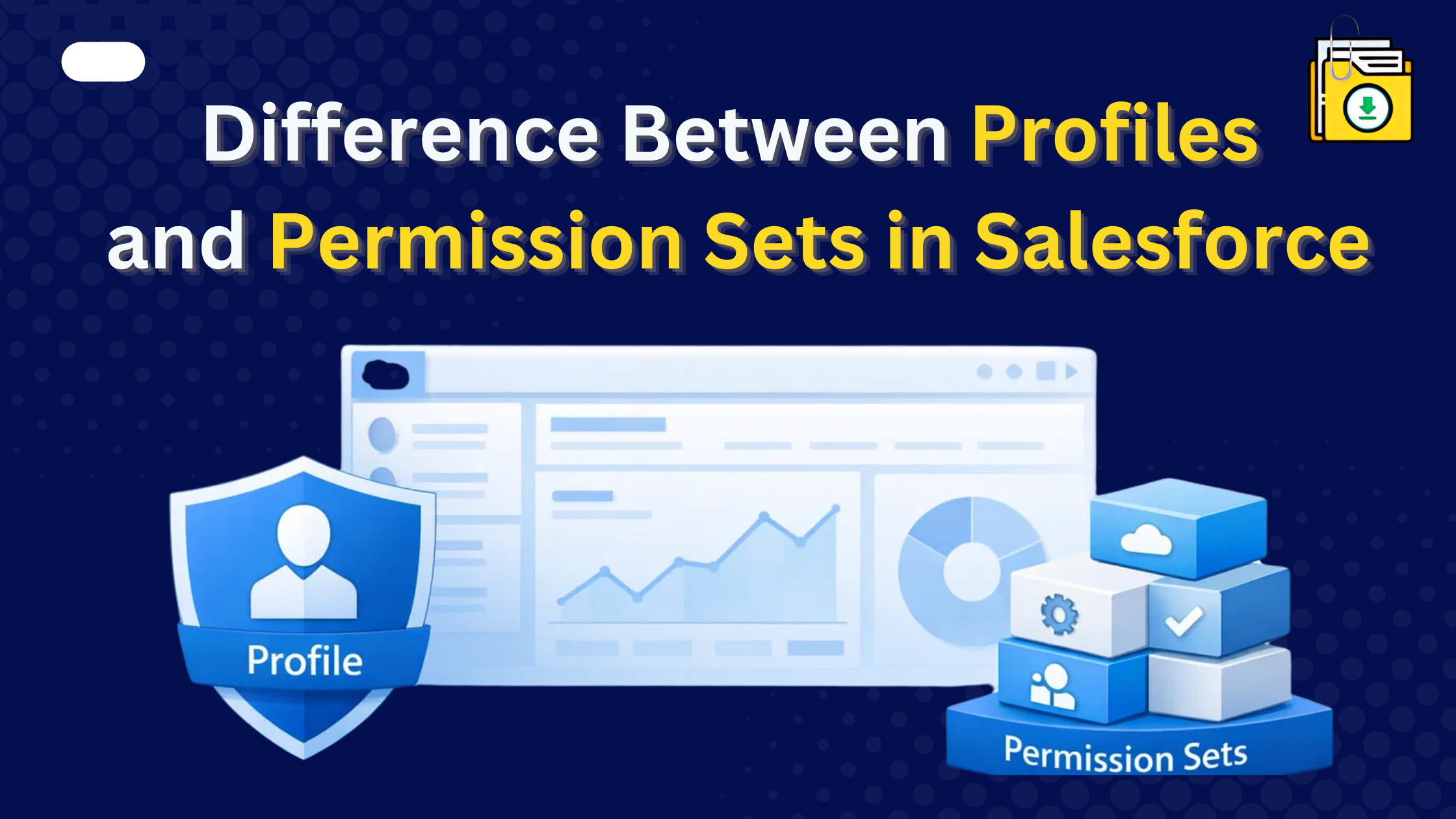


Understanding the Difference between Profile and Permission set in Salesforce is essential for designing a secure and scalable user access model. Profiles and Permission Sets control how users interact with data, but they work in very different ways within Salesforce security architecture. Whether you’re onboarding new users, troubleshooting access issues, or designing a scalable security model, understanding the difference between Profiles and Permission Sets is critical.
Thank you for reading this post, don't forget to subscribe!With Salesforce’s shift toward a Permission Set-led security model, the “cloning profiles” era is officially over. If you want to avoid “Profile Sprawl” and build an agile org, this guide is for you.
Difference Between Profile and Permission Set in Salesforce
In Salesforce, a Profile defines the baseline level of access that every user must have. Every user in Salesforce must be assigned exactly one profile.
It controls object-level permissions such as Create, Read, Edit, and Delete (CRUD), along with Field-Level Security (FLS) to determine which fields a user can view or modify. A profile also governs app access, record type access, system permissions, and tab visibility.
Beyond data access, it manages security controls like login hours and IP range restrictions. Profiles establish the minimum required access for a user and typically align with job roles such as Sales User, Marketing User, or System Administrator. In simple terms, a profile acts as the base access framework that defines what a user can generally see and do across the system.
What Is a Permission Set in Salesforce?
A Permission Set in Salesforce is an additional layer of access that extends the permissions already granted through a user’s profile. Unlike profiles, users can be assigned multiple permission sets or none at all, depending on their access needs.
Permission sets are specifically designed to grant extra access without requiring changes to the user’s base profile. They can control object permissions, field permissions, app access, system permissions, Apex class access, and Visualforce page access.
Permission sets are optional and highly flexible, allowing administrators to assign them as needed. They are additive in nature, meaning they can only grant additional permissions and cannot restrict existing access. This makes them ideal for temporary, project-based, or special access requirements. In simple terms, a permission set works like a booster pack that enhances a user’s capabilities beyond their standard profile permissions.
Profiles vs Permission Sets: Side-by-Side Comparison
| Feature | Profile | Permission Set |
|---|---|---|
| Required for User? | Yes | No |
| Number per User | Only 1 | Multiple |
| Purpose | Base access | Additional access |
| Can Restrict Access? | Yes | No (only adds access) |
| Used for Temporary Access? | Not ideal | Perfect |
| Affects Login Hours/IP? | Yes | No |
| Scalable? | Limited | Highly scalable |
| Best Practice in Modern Orgs | Minimal profiles | Permission-set heavy model |
Core Differences Explained (In Depth)
1. Assignment Structure
The most fundamental difference between Profiles and Permission Sets lies in how they are assigned to users.
In Salesforce, every user must have exactly one Profile. This profile acts as the user’s primary identity in the system and defines their baseline access. Because only one profile can be assigned per user, administrators must carefully design profiles to reflect broad job functions rather than granular variations.
In contrast, users can be assigned multiple Permission Sets or none at all. This allows administrators to layer additional permissions on top of the base profile without altering it. For example, if five sales users need access to a new custom object, instead of cloning the Sales profile five times, you can simply create one Permission Set and assign it to those users.
This one-to-one vs one-to-many structure is the biggest architectural difference between the two.
2. Flexibility and Scalability
Profiles bundle many settings together object permissions, login restrictions, tab visibility, and more. If even one small variation is required, admins often clone the profile.
Over time, this creates “profile sprawl,” where dozens of similar profiles exist with minor differences. This makes auditing, troubleshooting, and maintenance difficult.
Permission sets solve this problem through modular design. You can isolate specific permissions into reusable access components and assign them only when required.
This approach is cleaner, more scalable, and easier to manage in growing organizations.
3. Access Philosophy
Profiles are role-centric. They are typically aligned with job functions such as Sales User, Marketing User, Support Agent, or System Administrator. In other words, a profile defines who the user is in the organization.
Permission Sets are capability-centric. They define what additional tasks the user needs to perform beyond their core role. For example, a Sales User may temporarily need access to a marketing campaign object. Instead of redefining their identity with a new profile, you simply grant the additional capability through a Permission Set.
This philosophical distinction makes Permission Sets more adaptable to dynamic business needs, where users frequently take on cross-functional responsibilities.
4. Restriction Capability
Profiles have the ability to both grant and restrict access. They can:
- Define login hours
- Restrict login IP ranges
- Control page layout assignments
- Limit object and field permissions
- Hide tabs entirely
Because profiles are foundational, they serve as the primary enforcement layer of user security policies.
Permission Sets, however, are strictly additive. They cannot remove or restrict permissions granted by a profile. They can only expand access. If a user’s profile allows “Read” access to an object, a Permission Set can grant “Edit” access but it cannot downgrade access or impose login restrictions.
This means profiles remain essential for enforcing security boundaries, while Permission Sets are used to extend capabilities safely and efficiently.
5. The Modern Powerhouse: Permission Set Groups
In 2026, we don’t just assign 20 individual Permission Sets. We use Permission Set Groups.
- Bundling: Bundle several sets into a “Job Function” (e.g., “Contract Manager”).
- Muting: Use a Muting Permission Set within a group to strip away one specific permission from that bundle for certain users. This is the only way to “subtract” access in an additive model.
Real-World Example: Managing “Files Downloader” App Access
Let’s look at a practical scenario with a native app like Files Downloader, which allows bulk exporting of attachments.
The Problem:
You have 50 Sales users. 10 of them need to bulk export files, but 40 should not have that power.
- The Old (Wrong) Way: Clone the “Sales User” profile to create a “Sales User + Export” profile. Now you have two profiles to maintain every time you add a new field.
- The Modern (Right) Way: Keep all 50 users on the standard “Sales User” profile. Create one Permission Set called “App_Files_Downloader_Admin” and assign it only to the 10 users who need it.
The Result: No profile duplication.
- The security model stays “clean.” organized.
- Access is easily revoked by removing one assignment.
When Should You Use Profiles?
1. Defining Baseline Job Access
Profiles are ideal for assigning access based on structured job roles such as Sales Representative, Marketing Executive, Support Agent, or Finance User. These roles typically share consistent object permissions, record type visibility, and system capabilities.
2. Setting Login Restrictions
Profiles are the only place where you can configure:
- Login hours
- Login IP ranges
These restrictions are critical for security and compliance. If your organization operates in specific regions or time windows, profile-level login controls help enforce those boundaries.
Permission Sets cannot override or modify these restrictions.
3. Enforcing IP Security
IP restrictions are especially important in industries with strict compliance requirements such as finance, healthcare, or government sectors. Profiles allow you to limit system access to approved corporate networks.
Because this is a structural security control, it belongs at the profile level not in permission sets.
4. Assigning Default Apps
Profiles determine which apps are visible by default and what tab settings apply. This ensures that users see the correct navigation structure when they log in.
5. Controlling Page Layout Assignments
Profiles allow administrators to assign different page layouts to different types of users. This ensures that each role sees the fields and sections relevant to their responsibilities.
When Should You Use Permission Sets?
Permission Sets should be used whenever you need to extend access beyond a user’s core role without changing their profile.
1. App-Specific Access (Like Files Downloader)
When installing apps such as Files Downloader, it is best practice to grant access via Permission Sets rather than modifying existing profiles.
For example:
- Only certain users may need bulk file export access.
- Others may only need dashboard visibility.
Instead of creating “Sales User – With Files Access” profiles, you assign a dedicated permission set that grants access to the app and its related objects.
This keeps your profile structure clean while allowing precise app-level access control.
2. Temporary Access Needs
Projects, audits, migrations, or seasonal campaigns often require short-term permissions.
Instead of permanently modifying profiles:
- Assign a permission set.
- Remove it once the task is complete.
This prevents long-term security drift and reduces accidental overexposure of sensitive data.
3. Feature-Based Permissions
Sometimes users within the same role need slightly different capabilities.
4. Cross-Functional Responsibilities
In growing organizations, employees often wear multiple hats. A marketing user might assist with reporting, or a sales manager might need limited admin capabilities.
Permission Sets allow you to layer additional responsibilities without redefining the user’s core identity.
5. Controlled Administrative Capabilities
Instead of assigning full System Administrator profiles, you can create permission sets that grant specific elevated rights such as:
- User management
- Report creation
- Dashboard management
- Object customization (limited scope)
This supports the principle of least privilege while maintaining operational efficiency.
Conclusion
The most successful Salesforce Architects today use the “Least Privilege” model. They assign a very restricted “Minimum Access” profile to everyone and use Permission Set Groups to build out the user’s actual capabilities.
By moving your logic from Profiles to Permission Sets, you reduce technical debt, simplify your audits, and make your Salesforce environment ready for the future. Understanding the Difference between Profile and Permission set in Salesforce helps admins build a cleaner, more scalable security model with minimal profile sprawl.