
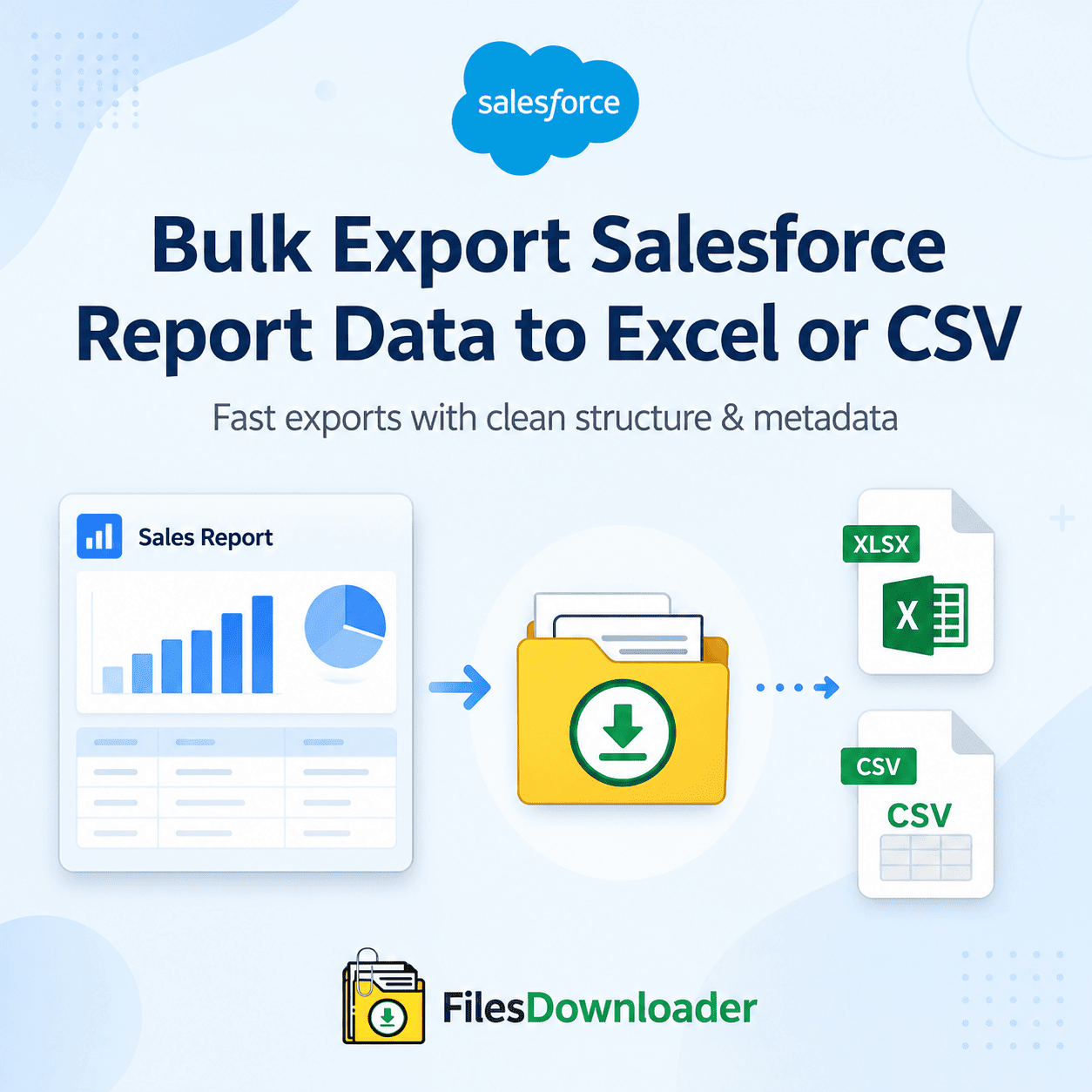


How to Bulk Export Salesforce Report Data to Excel or CSV
To bulk export Salesforce report data to Excel or CSV, you need to pull the rows and columns generated by a Salesforce report—opportunity totals, case volumes, and pipeline breakdowns—into a spreadsheet for analysis outside the platform. This is handled through Salesforce’s native reporting tools, not a file exporter, and knowing which native option fits your data volume makes the difference between a two-minute export and a stalled one.
Thank you for reading this post, don't forget to subscribe!How to Actually Export Salesforce Report Data
A few native paths handle bulk report data export, depending on scale:
- Report “Export Details” button—the fastest option for smaller reports, available directly from any report view, exports straight to Excel (.xlsx) or CSV in a couple of clicks.
- Reports API — for developers automating recurring exports, the Analytics REST API can pull report data programmatically on a schedule, ideal for feeding dashboards or external BI tools.
- Data Loader / Data Export Wizard—For the underlying object data behind a report (not the report’s summarized view), these tools bulk-export full datasets, useful when you need raw records rather than aggregated report totals.
- Scheduled report exports via Flow or third-party tools — for teams that need report data landing in Excel or CSV automatically on a recurring basis, without manual clicks each time.
If your bottleneck is genuinely getting report rows and columns into Excel or CSV, this is the layer to use—a file export tool, including ours, doesn’t generate or export report data itself.
Where File Management Comes In Alongside Report Data
Reports often summarize data tied to records that also have their own attachments—contracts behind opportunity reports, supporting documents behind case reports, and signed agreements behind account-level analysis. Once you’ve exported the report data itself, the next task is usually pulling those related files for a complete audit trail or migration package, and this is where native Salesforce file exports fall short.
The default Weekly Export Service dumps attachments into unstructured zip files, strips original file names, and replaces them with unreadable record IDs—so tracing a file back to the specific record behind your report data means manual cross-referencing. There’s no selective filtering either, so a File Storage Limit Exceeded warning forces an all-or-nothing export even when you only need files tied to a narrow report segment.
Exporting Files Behind Your Report Data with a Files Downloader
Once report data is in Excel or CSV, here’s the workflow for the supporting files:
1. Start from a list view matching your report scope. Use the same standard or custom list view your report is built on—Opportunities, Cases, or custom objects—to filter to the exact records behind your report data.
2. Run SOQL for precision. Target specific ContentVersion records by date, file type, or object relationship, avoiding a full-repository download for a narrow report segment.
3. Export with full context. Files retain original names, folder structure, owner, object type, and parent-record association, so each attachment stays traceable to the record behind your report.
4. Import cleanly downstream. Structured output loads directly into SQL Server or Excel alongside your report data, without manual sorting or broken lookup fields.
Native File Export vs. files downloader
| Challenge | Native Salesforce Export | files downloader |
|---|---|---|
| Selective Filtering | All-or-nothing | Object, list view, or SOQL-based |
| File Naming | Replaced with record IDs | Original names preserved |
| Metadata Preservation | Stripped or separated | Owner, object type, record link retained |
| File Format Support | Generic archive | PDFs, images, docs, spreadsheets, CAD |
| Setup Time | Hours, batch-dependent | One-click, instant |
The export runs natively within Salesforce and respects existing permission sets and sharing rules, so exporting the files behind a report doesn’t introduce a separate compliance risk.