


Best Salesforce Data Export Tool 2026: Why Files Downloader is No.1
With storage costs on the rise, File Storage Limit Exceeded warnings are now common, and migrations require clean and organized file transfers, finding the best Salesforce file export tool 2026 is now a top priority for admins and data teams. There are a number of options out in the market, but any serious contender must do more than just download files—it must filter with precision, preserve metadata, handle bulk volumes, and work across every object type without custom development. Files Downloader does all that and more.
Thank you for reading this post, don't forget to subscribe!In this guide, we’ll show you the value of the best Salesforce file export tool 2026 over generic export options — and why Files Downloader wins the title for admins dealing with real-world file export challenges.
What the Best Salesforce File Export Tool Should Do in 2026
Before you begin comparing the options, it’s helpful to define what sets apart the best Salesforce file export tool 2026 from a simple download utility. As orgs have gotten more complex, the demands have gotten more demanding.
Selective Filtering Not All Or Nothing
The native Salesforce Data Export Service gives you a zip file of everything. With a purpose-built tool, you’re in control. Filter by object, list view, date, file type, or a custom SOQL Query to export only the files you actually need. That precision saves hours of manual sorting on the other side.
Retention of Metadata
There is no question about preserving metadata owner, object type, record association, and creation date must all survive the export so that the files remain traceable and useful. A metadata-stripping tool requires teams to recreate context manually, defeating the purpose of a fast export.
Bulk Export at Scale
The right tool should be able to process hundreds or thousands of ContentVersion records and legacy Attachments in one pass, not require repeated manual exports as volume increases.
No Custom Development Needed
In 2026, a tool that requires Apex code, custom configuration, or an IT ticket doesn’t cut it for most teams. Admins want something they can install, configure, and run themselves.
Support for Cross-Object, Cross-Destination
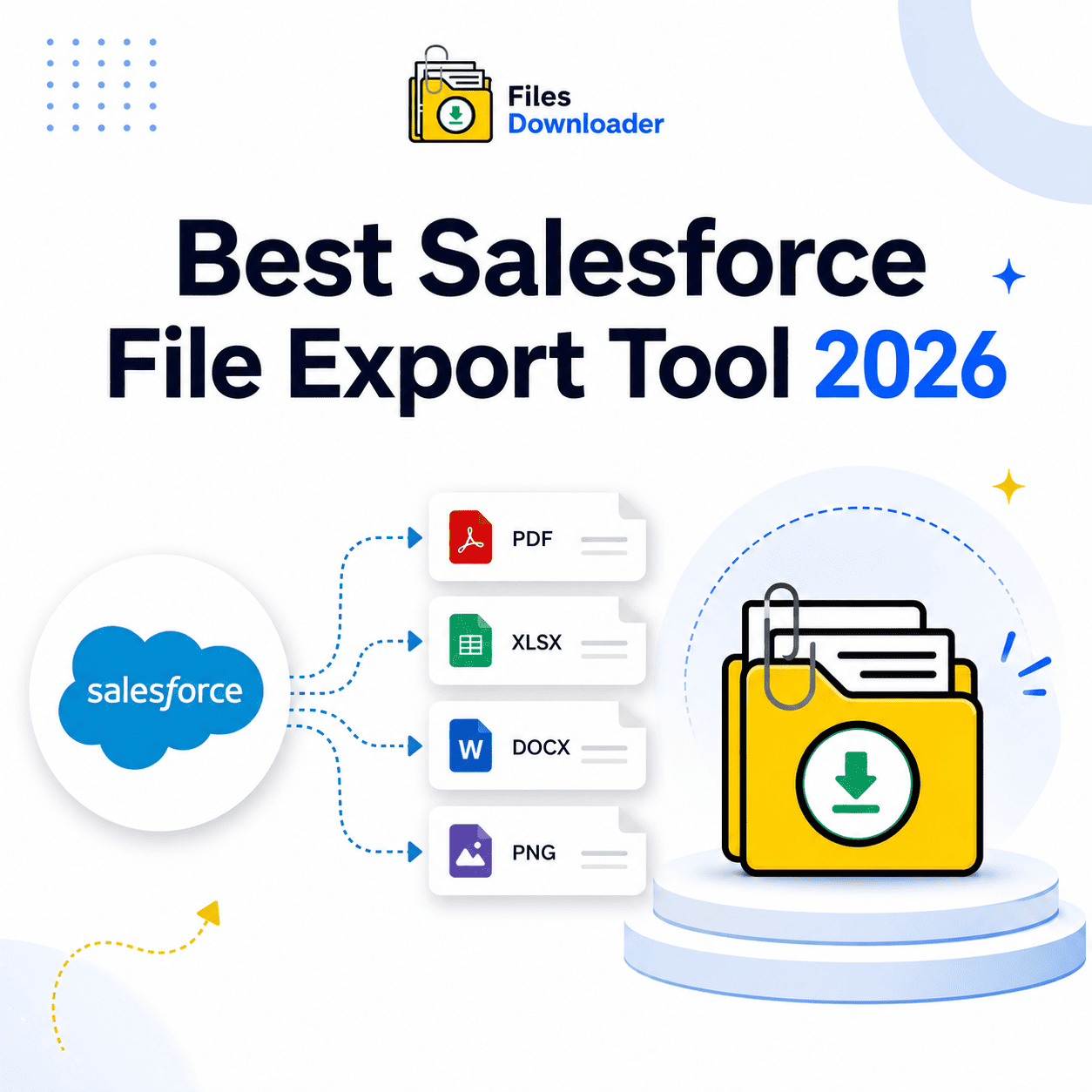
The best Salesforce file export tool 2026 supports standard and custom objects, and exports to the destinations teams already use — Google Drive, OneDrive, SharePoint, Dropbox, and local storage.
Why Files Downloader is the Best Salesforce File Export Tool 2026
Files Downloader meets all of those requirements and it does so within a workflow that mirrors how admins already work within Salesforce. Here’s why it’s the best Salesforce file export tool 2026 for teams with real export needs.
Export in Bulk From Any List View: Files Downloader provides standard and custom list views so the export begins with the view the admin already has. Select the records, run export, and all ContentVersion files and Attachments related move together. No zipping, no manual sorting, just a clean, organized export that any leading tool should ship by default.
Surgical Accuracy Export via SOQL Query: Files Downloader can use custom SOQL Query Export for ContentVersion, ContentDocumentLink, and Attachment objects for granular control. The best Salesforce file export tool 2026 comes in there: filter by file size, date, owner, parent object, or record status and export only what matches. This is something no one else offers without custom code.
Full Metadata and Folder Structure: Files Downloader retains the owner, object type, and record association on every export. Original file names and folder structure are delivered to the destination as-is from Salesforce. Files Downloader is the best Salesforce file export tool 2026 because it never forces teams to choose between speed and context.
Single Run to Handle Any File Type: PDFs, images (.jpg, .png), Word docs, spreadsheets, and most standard attachment formats are all handled in their original format without conversion. In 2026, the best Salesforce file export tool does not need to be run separately for different file types.
Works with Standard and Custom Objects: For mature Salesforce orgs, custom objects often have the largest hidden file loads. Files Downloader exports from standard objects and custom objects, and from any standard or custom list view, which makes it the best Salesforce file export tool 2026 for orgs of any complexity.
Flexibility After Export
After the export, if you need to use the data in SQL Server or Excel, you can import the exported files — giving data teams more than just an archive. The best Salesforce file export tool in 2026 not only saves storage, but also creates value by making files useful in downstream workflows.
Who Needs a Salesforce File Export Tool in 2026?
Admins Managing Storage Costs: As storage bills continue to rise, the best Salesforce file export tool 2026 keeps consumption flat by exporting and archiving files on a recurring schedule.
Data Teams Running Migrations: Any org migrating to a new Salesforce instance or different CRM needs the best Salesforce file export tool 2026 to move ContentVersion and Attachment records with full record association intact.
Compliance Teams: Files exported to an auditable external destination must preserve metadata for regulated industries. The best Salesforce file export tool 2026 for compliance is one that keeps ContentDocumentLink relationships coming out.
Teams Replacing Manual Workflows: If a team is downloading files one by one or running scripts to export Salesforce files, they need the best Salesforce file export tool 2026 to replace that process with one repeatable bulk action.
Files Downloader is a perennial favorite among teams already shopping around on the filtered, metadata-preserving exports across all object types. Browse the listing to compare it side by side with other options out there.
Ready to Use the Best Salesforce File Export Tool 2026?
Stop managing files by hand. Save your storage limits, keep your metadata intact, and run your exports in one unified step. Files Downloader is the best Salesforce file export tool 2026 for admins and data teams looking for accuracy, speed, and full file context on every run.
[Book a Free Demo] | [View Pricing] | [Install on AppExchange]