


How to Export 10 Years Salesforce Files? History Without the Head-ache
At some point every Salesforce Admin will encounter that dreaded “File Storage Limit Exceeded” notification. Your org accumulates gigabytes—or even terabytes—of contracts, invoices, case attachments, and design assets over a decade of growth. Trying to export 10 years Salesforce files history using native tools often ends up as an exhausting “zip file scavenger hunt.”
Thank you for reading this post, don't forget to subscribe!Native Weekly Data Exports deliver fragmented, nested folders with cryptically renamed files and missing metadata. Meanwhile, conventional tools require complex mapping or crash under massive data volumes.
You need a seamless way to extract a decade of compliance records, get ready for a clean migration, or offload heavy attachments to cut storage costs. This authoritative guide demonstrates how to make your file management more efficient, save important metadata, and zero-in on specific records without friction.
The Problem with Exporting Historical Salesforce Data
Extracting long-term data from Salesforce presents different operational hurdles, especially when you are dealing with enterprise legacy data going back a decade.
The Native Export Trap: Missing Metadata and Cryptic File Names
Standard Salesforce export methods remove the contextual glue that holds your records together. Native bulk file download in Salesforce renames files to their internal ContentVersion IDs rather than their actual file names.
What’s worse, you lose direct links to original record IDs, object associations, and ownership history. Exporting data requires hundreds of hours of data cleanup and complex scripts to re-associate the millions of files.
The Storage Cost Squeeze
Salesforce file storage costs a lot of money. You’re holding on to 10 years of legacy files due to regulatory requirements, which is putting a strain on your IT budget.
Export 10 Years Salesforce Files History in a way that eliminates storage overages but still allows them to be audited.
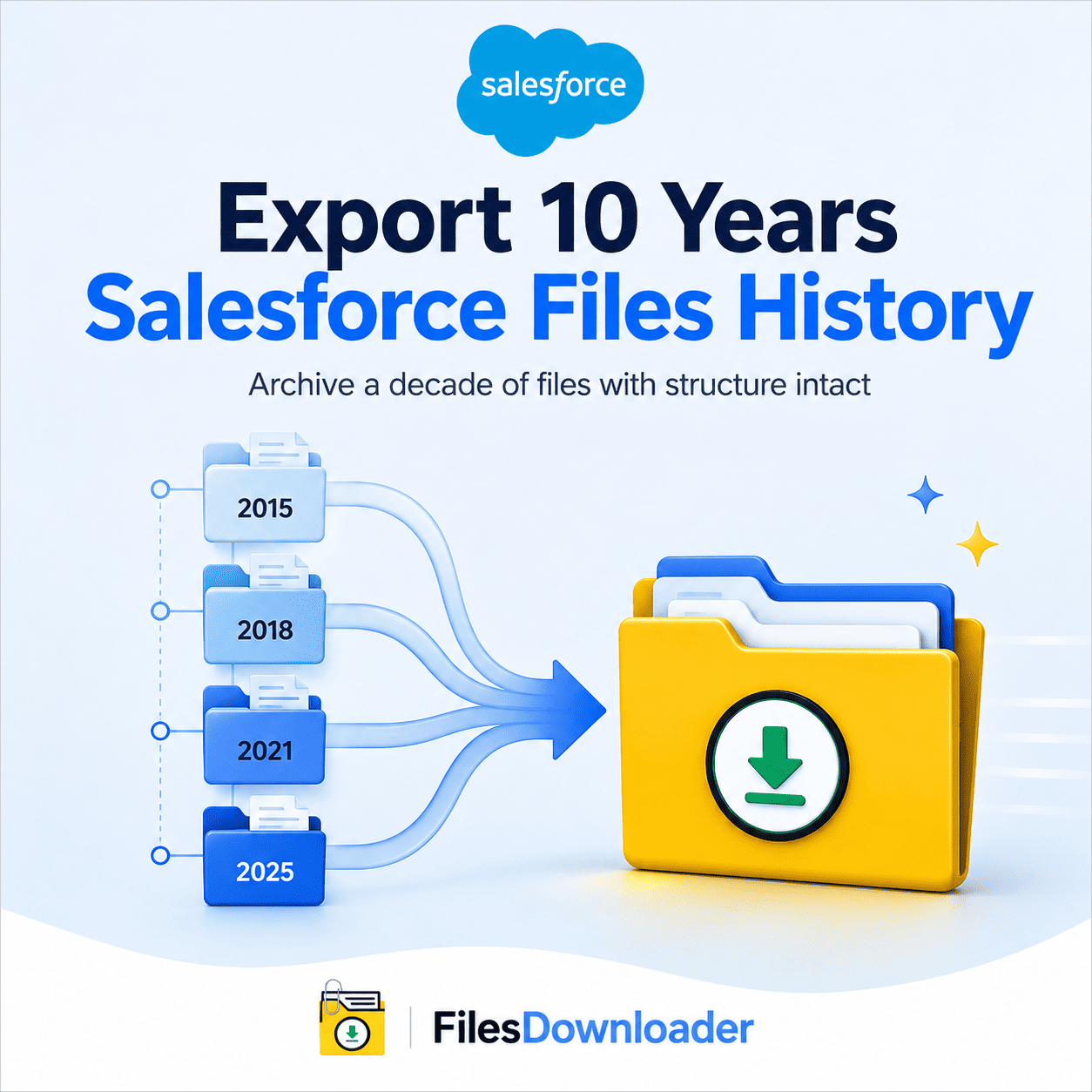
Bulk Export Salesforce Files History 10 Years How to
To Export 10 Years Salesforce Files History efficiently, you need a dedicated file exporter built specifically for Salesforce admins and data teams.
Filter and Extract Only Relevant Files in One Step
Stop downloading bulk archives in an unorganized way. With modern file extraction tools, you can filter and extract only the files that meet your criteria in one step.
Need PDF contracts attached to closed Opportunities from 2016 or .png images from resolved Cases, targeting specific objects & fields can simplify complex data downloads.
Standard & Custom Objects: Bulk extract attachments from Accounts, Contacts, Leads, or custom objects.
List View Integration: Works with standard and custom list views so you can kick off mass downloads directly from the UI screens you already know and love.
Targeted Filtering: Filter by date range, file type, or record owner so you can download just what you need.
Download with Precision by Running Custom SOQL Queries
Custom querying provides technical admins and developers with unmatched control over enterprise file exports. Customize & run your own SOQL Query Export to access the latest data instantly.
Directly target the ContentVersion and ContentDocumentLink objects to query 10 years of historical records to exacting audit criteria.
Why Files Downloader is a Must-Have for Salesforce Administrators
Export 10 Years Salesforce Files History Bulk downloads should not require complex command-line interfaces or unreliable local scripts. Files Downloader is the fastest way to export Salesforce files without complex tools, giving you the power of the enterprise but with a point-and-click interface.
| Feature | Native Data Export | Files Downloader | Data Loader Generic |
| Preserves File Names | No (Renames to IDs) | Yes (Original Names) | No |
| Object Metadata Management | No | Yes (Auto-Associated) | Requires VLOOKUPs |
| Direct Export from List View | No | Yes (Standard & Custom) | No |
| Filter Date/Type | No (All or Nothing) | Easy Filters | Advanced Queries |
| Supported File Types | Limited | All Formats (.pdf, .jpg, etc) | Limited |
Keep Original File Names & Folder Structures
When you export mass files and attachments from any list views using Files Downloader, your folder hierarchies are preserved.
The system retains the original file names and folder structure when exporting. That means your “2016_Master_Service_Agreement.pdf” file keeps its name instead of being turned into some 18 character long alphanumeric string that makes no sense.
Preserve Critical Metadata for Audits and Migrations
Context must be retained in a compliant export. Files Downloader allows you to retain metadata such as owner, object type, and record association on every file you download.
This makes it ideal for clean migrations, regulatory audits and system backups. Moreover, maintaining this structure makes it easier to import Salesforce data into SQL Server or Excel post-export, saving hundreds of engineering hours during enterprise platform migrations.
Supports All Formats & No Mapping Required
With Files Downloader, you can back up CAD drawings, contracts, customer receipts, and any other file type you need, including PDFs, images (.jpg, .png), docs, and more.
Export 10 Years Salesforce Files History Download files & attachments from Salesforce in the same format as they were uploaded. Because the tool reads your Salesforce schema natively, it requires zero field mapping—saving you time by avoiding manual data sorting.
Step by Step How to Export 10 Years of Salesforce File History
Ready to archive 10 years of files? Just follow this simple process:
Specify Export Criteria: Open your target standard or custom list view or paste in a custom SOQL query to the extraction interface.
Set File Parameters: Pick your target object types, set date ranges (e.g., filtering for 10 years of historical files), and choose output folder structures.
Download: Select Export. Files Downloader processes files in bulk and keeps the original titles, parent record IDs, and creation dates.
Verify & Archive: Check your structured output, including an index file for database import or cold storage offloading.
[Book a Free Demo] | [View Pricing] | [Install on AppExchange]