


Exporting Files from Salesforce Native format without the data export nightmare
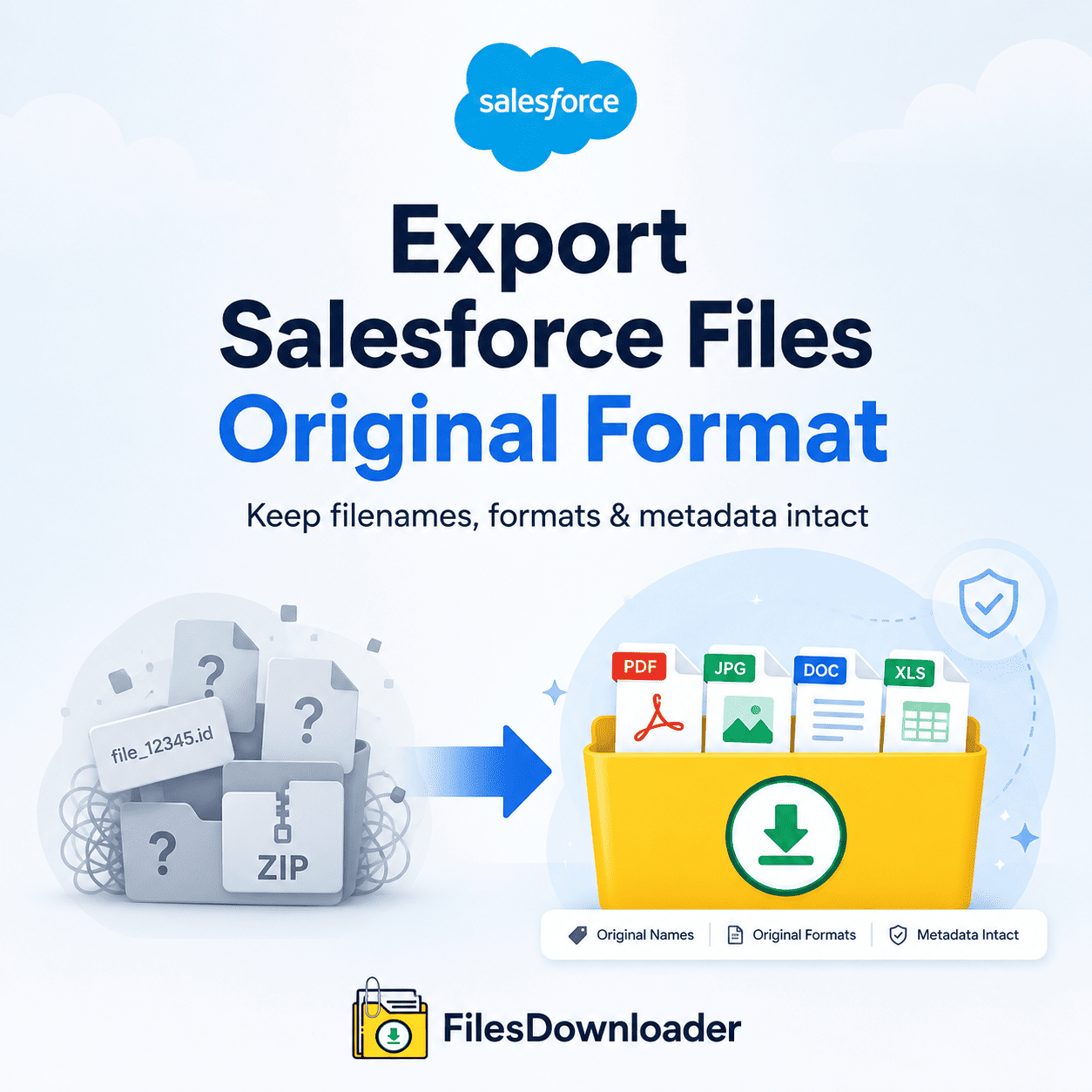
If you’ve ever tried to extract attachments from Salesforce with the native tools, you know the pain of the “Zip File Scavenger Hunt.” You request a backup, wait hours for an email notification, download dozens of corrupted .zip files, and instead of recognizable document titles, you get a mess of cryptic alphanumeric IDs. If you want to export Salesforce files original format, native options are woefully inadequate.
Thank you for reading this post, don't forget to subscribe!Basic export queues cost valuable engineering hours and can corrupt data if you’re hitting your File Storage Limit Exceeded threshold, getting ready for a complex system audit, or moving data into SQL Server or Excel. You need an easy way to extract documents, images, and attachments with their native extension, folder structure, and key metadata intact.
The Native Export Trap: Why Admins Need a Better Tool
While Export Salesforce Files Original Format is a best-in-class CRM, its native file export capabilities are lacking. Admins and data ops teams are hitting brick walls when it comes to bulk download of assets for compliance or backup purposes.
The “Zip File Scavenger Hunt” and ContentVersion Bottlenecks
Native Weekly Data Exports zip up your assets into arbitrary batch files. When you download, the file names are replaced with 18 character Salesforce record IDs, so teams need to do complex VLOOKUPs on the ContentVersion object just to know which PDF is attached to which Account.
Native tools also lack any granular filtering. If you only need Q4 invoices, you will still need to export your entire file repository. This inefficient process wastes massive amounts of bandwidth, creates unnecessary security risks, and delays critical operational timelines.
Native Salesforce Export: [ 0685g000003xYZ1 ] Manual Lookup Required Please download our file: [Q4_Invoice_AcmeCorp.pdf] Ready to Go & Preserved
The Best Solution: Salesforce Bulk Export Files
Our file exporter removes the need for manual data sorting and cryptic record matching. Built from the ground up as the go-to file exporter for Salesforce admins and data teams, it’s the fastest way to export Salesforce files original format without writing code or wrestling with complicated command-line interfaces.
Keeping the Structure and Metadata Intact When Exporting Salesforce Files Original Format
When you extract files with our tool, your assets keep their real-world context. The system automatically keeps the original file names and folder structure during export so your target destination will look just like your CRM layout.
And most importantly, Export Salesforce Files Original Format the tool allows you to keep metadata like owner, object type, and record association. This way, each extracted file still has its historical context and it’s easy to map the attachments back to the Opportunities, Cases or custom objects after the export.
Key benefit: No need to rename files manually. Zero lost record associations. One click to extract clean usable files.
Powerful features for fast, focused exports
Why spend days sifting through raw data dumps when you can hone in on the assets you need? Our tool plugs easily into your existing processes for Export Salesforce Files Original Format and managing files with unmatched speed and accuracy.
1. Supports Normal and Custom List Views
No need to build complex data pipelines to pull out files. Just go to any standard or custom list view in Salesforce, select the records you want and start the download. Export mass files and attachments from any list views instantly, allowing end-users and admins to export Salesforce files original format directly from their daily workspace.
2. Deep Filter Custom Objects & Fields
Target specific objects & fields for easier complex data downloads. Instead of downloading your whole history database, filter and extract only the files that meet your criteria in one step. Want contract documents attached to “Closed-Won” Deals? Photo attachments from custom field service logs? Narrow down your extraction to the exact field value.
3. SOQL Query (Expert) Export Engine
Harness the complete potential of Salesforce Object Query Language for sophisticated data operations. Run your own SOQL query Export. Customise. Get the latest data instantly. With this feature, data engineers can target nested parent-child relationships and extract specific file payloads without pulling in unnecessary overhead.
4. Supported all file types
No matter the file extensions your company uses, our solution handles them perfectly. Compatible with all file types. PDFs, images (.jpg,.png), docs, CAD drawings, etc. Download files & attachments from Export Salesforce Files Original Format exactly as they were uploaded. No file corruption, no changed extensions.
Streamline Audits, Backups, and SQL/Excel Migrations
Export Salesforce Files Original Format is seldom a one-time task, but the first step in a larger data transformation project.
Use Case: System Backups
Typical Problem: File Storage Limit Approaching Exceeded warnings
How to Use our Exporter It: Export Salesforce files original format to offsite cloud storage to free up Salesforce storage space.
Use Case: Data Migrations
Typical Problem: Complex mapping of ID -> filename needed
How to Use our Exporter It: Keep original file names and metadata. Makes importing Salesforce data into SQL Server or Excel after export easier.
Use Case: Compliance Audits
Typical Problem: Bulk downloads that are not organized and searchable
How to Use our Exporter It: Export Salesforce Files Original Format Files from Standard & Custom Objects with Clean Searchable Folder Hierarchies
Our exporter is the ideal solution for clean migrations, audits and system backups, drastically reducing the hours your team spends on routine data maintenance.
How to export Salesforce files in their original format in 3 simple steps
[ Step 1: Choose Records/SOQL ] ➔ [ Step 2: Set output rules ] ➔ [ Step 3: Export in one click ]
Choose Your Poison: Choose a standard/custom list view or type a custom SOQL Query Export to define your data set.
Set Up Your Export: Choose the parameters for the desired folder structure and the options for including metadata.
Perform Bulk Action with One Click: Click download. 5. The system runs in the background processing the request and providing your assets with native names and formats preserved.
[Book a Free Demo] | [View Pricing] | [Install on AppExchange]