


Delete Old Attachments Salesforce Storage: Complete Guide Files Downloader
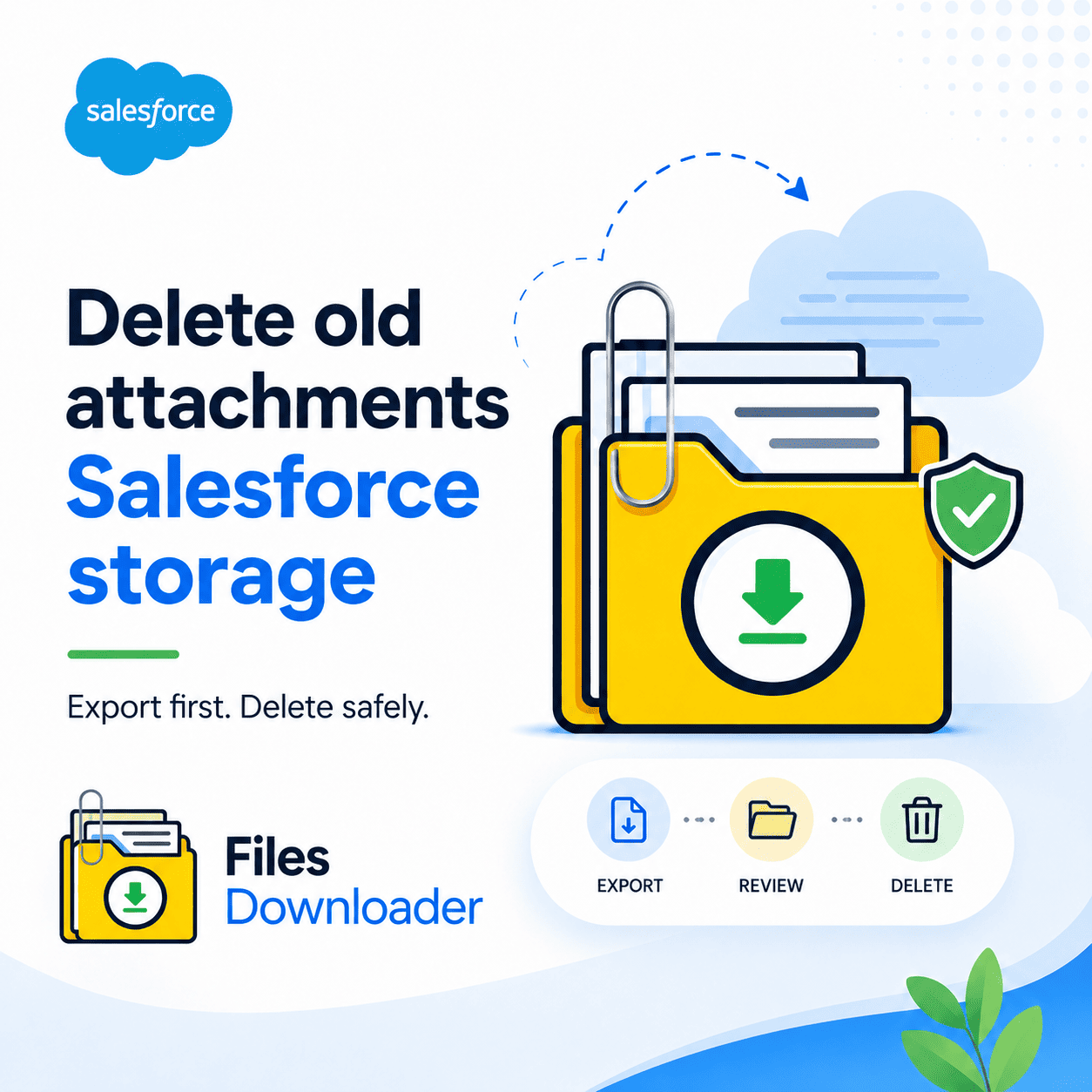
The smartest way to Delete Old Attachments Salesforce Storage that is being consumed is not to delete first, but to export first, then verify, and then remove. Files Downloader is the best way for admins and data teams to delete old attachments in a filtered, repeatable and direct way. Bulk exporting files to an external location before deleting them from the org prevents wastes of Salesforce storage and ensures nothing is permanently lost in the process. If you’re getting the File Storage Limit Exceeded warning in your org, or storage costs are increasing at renewal, this guide shows exactly how to remove old attachments Salesforce storage keeps charging you for safely and at scale.
Thank you for reading this post, don't forget to subscribe!Why Teams Need to Delete Old Attachments Salesforce Storage Is Eating Up
Salesforce charges based on what the org holds for file storage, and most orgs hold far more than they need. Over time you build up years of PDFs, images, contracts, and email attachments as ContentVersion records and legacy Attachment objects with no automatic cleanup. Delete Old Attachments Salesforce Storage that have been accumulating in Salesforce storage, admins need a selective, auditable process not a manual delete spree.
The Problem of ContentVersion Accumulation
Every file uploaded via Salesforce Files results in a ContentVersion record. Each revision creates another. An org that has been around for 5 years or more can have hundreds of old ContentVersion records associated with closed records that no one accesses. Teams must first filter by object, date, and status — and export before any deletion occurs to Delete Old Attachments Salesforce Storage is tied to these records.
Legacy Attachment Records Often Overlooked
Older Salesforce orgs have Legacy Attachment records that are associated directly with standard and custom objects. These don’t always show up prominently in the storage reports, but they represent a significant volume of files to delete from old attachments Salesforce storage consumption. Without a targeted export tool they are difficult to deal with in bulk – and easy to forget about when planning a clean-up to Delete Old Attachments Salesforce Storage has been quietly accumulating.
The Perilous Business of Deleting Without Exporting First
The #1 mistake teams make when trying to Delete Old Attachments Salesforce Storage is deleting files without first exporting them. Files Downloader is the solution to this, offering a clean, organized export before anything is removed so every file is accounted for before you delete old attachments Salesforce Storage has been marked for deletion.
How Files Downloader Helps You to Delete Old Attachments Salesforce Storage Wasting
Files Downloader was created for this exact workflow. It gives teams an accurate bulk and metadata-preserving export process so admins can delete old attachments with confidence Salesforce storage has been eating up with no loss of any file context or audit trail.
Bulk Export before Delete: Files Downloader exports all matching ContentVersion record and legacy Attachment to your chosen destination in one batch before you Delete Old Attachments Salesforce Storage is carrying. No zip files, no manual downloads – just a clean, organized export that mimics the original Salesforce structure.
Export SOQL Query for Specific Cleanup: Files Downloader has a custom SOQL Query Export for ContentVersion, ContentDocumentLink and Attachment objects. Use the creation date, file size, object type, or record status filter to pinpoint the exact files for deletion. Target and export old attachments that have been amassing in Salesforce storage on specific objects such as closed cases, inactive accounts, or completed projects in one step.
Folder Structure and Metadata Preserved: An export before you Delete Old Attachments Salesforce Storage is consuming means that every file arrives at its destination with original file names, folder structure and metadata like owner, object type, and record association fully preserved. Nothing is lost in the process — files just move from Salesforce to a less expensive external home.
Works with Standard and Custom Objects: Files you need to Delete Old Attachments Salesforce Storage is often on custom objects that are not shown in the standard storage reports. Files Downloader exports from any standard or custom list view, as well as from any standard or custom object — so no storage source is left unaddressed.
All File Types Covered: PDFs, images (.jpg,.png), Word docs, spreadsheets, and most standard attachment formats — Files Downloader supports all file types, without conversion or quality loss, no matter what object type carried it.
The Safe Way to Delete Old Attachments That Are Eating Up Your Salesforce Storage
Step One – Identify: Identify the objects and file types that use the most space with the Salesforce Storage Usage Report. Run SOQL queries on the ContentVersion or Attachment objects to understand the details before deleting old Salesforce storage attachments.
Step Two — Export: Bulk export the targeted files to Google Drive, OneDrive, SharePoint, Dropbox, or local storage with Files Downloader. Each file is transferred with its metadata and folder structure intact.
Step Three — Confirm: Before taking any delete action inside Salesforce, check to make sure files have landed correctly at the destination. This step is critical — it’s the difference between a tidy storage purge and an irreversible data loss event.
Step Four – Remove: Then, after you verify the export, delete the original ContentVersion or Attachment records from Salesforce. This is the step that will actually reduce the billable storage number and resolve the warning about File Storage Limit Exceeded.
Cases for Removing Old Attachments from Salesforce Storage
Cleanup of Closed Records: The lowest risk files to target are those associated with closed opportunities, resolved cases or dormant accounts. Export, verify, and then Delete Old Attachments Salesforce Storage associated with those records instant storage savings with little operational risk. Recurrent Storage Management: Use Files Downloader to set an export cadence (quarterly or monthly) to identify and delete old attachments Salesforce storage builds up over time. Prevention is cheaper than a storage overage.
Cleanup Before Renewal: Salesforce storage has accumulated since the previous review. Prior to a Salesforce contract renewal, export and delete old attachments. A lower storage footprint going into renewal is a direct cost lever.
Archiving for Compliance: If your industry has document retention requirements, export files to a compliant external location before deleting them from Salesforce — satisfying the compliance requirement and the need to delete old attachments that Salesforce storage is charging for.
Files Downloader is one of the most purpose-built solutions available for teams that need to delete old attachments Salesforce storage is consuming at any volume.
After Export and Delete
Once you export old attachments and delete them, Salesforce storage has been cleared, and the storage dashboard reflects the reduction immediately. Exported files are completely available at the external destination – searchable, organized and linked to their original Salesforce records via preserved metadata. Teams can also bring in exported data for auditing and reporting in SQL Server or Excel.
How to Delete Old Attachments Salesforce Storage Has Been Charging You For?
First export. Second check. Third is erase. Files Downloader offers admins and data teams the safest, fastest and most filtered way to Delete Old Attachments Salesforce Storage has accumulated – without risking a single file in the process.
[Book a Free Demo] | [View Pricing] | [Install on AppExchange]