


Salesforce Agentforce Platform: Unlocking the File Export Bottleneck for Every AI-Powered Org
If you’ve ever tried to download every PDF, invoice, or contract attached to a list view, you know the pain. That’s called reporting on Salesforce. Admins call it the “Zip File Scavenger Hunt”—clicking into record after record, downloading one file at a time, and praying nothing gets missed. As organizations scale their Salesforce Agentforce Platform deployments, this manual bottleneck only gets worse because autonomous AI agents are generating, attaching, and referencing more files than ever before.
Thank you for reading this post, don't forget to subscribe!The Salesforce Agentforce Platform is designed to automate work and surface data faster but native Salesforce still doesn’t have a fast, native way to bulk-export the files behind that data. That’s the gap Files Downloader fills.
The Real Issue: No Selective Filtering
Standard Salesforce export tools offer you all-or-nothing options. There’s no simple way to filter attachments by object, owner, or date range before downloading. Teams with a Salesforce Agentforce Platform instance handling thousands of automated records hit this wall almost immediately.
The result is “File Storage Limit Exceeded” errors, bloated backups, and hours lost to manual sorting. Admins end up exporting everything and then deleting irrelevant files after the fact backward, slow, and risky.
How Files Downloader Solves It
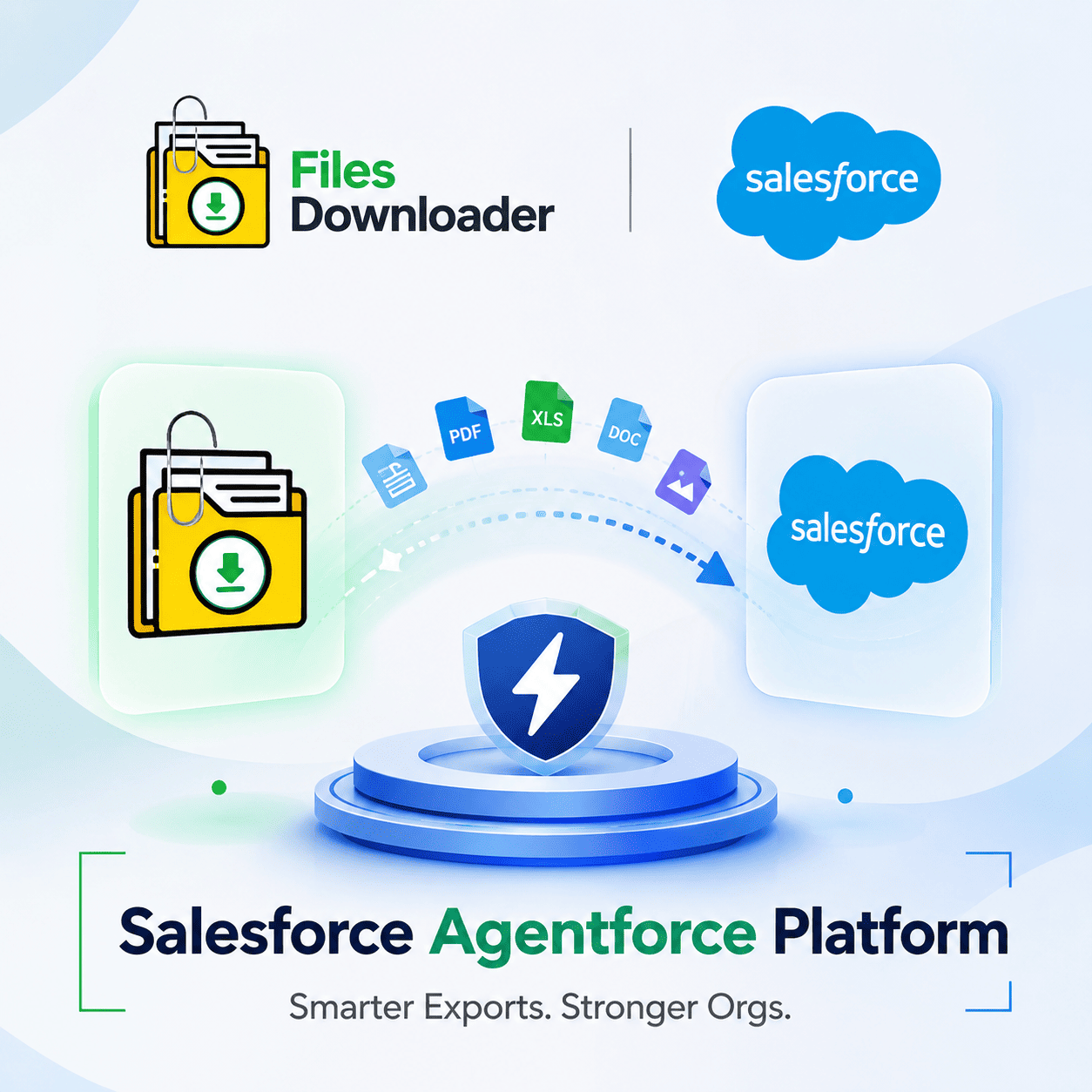
Files Downloader is built for teams working with data-heavy Salesforce orgs, including those scaling on the Salesforce Agentforce Platform. It removes the manual layer altogether.
Works with Any List View Standard or Custom
Files Downloader works with both standard and custom list views, so you’re never locked into Salesforce’s default filtering. Export mass files and attachments from any list view in one action. This is the one-click bulk action admins have been asking for over years — requiring zero custom development or third-party middleware.
Built on ContentVersion and SOQL Query Export
Salesforce stores files under the hood as ContentVersion records, which do not play well with native tools at scale. Files Downloader reads the ContentVersion data directly, so files download exactly as they were uploaded — PDFs, images (.jpg, .png), docs, and more — without corruption or re-encoding.
SOQL Query Export
For teams that need precision, you can write and run your own query to access the latest data instantly. Extract only the files that match your criteria in a single step no exporting everything just to delete the noise later.
Why It’s a Go-To for Admins and Data Teams
This is an essential file exporter for Salesforce administrators and data teams managing growing Salesforce Agentforce Platform environments. It’s the fastest way to export Salesforce files without using complex tools, heavy ETL platforms, or custom Apex scripts.
Main Capabilities Include:
Bulk Export: Export Salesforce files en masse from standard and custom objects.
Metadata Preservation: Retain critical context such as owner, object type, and record association.
Original Structures: Export with original filenames and folder structures intact.
Granular Target Filtering: Target specific objects and fields to simplify complex data downloads.
This is much more than just file storage cleanup; this is full Salesforce data export and file management built for how modern, AI-driven orgs actually work.
Core Use Cases
1. Migrations
When moving off legacy systems or consolidating orgs after an acquisition, you want every file accounted for with metadata intact.
2. Audits
Compliance teams require clean, traceable file sets that can be linked to specific objects and date ranges. SOQL Query Export turns this into a one-step task rather than a weeklong project.
3. Restores & Backups
You shouldn’t need a developer to do routine backups of a Salesforce Agentforce Platform org. You can schedule and run exports cleanly without complex mapping.
Where Your Files Go Next: Beyond Salesforce
Exported files don’t need to remain static. After exporting, Files Downloader makes it easy to import your Salesforce data into SQL Server or Excel so your data team can analyze, report, or re-platform without having to manually reformat everything.
No more data sorting by hand means you save significant time. When files leave Salesforce in their native structure, each downstream step be it analytics, archiving, or migration proceeds much faster.