


Your Existing Salesforce Tools Can’t Bulk Export Your Files
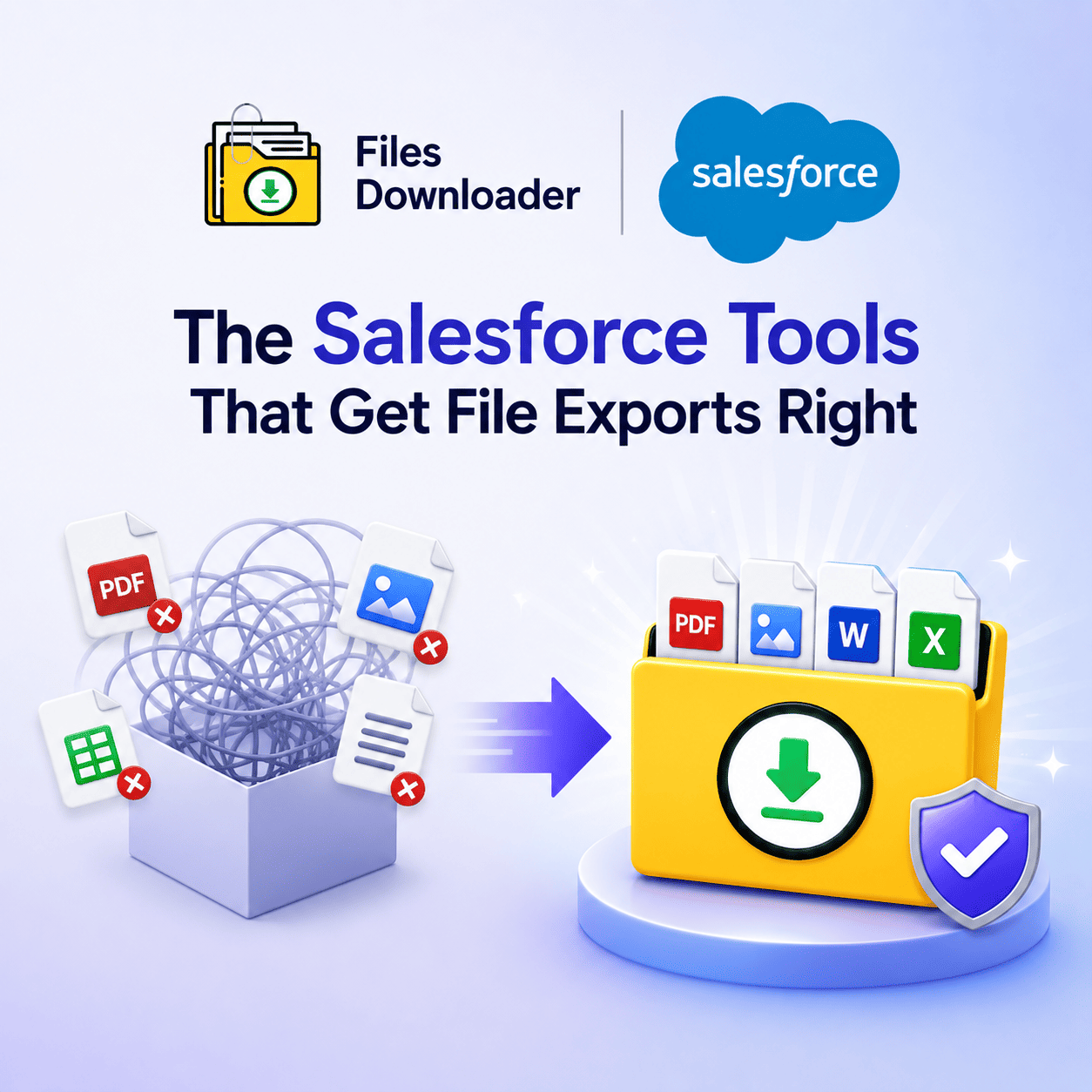
Most Salesforce tools are built to help you create, organize and update records — not extract files from them at scale. Suddenly someone asks for every attachment for last quarter’s deals and you’re in a Zip File Scavenger Hunt, opening record after record, downloading one file at a time, renaming duplicates so nothing overwrites. This is not something that can be filtered using any of your current Salesforce tools. Files Downloader is the only tool designed specifically to fix it.
Thank you for reading this post, don't forget to subscribe!Most Salesforce Tools Still Get File Export Wrong Here’s Why
Native Salesforce tools allow you to see files through list views, reports, and related lists — they were never meant to export them in bulk. No selective filtering. Either you download everything or nothing, no in-between for targeting just what you need. That gap forces teams into manual workarounds that don’t scale beyond a handful of records.
ContentVersion
Most files in Salesforce are ContentVersion records, not simple attachments — and that’s where most Salesforce tools fall short. Standard export options or simple data loaders can’t manage this object structure, forcing admins to download files one by one. On top of that you get a File Storage Limit Exceeded warning. So you have a storage problem and no fast way to triage it.
Many teams are forced to cobble together two or three different Salesforce tools just to manage file exports – one for list views, another for attachments, a third for anything related to custom objects. This patchwork multiplies setup time and maintenance without really solving the problem. All three are replaced by one single tool designed specifically for bulk file export, with less configuration and many fewer points of failure.
What the Right Salesforce Tools Are Supposed to Do
Works with all list views – standard and custom: Files Downloader can export mass files and attachments from any list view, whether that’s a default Salesforce view or one your team built for a specific report. No other tools in this category from Salesforce deliver that kind of flexibility out of the box.
Download files exactly as they were originally: PDFs are PDFs, images are images and the original file names and folder structure are preserved on export. That’s important when your next step is to import Salesforce data into SQL Server or Excel — there’s no need to reformat it first.
Support any file type, any object: PDFs, images (.jpg,.png), docs, and more export in bulk from standard and custom objects. That’s why Files Downloader is a must-have file exporter for Salesforce admins and data teams that’ve outgrown manual downloads.
Keep the metadata that provides context to files: All exported files come with owner, object type and record association. In the world of audits, clean migrations and system backups, that metadata is often more valuable than the file itself.
Native accuracy for SOQL query export
Skip the all-or-nothing export. Customize and run your own SOQL Query Export to filter and pull only the files that matter to your criteria — by object, date, owner, or any field you want. It’s one step that makes difficult data downloads that other Salesforce tools require you to do manually easier, saving you real time you’d otherwise be spending sorting files after the fact.
How This Works With Your Salesforce Software
There’s no need to replace anything in your existing stack. Files Downloader fits perfectly into your existing Salesforce data export and file management flow and is the missing piece for bulk file operations.
That’s the kind of thing teams most commonly use it for clean migrations, compliance audits, routine system backups, when “export everything relevant” actually means something as opposed to “everything, as in literally everything”. Check out plans based on your data volume on our
Why Admins Prefer This to Other Salesforce Tools
It’s the fastest way to export Salesforce files without having to learn a complicated new platform or write custom scripts. Admins and data teams choose it because setup takes minutes, not a developer sprint. See how other teams are using it on the listing before you commit.
If you are comparing Salesforce tools side by side, the difference becomes clear the first time you need a targeted, repeatable export, and not a one-off manual download.