


The Ultimate Guide to Export Files from Salesforce Experience Cloud
If you manage data in Salesforce Experience Cloud, you know the frustration: your files are in there, buried across records, custom objects, and ContentVersion entries, and getting them out is anything but simple. Whether you are running a compliance audit, migrating to a new system, or just trying to hand off a clean data set to your SQL Server team, the native export tools have you playing a Zip File Scavenger Hunt — downloading folders one by one, renaming files manually, and praying the metadata survived. Files Downloader puts an end to that nightmare.
Thank you for reading this post, don't forget to subscribe!Why File Exports in Salesforce Experience Cloud Are Not Easy As They Should Be
Salesforce Experience Cloud is a powerful platform — but the file management layer wasn’t built for bulk exports. You have three hard stop problems out of the box.
Lack of Selective Filtering – Standard file downloads are all or nothing. There is no native way to filter by object type, owner, record association, or date range before you export. You end up with thousands of files that you don’t need.
File Storage Limit Exceeded – If you work with large document libraries, you’ll quickly encounter File Storage Limit Exceeded warnings. But the only way to free up space or archive data cleanly is to export first — which brings you right back to the same clunky toolset.
SOQL Query Export Developer Only – Salesforce Experience Cloud admins who are not technical do not have an easy way to run a targeted SOQL Query Export without writing Apex code or launching Data Loader. That’s a tall order for a data team on deadline.
Salesforce Experience Cloud: Easiest way to export files
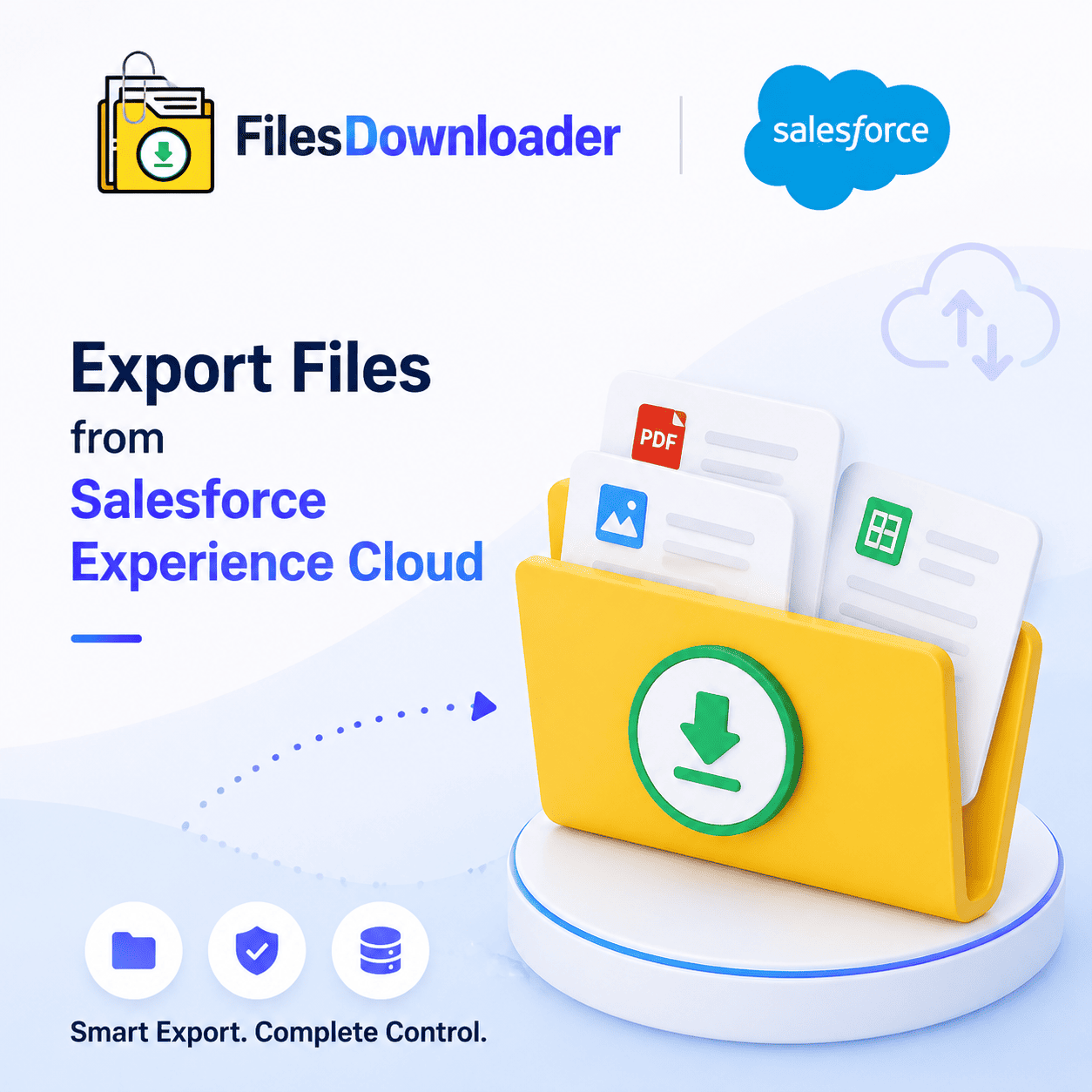
Files Downloader is a native Salesforce AppExchange app that is designed specifically for Salesforce Experience Cloud admins, data managers, and migration teams. No third party Middleware. No csv mapping No developer needed.
Here’s the best solution:
Works with Any List View – Standard or Custom – Files Downloader integrates directly into the standard and custom list views within Salesforce Experience Cloud. Choose the records that matter to you, start the export, and you’re good to go. It supports all standard and custom objects – Accounts, Cases, Opportunities and anything you’ve built yourself. It fits right into your existing Salesforce data export and file management processes without disrupting what you already have.
Export Every File Type, Every Time – PDFs, images (.jpg, .png), Word docs, spreadsheets, CSVs — if it exists within your Salesforce Experience Cloud org, Files Downloader can export it. No reformatting, no conversion, no data loss. Files arrive in your hands exactly how they were stored.
Keep Metadata and Folder Structure
This is where most bulk export tools fail. Files Downloader Saves:
Original file names – no more download_1847263.pdf
Folder structures – your hierarchy of organization is preserved on export
Metadata: owner, object type, and record association go with every file
That means your files are immediately ready-to-use after export — whether you’re importing into SQL Server, loading into Excel, or passing to a migration partner.
Run Your Own SOQL Query — No Developer Required
Files Downloader includes a built in SOQL Query Export interface for Power users and Salesforce Experience Cloud admins who need surgical precision. Write or paste your own SOQL query to hit the exact records and ContentVersion entries you want. Get the freshest data right away, without waiting for a developer sprint.
This is the feature that makes a day-long manual export a five-minute task.
Designed for Migrations, Audits, and System Backups
Files Downloader is not just an export tool – it’s infrastructure for the moments that matter most on Salesforce Experience Cloud:
Clean migrations: Keep record associations and folder structures intact so that your destination system accurately reflects your source org.
Compliance audits: Filter and extract only the files relevant to your audit criteria in one step — no manual sorting, no missed records.
System backups: Perform scheduled or on-demand bulk exports for your entire Salesforce Experience Cloud org prior to major updates or org merges.
When your Salesforce Experience Cloud environment is holding years of business-critical documents, you can’t afford a broken export process.
[Book a Free Demo] | [View Pricing] | [Install on AppExchange]