



Objects Salesforce Admins Manage Every Day: The Complete File Export Guide
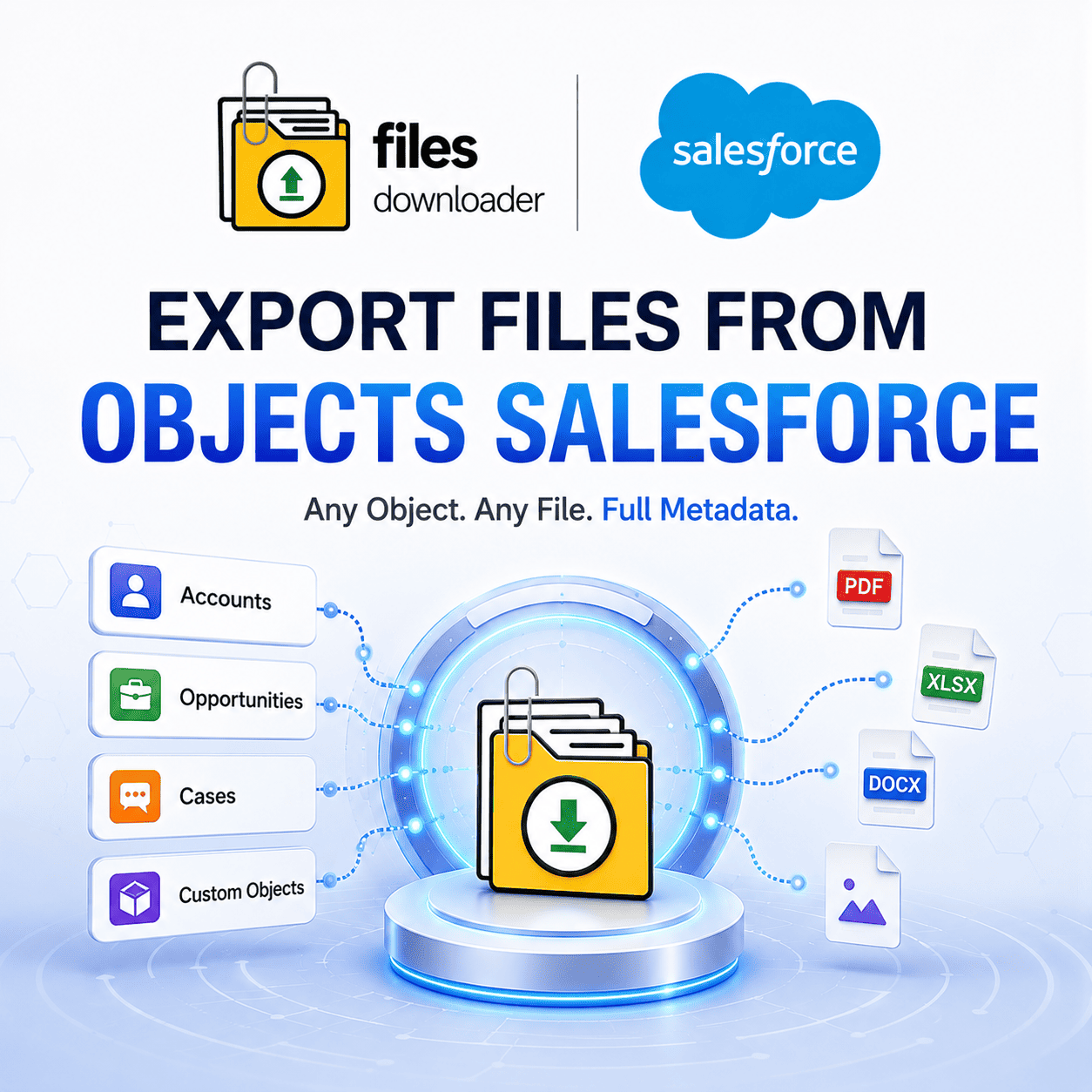
Every file, attachment, and document in your Salesforce org lives on an object. The objects Salesforce uses — standard ones like Accounts, Cases, and Opportunities, and every custom object your org has ever built — are the containers that hold your data. And when it’s time to export that data, the objects Salesforce has structured your files across become the biggest obstacle. Files buried in dozens of objects. No bulk export that respects object context. Metadata stripped before files ever leave the platform. Files Downloader solves every one of these problems. It gives Salesforce admins and data teams complete bulk export control across every standard and custom object in their org — with full metadata, original filenames, and folder structure intact.
Thank you for reading this post, don't forget to subscribe!Why Exporting Files Across Objects Salesforce Stores Them In Is So Hard
The objects Salesforce provides — and the custom objects your team has built — aren’t designed for bulk file extraction. They’re designed for data entry and CRM workflows. Getting files out of them cleanly requires a tool built for the job.
The “Zip File Scavenger Hunt” Across Multiple Objects
Run a native Salesforce bulk export across multiple objects Salesforce supports and here’s what you get: a collection of zip archives with no original filenames, no folder structure, and no indication of which object each file came from. Admins spend days reconstructing record context that should have been preserved automatically. The objects Salesforce uses to organize your data don’t survive the export.
Lack of Selective Filtering Across Objects
Once you need to export files from specific objects Salesforce has in your org, native tools offer almost no granularity. You can’t say “export only the PDFs from Opportunities that are closed-won, and only from the Northeast region custom object.” The blunt all-or-nothing approach of native export tools ignores the object structure that makes your Salesforce data meaningful.
File Storage Limit Exceeded — Spread Across Every Object
File Storage Limit Exceeded errors don’t come from one object in isolation. They accumulate across every object Salesforce stores files on — Accounts, Cases, Opportunities, custom objects, all of them simultaneously. When storage hits the ceiling, admins need to export and offload files from specific objects quickly and cleanly. Native tools can’t support that level of precision.
How Files Downloader Works Across Every Object Salesforce Supports
Files Downloader is a purpose-built Salesforce AppExchange tool designed to work across every standard and custom object in your Salesforce org. It closes every gap that native export tools leave open when working across the full range of objects Salesforce supports.
Object — Standard or Custom — Via List Views
Files Downloader works with both standard and custom list views exactly as they exist in your org today. Every object Salesforce supports that has associated files or attachments is accessible through its list view. Open any list view on any object, apply your filters, and trigger a mass export in one step.
You get bulk file and attachment exports from any list view across every standard and custom object in your org — instantly, without rebuilding your existing workflow. This is the fastest way to export Salesforce files without using complex tools, regardless of which objects Salesforce has your data stored across.
Download Every File in Its Exact Original Format
Unlike native Salesforce exports that convert or rename files during extraction, Files Downloader downloads files and attachments from the objects Salesforce stores them on in their exact original format. PDFs stay PDFs. Images stay .jpg or .png. Word documents stay .docx. Nothing gets compressed into an unreadable archive or renamed with a system-generated ID.
It supports all file types: PDFs, images (.jpg, .png), docs, spreadsheets, and more. For teams importing Salesforce data into SQL Server or Excel after exporting across multiple objects Salesforce supports, format consistency eliminates hours of post-export reformatting.
Preserve Metadata — Including Which Object Each File Came From
When exporting files across the objects Salesforce uses to structure your data, metadata is everything. Files Downloader preserves:
- Original file name — exactly as stored in Salesforce, never replaced by a system ID
- Owner and record association — who created the file and which record it belongs to
- Object type context — so your exported folder structure maps directly back to the objects Salesforce stored those files on
This object-aware metadata preservation makes Files Downloader the go-to tool for clean migrations, compliance audits, and system backups where knowing which objects Salesforce files came from directly affects data quality.
Use SOQL Query Export to Target Files on Specific Objects Salesforce Supports
For admins who need precision control over which files to export from which objects Salesforce has in their org, Files Downloader’s SOQL Query Export interface is the most powerful tool available. Write and execute your own queries against ContentVersion and related objects — no developer required.
How SOQL Query Export Targets Files by Object
Access the latest data instantly by customizing and running your own SOQL query directly inside the app. Filter by object type, record type, creation date, owner, status, or any field your org tracks. Extract only the files relevant to your criteria from only the objects Salesforce you want to target — in a single step, with no exporting everything first and sorting afterward.
This is especially powerful when working with ContentVersion records that are associated with multiple objects Salesforce has in your org. A targeted SOQL query lets you define exactly which object’s files you extract — keeping every export scoped, intentional, and clean.
Simplify Complex Exports Across Multiple Objects
In most Salesforce orgs, files are distributed across Accounts, Opportunities, Cases, and custom objects simultaneously. Files Downloader lets you simplify complex data downloads by targeting specific objects and fields. An Opportunity-level export won’t accidentally pull in unrelated Case attachments or files from other objects Salesforce has in scope.
Built for Every Role Working With Objects Salesforce Supports
Files Downloader isn’t a generic file management tool with a Salesforce connector bolted on. It’s a must-have file exporter for every Salesforce role that works with files stored across the objects Salesforce provides.
- Salesforce Admins use it to offload files from specific objects before hitting File Storage Limit Exceeded thresholds
- Data Teams use it to structure clean exports from targeted objects Salesforce supports for SQL Server, Excel, and BI platforms
- Migration Specialists rely on it to preserve original file names and object-aware folder structures during org-to-org or platform transitions
- Developers and Architects use it to validate ContentVersion and Attachment records across specific objects Salesforce has deployed
It works perfectly with Salesforce data export and file management workflows — and saves time by eliminating the manual data sorting that follows every bulk export.
Files Downloader Works Across Every Scenario Involving Objects Salesforce Uses
Quarterly storage audit across all standard objects. Full custom object file migration. Compliance export from specific objects Salesforce has in your org. Pre-merger org cleanup across dozens of standard and custom objects simultaneously. Files Downloader gives every scenario the same clean, repeatable, metadata-intact export foundation.
Export files with full metadata preserved. Maintain original folder structures that map back to the objects Salesforce stored them on. Re-import cleanly into Google Drive, SharePoint, SQL Server, or any staging environment. What used to take days of manual work now takes minutes.
[Book a Free Demo] | [View Pricing] | [Install on AppExchange]