
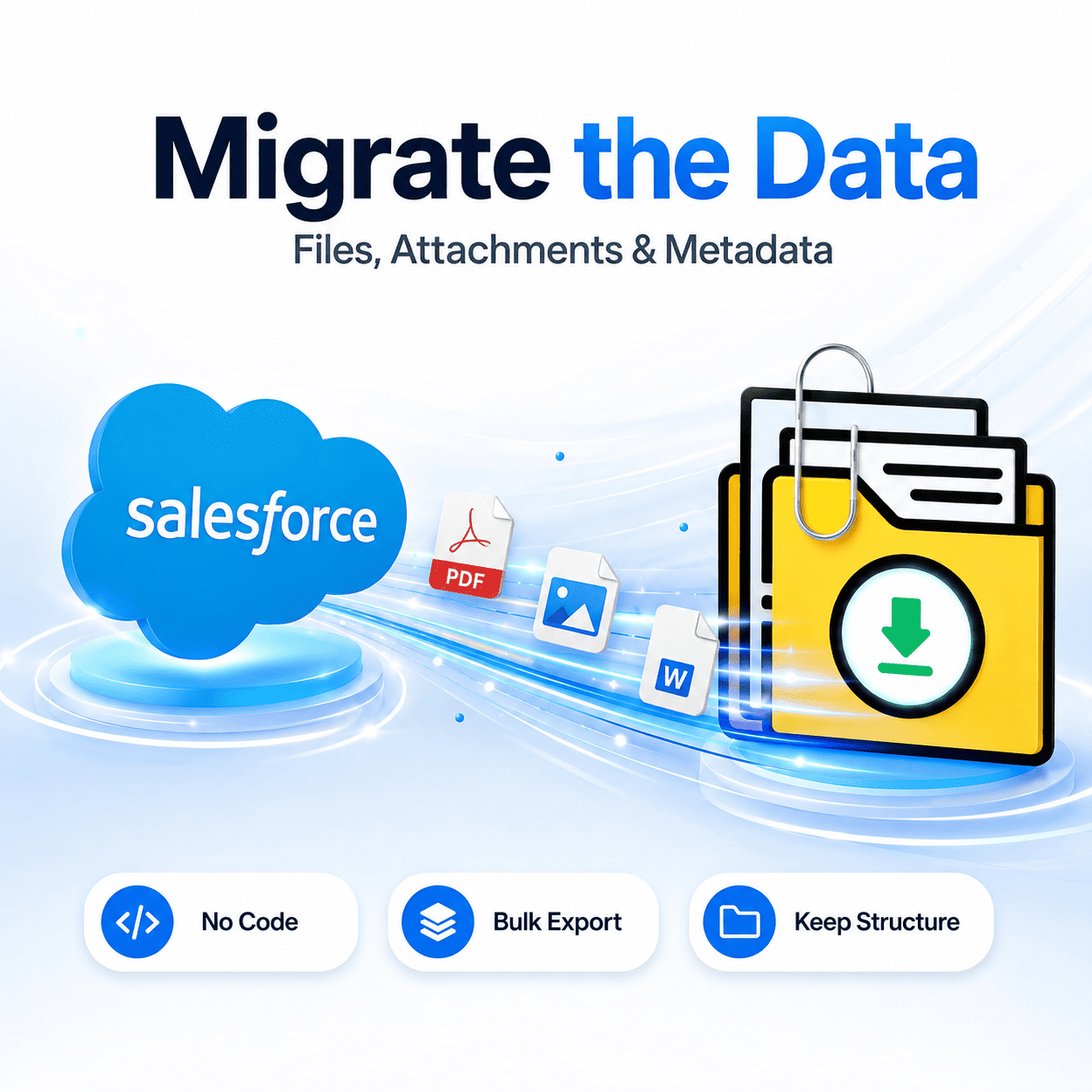


The Smartest way to migrate the data out of Salesforce Files, Attachments, and All
When teams begin planning to export data out of Salesforce, they begin with the records – Accounts, Contacts, Opportunities, Cases. The last are the files. And that is exactly where migrations fall apart. Orphaned attachments. Folder structures fall down. The metadata is gone. By the time the team realizes the problem, the migration is already underway and fixing it mid-flight is costly.
Thank you for reading this post, don't forget to subscribe!Files Downloader was created for this moment. It’s the fastest, most reliable way to migrate the data every file, attachment, and document — out of Salesforce without writing a single line of code.
Why File Exports Fail When You Migrate the Data in Salesforce
Data migration projects are more likely to fail on files than on records. ETL tools and Salesforce native export are well suited for structured data (rows, fields, relationships). Files aren’t. Here’s what teams always run into.
The “Zip File Scavenger Hunt”
Salesforce’s native export zips everything into a zip archive and generates system file names. This approach to migrating data results in the loss of original file names, folder hierarchy, and the record associations that make files useful. Rebuilding that context on the destination system is a project of its own.
Absence of Selective Filtering
A real migration rarely means moving all. You should migrate the data in phases – maybe active Accounts first, or only data added after a certain date, or attachments related to a specific record type. That level of granularity isn’t available in native Salesforce tools. You export everything, then manually sort it. That’s not a migration strategy — that’s a clean-up exercise.
ContentVersion Architectural Complexity
Salesforce stores files in the ContentVersion object and links them to records with ContentDocumentLink. To migrate the data properly, you must understand this model — which files belong to which records, which versions are current, and how ownership maps to the destination system. If you don’t have tooling that does this for you, migrations become a Salesforce-specific development exercise that most project teams simply don’t have the bandwidth to undertake.
Migration failed due to file storage limit
Many large orgs running parallel systems during a migration window often cause File Storage Limit Exceeded errors. New files coming in, old files not yet removed – the storage ceiling gets hit fast. We are stuck in migration without a bulk-export and file-clear mechanism.
Files Downloader: Built to Migrate Data Cleanly
Files Downloader is a native Salesforce app that gives migration teams the file export capability they need. No complex tooling, developer support, or post-export cleanup.
It runs in your current Salesforce org, honors your permission model, and produces files in a format that’s immediately usable in the destination system.
How Files Downloader Facilitates Data Migration Without Data Loss
Supports Standard and Custom List Views
Files Downloader directly connects to both standard and custom list views, across every object in your org. Whether you’re migrating Accounts, Cases, custom objects, or a combination, you can start bulk exports from the same list views your team already uses. No new interfaces. No report rebuild. No delays.
Export Mass Files from Any List View—in One Step
Choose the records in scope, initiate the export, and Files Downloader downloads all files and attachments associated with these records in one go. This one click bulk action is the fastest way to migrate the data out of Salesforce without using complex ETL tools or writing custom SOQL scripts from scratch.
Download Files In Their Original Format
Each file exports in its native format.
PDFs are still PDFs.
Images remain as .jpg or .png.
Office documents export as .docx, .xlsx, or .pptx — no conversion, no compression, no format loss.
When you migrate the data to the destination system, your files will appear exactly the way your users expect to see them.
Supports All Files
Files Downloader supports all file types allowed by Salesforce: PDF, images (.jpg, .png, .gif), Word docs, Excel spreadsheets, PowerPoints, CSVs and more. No file types are off-limits, and no workarounds are necessary for non-standard formats.
Migrate the Data With Precision: Filter, SOQL, and Metadata
Filter First — Export Only What You Need
You don’t want to migrate more than you need, wasting time. Files Downloader’s filtering engine lets you define exactly which records – and therefore which files – are in scope for a given migration phase. Filter by owner, object, record type, date range, field value, or a combination. You transfer the data in targeted batches, not in a single overwhelming dump.
This solves directly the Lack of Selective Filtering problem that makes migration projects take weeks longer than they should.
Custom SOQL Query Exports
Files Downloader offers a built-in SOQL query export interface for migration architects who need full control. Create your own query on any standard or custom object, execute it and export the related files instantly. Get the latest data instantly. No dev dependency. No scheduled jobs. No approximation. You can export it if you can define the scope in SOQL.
Preserve Metadata During Migration
Each export keeps the metadata that makes a migration trustworthy: owner name, object type, record id, record association and creation date. Bring your Salesforce data into SQL Server, Excel or the destination CRM and your files come with full context — ready to map and load, not ready to audit and fix.
Keep Original Folder Structure and File Names
Files Downloader keeps original file names and builds a logical folder structure based on records on export. A file associated with Opportunity: Acme Corp Enterprise Deal ends up in an Opportunities/Acme Corp – Enterprise Deal folder not a random folder name within some zip file.
This is the difference for any team trying to migrate the data into a new system between a clean cutover and a chaotic one. Your destination system inherits organized, traceable files – not a pile of uncontextualized assets.
How to Use Files Downloader to Migrate the Data
Salesforce Admins or Architects preparing for an org-to-org migration, a CRM consolidation or a sandbox refresh? Files Downloader is the tool you need for the file layer that standard migration tools ignore. A must-have file exporter for any Salesforce admin running a migration project.
Data & IT Teams Decommission legacy systems Files Downloader Export Salesforce files in bulk from standard and custom objects with zero structural loss and full metadata preservation.
System Integrators & Consultants who are managing client migrations to provide cleaner, faster file handoffs that dramatically reduce post-migration remediation time.
Operations Teams who need to migrate the data into downstream systems – SQL Server, data warehouses, Excel-based reporting pipelines – they get exports that import cleanly without transformation or manual cleanup.
[Book a Free Demo] | [View Pricing] | [Install on AppExchange]