


The Complete Guide to Salesforce ContentVersion Object Salesforce: How to Export, Manage and Protect Every File
Every Salesforce developer and admin who has worked directly with the ContentVersion object Salesforce knows exactly when it becomes a problem. Files are everywhere across Accounts, Cases, Opportunities, and dozens of custom objects. Records pile up silently across every object in your org. And when it comes time to export, back up, or migrate those files cleanly, the way Salesforce stores file data becomes the single biggest roadblock standing between your team and a complete, metadata-intact file export.
Thank you for reading this post, don't forget to subscribe!Files Downloader is made for these times. It provides admins, developers, and data teams complete bulk export control — with full metadata, original filenames, and folder structure intact.
What Is the ContentVersion Object and Why Does It Matter
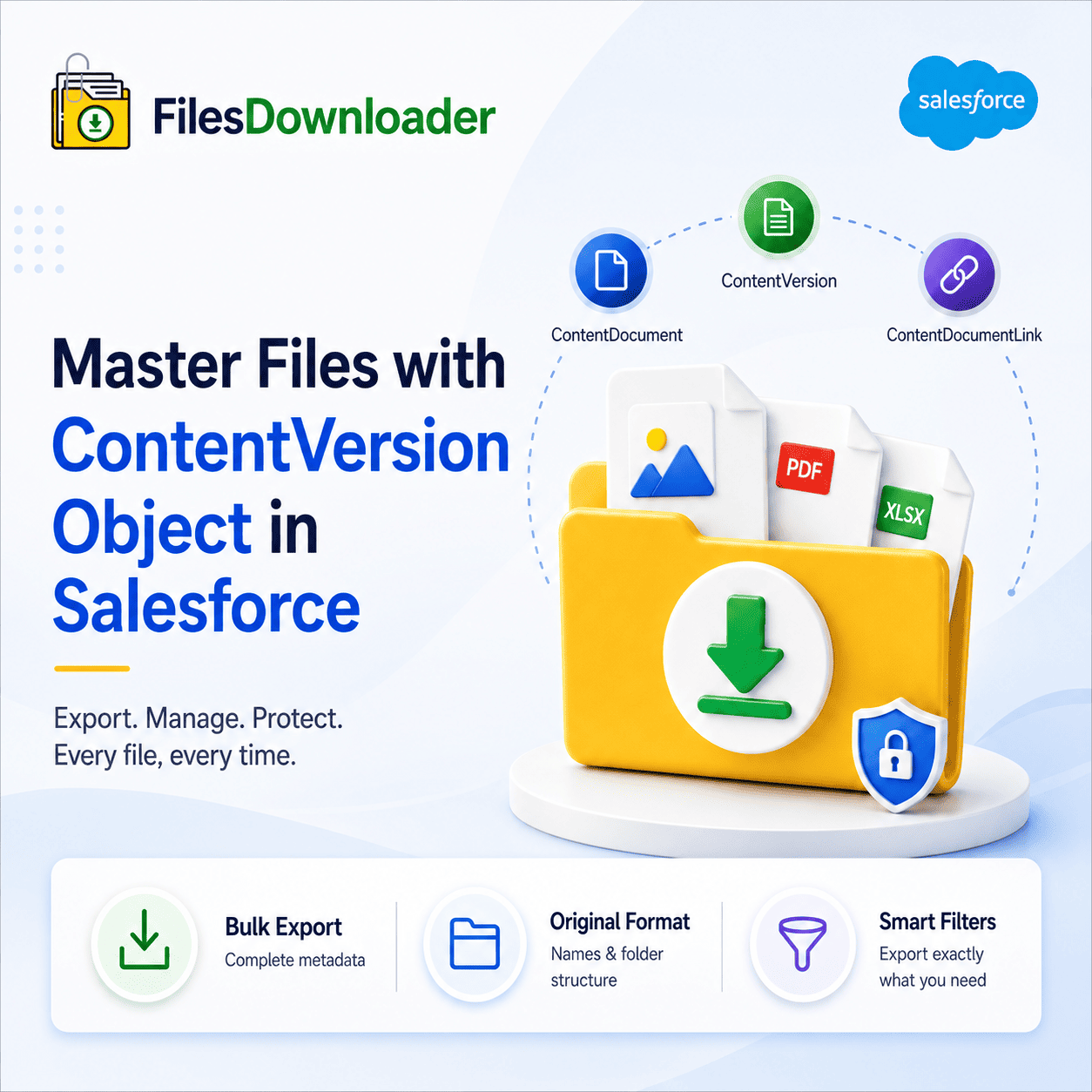
The ContentVersion object Salesforce is the core object that holds the actual file data for every document stored in your org. It is part of a three-object model that controls how Salesforce stores, versions, and relates every file to your CRM records.
ContentDocument is the parent record that identifies the unique file. ContentVersion sits beneath it — containing the binary content, the filename, the owner, the file type, the creation date, and all metadata about that particular version of the file. ContentDocumentLink is the junction object that relates the file to one or more records at the same time. An Account, an Opportunity, and a Case can all refer to the same file through different ContentDocumentLink records.
Salesforce creates a new ContentVersion record every time a file is updated. That is the power of Salesforce file management for live CRMs. It is also precisely why these records pile up faster than most teams anticipate — and why exporting them without the right tool destroys all context.
Why Exporting From Salesforce Creates Problems
Native tools struggle with the three-object relationship when you try to export files. ContentDocumentLink associations get lost. The metadata in each record — owner, creation date, file type, record ID — disappears from the exported bundle. What you end up with is a flat collection of files with no context and no indication of what record or object they came from.
The “Zip File Scavenger Hunt” Every Admin Knows
Native bulk export outputs a collection of numbered ZIP archives with scrambled filenames and no folder structure. Admins spend days rebuilding the record context that the platform had always maintained automatically.
The Lack of Selective Filtering Problem
Native tools do not give you any option to extract records selectively. You cannot say: “Only export the PDFs related to closed Opportunities in the Northeast region, created in the last 12 months.” It is all or nothing — and for large orgs with hundreds of custom objects, that approach is completely unworkable.
File Storage Limit Exceeded — The Direct Result of Uncontrolled Accumulation
The most common consequence of uncontrolled file accumulation in Salesforce is receiving File Storage Limit Exceeded errors. Every file update and every upload creates a new ContentVersion record. These records quietly consume your storage quota across every object in your org — Accounts, Cases, Opportunities, custom objects — with almost no warning.
How Files Downloader Solves the Challenge
Files Downloader is a Salesforce AppExchange application specifically designed to work directly with the ContentVersion object model. It natively reads ContentDocument, ContentVersion, and ContentDocumentLink — giving admins and data teams complete bulk export control across every standard and custom object where files have accumulated.
Works With Every Object in Your Org
Files Downloader works with both standard and custom list views exactly as they exist in your org today. Every object that has files associated with it is accessible through its existing list view. Open any list view on any object, set your filters, and perform a mass export in one step — without rebuilding your existing workflow.
This is the quickest way to move files for teams that need bulk export without complex third-party platforms, no matter how large or complex your org has become.
Download Every File in Its Exact Original Format
Files Downloader downloads every file in its exact original format, with its original filename, inside its original folder structure — rather than renaming or converting files during extraction as native Salesforce exports do.
PDFs are PDFs Images remain .jpg or .png Word files are still .docx Nothing is compressed into an unreadable archive or renamed with a system-generated ID
It supports all file types — PDFs, images (.jpg, .png), docs, spreadsheets, and more. Format consistency saves hours of post-export reformatting for teams importing data into SQL Server or Excel.
Keep All Metadata Intact During Export
When files pile up across multiple objects, metadata is everything. Files Downloader keeps all the metadata that Salesforce tracks:
Original file name — exactly as stored, never replaced with a system ID Owner and record association — who created the file and which record it belongs to Object type context — so your exported folder structure maps directly back to where each file lived in your org
This metadata-aware export makes Files Downloader the go-to tool for clean migrations, compliance audits, and system backups where object context directly affects data quality.
SOQL Query Export: Surgical Precision Over Your File Export
For admins and developers who need precise control over which records to extract, Files Downloader’s SOQL Query Export is the most powerful feature available. Write and run your own queries against ContentVersion and related objects — no extra developer resources, no Apex code, no waiting on a ticket.
Target Specific Objects and Fields in One Step
Get the most up-to-date data instantly by customizing and running your own SOQL query directly inside the app. Filter by:
Object type Record type Date of creation Owner Status Any field your org tracks
Extract only the records relevant to your criteria from the objects you want to target — in one step, without exporting everything first and sorting later. A targeted SOQL query lets you specify exactly which files you export — keeping every run scoped, intentional, and audit-ready.
Simplify Complex Multi-Object Exports
In most Salesforce orgs, files are spread across Accounts, Opportunities, Cases, and custom objects simultaneously. Files Downloader makes it easy to simplify complex exports by targeting specific objects and fields every time. An Opportunity-level export will not accidentally pull in unrelated Case attachments or files from other parts of your org.
Built for Every Role That Works With Salesforce Files
Files Downloader is not a generic file management tool with a Salesforce connector bolted on. It is a must-have file exporter for admins, developers, and data teams that work with files across standard and custom objects.
Salesforce Admins use it to offload files from specific objects before reaching File Storage Limit Exceeded thresholds Data Teams use it to generate clean exports from targeted objects for SQL Server, Excel, and BI platforms Migration Specialists use it to retain original file names and folder structures when migrating files during org-to-org or platform transitions Developers and Architects use it to validate ContentVersion and Attachment records across specific objects before and after major org changes
It works perfectly with Salesforce data export and file management workflows — saving time by eliminating the manual sorting that follows every unmanaged bulk export.
Every Scenario Where File Management Becomes a Challenge
Quarterly storage audit and offload before hitting the File Storage Limit Exceeded threshold Full custom object file export with all metadata preserved Compliance-driven export of specific files from targeted objects in your org Pre-merger org consolidation across dozens of standard and custom objects where files have accumulated simultaneously
Files Downloader provides a clean, repeatable, metadata-intact export foundation for any scenario — regardless of how large or complex your org has grown.
Export files with complete metadata retained. Maintain original folder structures that map back to where each file lived in your org. Re-import cleanly into your destination org, Google Drive, SharePoint, SQL Server, or any staging environment. What used to take days of manual work now takes minutes.
Call to Action
Stop losing hours to ZIP scavenger hunts and manual metadata reconstruction. Files Downloader gives you bulk, metadata-intact, audit-ready exports — in minutes, not days. Install from the AppExchange today, connect to your list views, and run your first export in under five minutes. No developer required.