
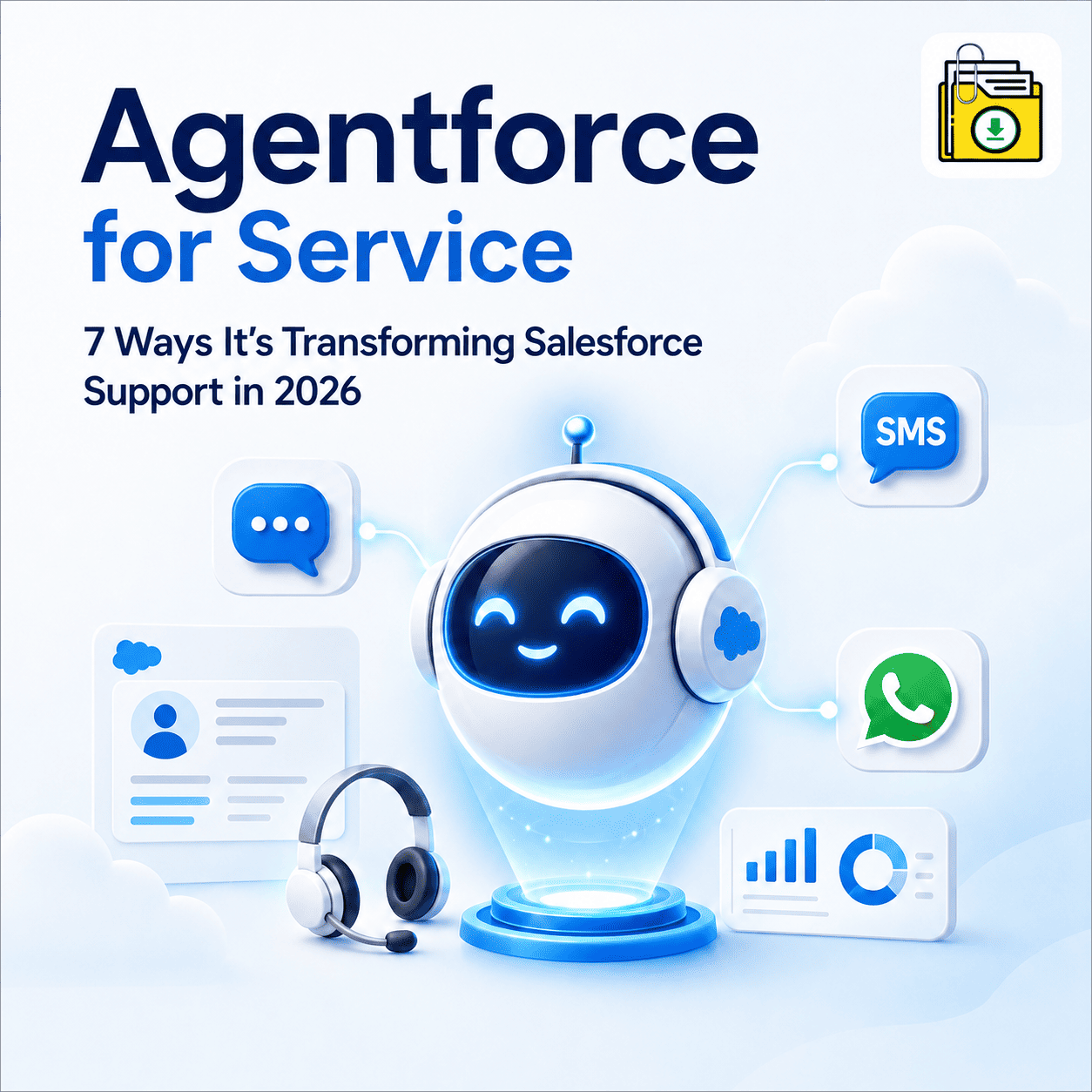


Agentforce for Service: 7 Ways It’s Transforming Salesforce Support in 2026
Customer service teams have spent a decade fighting the same battle: chatbots that break the moment a customer asks something unexpected. Agentforce for Service is Salesforce’s answer to that problem, and it’s built on a fundamentally different premise. Instead of scripting every possible conversation path, it uses generative AI to reason through requests, pull from trusted business data, and respond the way a well-trained human agent would.
Thank you for reading this post, don't forget to subscribe!Here’s what it actually does, how it compares to the Einstein Bots most Salesforce teams already know, and where messaging channels like SMS and WhatsApp fit into the picture.
What Is Agentforce for Service?
Agentforce for Service is Salesforce’s autonomous AI agent for customer support. It operates around the clock across self-service portals and messaging channels, handling tasks, making decisions, and replying in natural language that matches a brand’s voice—without a human writing dialog trees behind the scenes.
The agent is grounded in a company’s own knowledge articles, historical case data, and CRM records, so its answers stay tied to what’s actually true for that business rather than generic AI guesses. Every response also routes through the Einstein Trust Layer, which is Salesforce’s layer for keeping customer data secure during LLM calls.
7 Ways Agentforce Supports Service Changes
- Always-on coverage. Agents answer questions, deflect cases, and resolve issues at any hour, on any channel, with no shift schedule to manage.
- Context-aware replies. Because generative AI understands conversational context, the agent can follow up on earlier messages instead of treating every reply as a fresh, isolated question.
- Smarter clarification. Agents ask business-specific follow-up questions to gather missing details before offering a resolution, rather than guessing.
- Clean human handoff. When a case gets too complex, the agent escalates to a live rep with full conversation context attached—no repeating yourself.
- Faster deployment. Prebuilt templates and existing workflows mean teams can stand up an agent without writing dialogs, defining intents, or training a language model from scratch.
- Grounded accuracy. Responses are tied to knowledge articles, similar cases, and CRM data, which cuts down on the hallucinated answers that plague generic AI chat tools.
- Built-in trust and security. All model calls pass through the Einstein Trust Layer, giving support leaders a documented layer of data protection.
Agentforce for Service vs. Einstein Bots
Salesforce still offers Einstein Bots, and for good reason — some teams need the predictability of scripted flows. Here’s how the two compare:
| Capability | Agentforce for Service | Einstein Bots |
|---|---|---|
| Setup speed | ✔ Prebuilt subagents and actions, minimal manual config | ✗ Manual dialog and intent training required |
| Understands full conversation context | ✔ Yes | ✗ Responds only to the most recent message |
| Handles unplanned questions | ✔ Yes, via generative AI reasoning | ✗ Limited to trained intents |
| Maintenance load | ✔ Update instructions and actions as needed | ✗ Ongoing dialog and intent retraining |
| Best fit for regulated, deterministic flows | ✗ Less rigid by design | ✔ Better for strict, explainable processes |
If your business needs airtight, auditable conversation flows for compliance reasons, Einstein Bots still has a place. For most general support volume, Agentforce for Service’s flexibility wins.
Where Agentforce for Service Meets SMS and WhatsApp
Agentforce doesn’t live only in a web widget. At general availability, it supports all enhanced messaging channels, including SMS and WhatsApp, alongside web chat—so the same autonomous agent that resolves a case in your help center can carry that conversation into a customer’s text messages.
That matters because WhatsApp has become the preferred way many consumers reach businesses, with global adoption figures showing it now surpasses SMS usage in some regions. Customers increasingly expect service conversations to follow them onto the channel they already use daily, not force them into a separate portal.
The catch is architecture. Middleware-based messaging tools introduce sync delays between the moment your AI agent decides to act and the moment the message actually sends. A 100% native Salesforce SMS and WhatsApp platform like MessageBlink closes that gap—messages fire the instant Agentforce makes a decision, and every inbound and outbound message stays inside Salesforce, feeding the same data your agent reasons from. For teams building Agentforce workflows that need to text or WhatsApp a customer automatically—appointment reminders, case updates, follow-ups after a resolution—that native connection is what keeps the automation actually instant instead of “eventually.”
What Does Agentforce for Service Cost?
Pricing has shifted over the past year, and it’s worth understanding before you scope a project. Every Salesforce customer on Enterprise Edition or higher can access Agentforce at no additional cost through Salesforce Foundations, and the free tier includes Agent Builder, Prompt Builder, 200,000 Flex Credits, 250,000 Data Cloud credits, and the first 1,000 conversations with Agentforce for Service—a reasonable way to test before committing further. o-mega
Beyond that free allotment, Salesforce’s Flex Credits model charges per agent action rather than per conversation, with credits sold in bulk at roughly $500 for 100,000 credits, working out to about ten cents per standard action. Alternatively, a fixed $2-per-conversation model applies specifically to customer-facing agents under that buying structure, though Flex Credits and Conversations pricing can’t be used in the same Salesforce org at the same time.
One thing to plan around: Agentforce is an add-on that requires the relevant Salesforce platform already in place—Service Cloud or a digital experience portal for customer-facing use and standard Salesforce licenses for internal use. It isn’t a standalone purchase.
Getting Started with Agentforce for Service
Setup is more accessible than it sounds. From Setup, search for “New Agent” in the Quick Find box, choose the Service Agent type, and Salesforce walks you through connecting it to your knowledge base, case data, and chosen channels. Most teams get a basic agent live using out-of-the-box templates before customizing instructions and actions as case volume or complexity grows.
Ready to connect Agentforce for service to SMS and WhatsApp without the middleware lag? FilesDownloader is a 100% Salesforce-native messaging platform built to keep your AI agent’s conversations fast, compliant, and fully inside your CRM. [See how it works on AppExchange.]