


How to Bulk Delete Duplicates Automatically for Clean Salesforce Data
Managing big volumes of Salesforce data can be a tough slog with bloat, duplicate files, and storage caps. Storing automated bulk data deduplication for clean records costs you more in storage, impacts system performance, and creates cluttered audit trails. Salesforce admins want a simple way to pull, organize, and automate bulk data deduplication for clean records, without slow manual downloads or risky mass deletions to take back control.
Thank you for reading this post, don't forget to subscribe!This guide will walk you through how to bypass traditional Salesforce data export restrictions, track file lineage, and streamline your overall data hygiene process.
The Dirty Little Secret About Duplicate Files and Attachments
Automate bulk data deduplication for clean records, old contract PDFs, and image files over time. Allowing these duplicate files to grow will cause a File Storage Limit Exceeded warning in your org and push you into costly tier upgrades.
Deleting duplicates before export is virtually impossible with native tools. Admins are stuck with “Zip File Scavenger Hunt,” downloading gigabytes of haphazard files to scrub duplicates locally.
Avoid unnecessary storage costs and maintain database integrity by automating bulk data deduplication for clean records prior to running data migrations, system audits, or routine backups.
Why Manual De-duplication Fails to Scale
Zero Selective Filtering: Native exports throw everything into bulk zip files, duplicate or not.
Lost Record Lineage: Manual downloads of Lost Record Lineage often lose important context, making it difficult to find parent records.
Long Clean-Up: Manually sorting thousands of .jpgs, .pdfs, and .docxs consumes dozens of operational hours monthly.
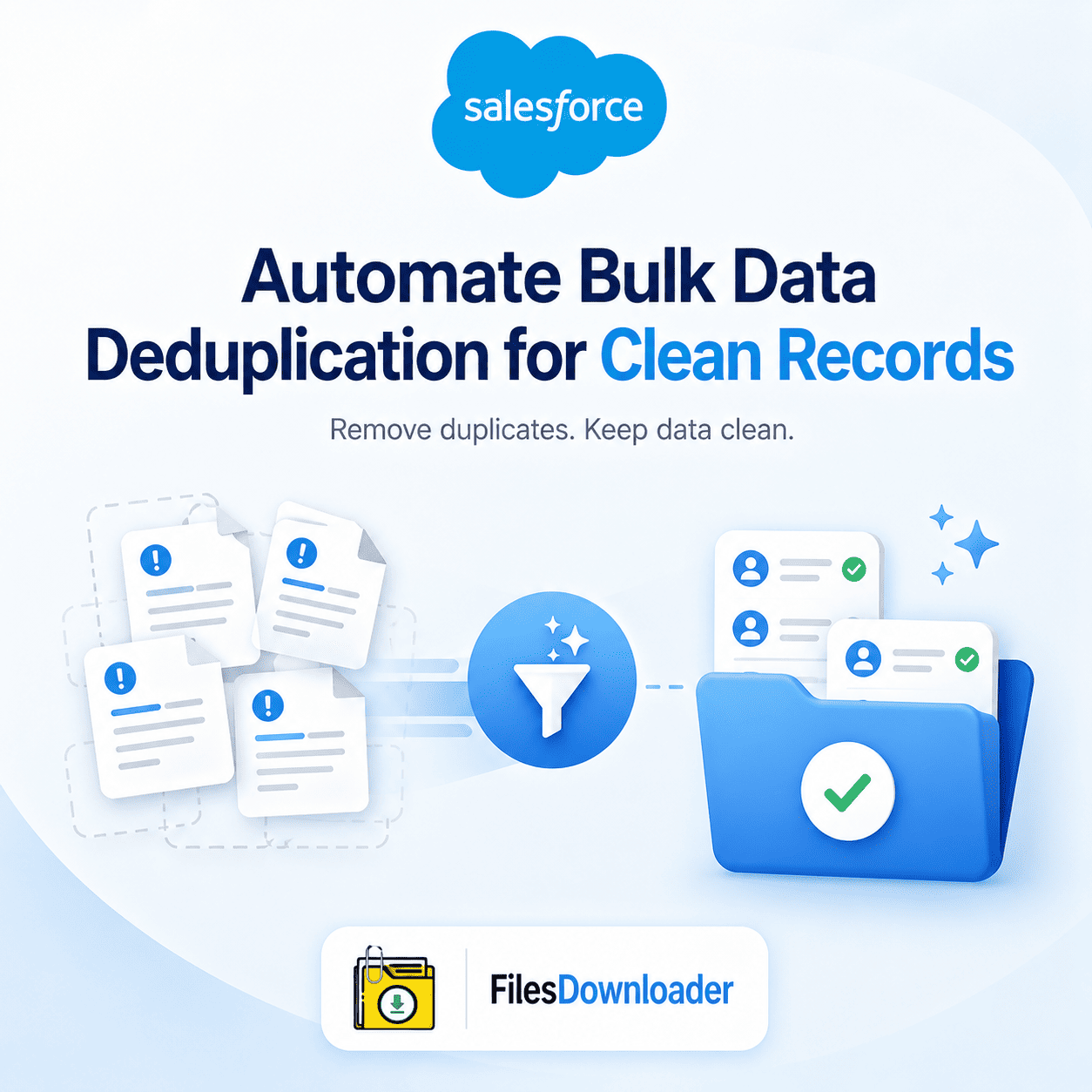
Automate Bulk Data Deduplication for Clean Records. No more manual data sorting. Only the new, unique data sets your business needs.
Bulk Data Duplicate Removal: Clean Records Automatically in 3 Steps
You can easily access clean record sets without writing custom Apex code or building complex ETL pipelines. Smart targeted exports, coupled with a dedicated file exporter, make it easy for Salesforce teams to clean up files.
Step 1: Locating Items Using Standard and Custom List Views
Automate Bulk Data Deduplication for Clean Records Find out where you have duplicate files piling up. Filter and retrieve only those files that meet your criteria, in one step, with accounts, opportunities, or custom objects.
Automate Bulk Data Deduplication for Clean Records Our solution supports both standard and custom list views, so you can find duplicate-prone records right in your familiar Salesforce environment. You do not download all the bytes. Instead, you narrow down your target dataset before you start exporting anything.
Step 2: Mass Files & Attachments Download from a Particular Query
In large enterprise environments, list views may not be able to handle complex logical conditions. That’s where a direct SOQL query export comes in handy to help you find exact versions of files and filter out duplicate entries programmatically.
You can query the ContentVersion object directly to find duplicate document checksums, to find the latest versions of files, and to skip old attachments. Build your own SOQL query. Write your own SOQL query to get the latest data for the given file IDs on the fly.
This leaner workflow lets you easily automate bulk data deduplication for clean records, keeping your export payloads light and accurate.
Step 3: Export Clean Data without Changing Metadata
Export your unique records en masse at the click of a button. Powerful file exporter: Download files & attachments from Salesforce in the same file format as uploaded—PDF, image (.jpg, .png), doc, or custom file extension.
Crucially, our solution preserves metadata such as owner, object type, and record association. This preserves the original file names and folder structure when you export so your target destination (AWS S3, SQL Server, or local servers) will be just like your Salesforce structure.
Why Salesforce Admins Should Use File Exporter Tool
As a Salesforce admin or data manager, you should be spending your time building workflows, not wrestling with data extracts. File downloader is the simplest way to export your Salesforce files. No complex tools or scripts are required.
| Native Data Export Tool | [files downloader] |
| Messy, large ZIP files | Clean, organized folder structures |
| No selective duplicate filtering | Filter & extract by list view/SOQL |
| Breaks parent record association | Keeps owner, object & file names |
| Slow, weekly exports | Instant, one-click bulk action |
1. All Object Bulk Action Clicks
Export Salesforce files from standard and custom objects right from your browser. Time to do an offsite compliance audit or to move legacy objects. Can move tons of files in seconds.
2. Seamless Migration & DB Sync
And when you do an automate bulk data deduplication for clean records. Ensure that target business intelligence tools consume unique and clean records. Save time by not having to sort data manually.
3. Native Integration with Salesforce AppExchange
Because our tool is built natively to the platform, your sensitive enterprise data never leaves the secure Salesforce trust boundary.
Build a focused solution to automate deduplication of bulk data for clean records. This will shield your organization from storage overages and provide data teams instant access to files.
Key Use Cases: Migrations, Auditing & Backup Hygiene
There are few enterprise use cases where a proactive file management approach is required:
System Migrations: Avoid bringing legacy duplicates into your new CRM architecture.
Compliance Audits: Unique documentation for financial/legal review, date stamped.
System Backups: Only current unique file attachments are kept in off-site backups in a lightweight manner.
By automating bulk data deduplication for clean records, teams could save up to 40% on backup file size, time, and cloud storage costs.
[Book a Free Demo] | [View Pricing] | [Install on AppExchange]