
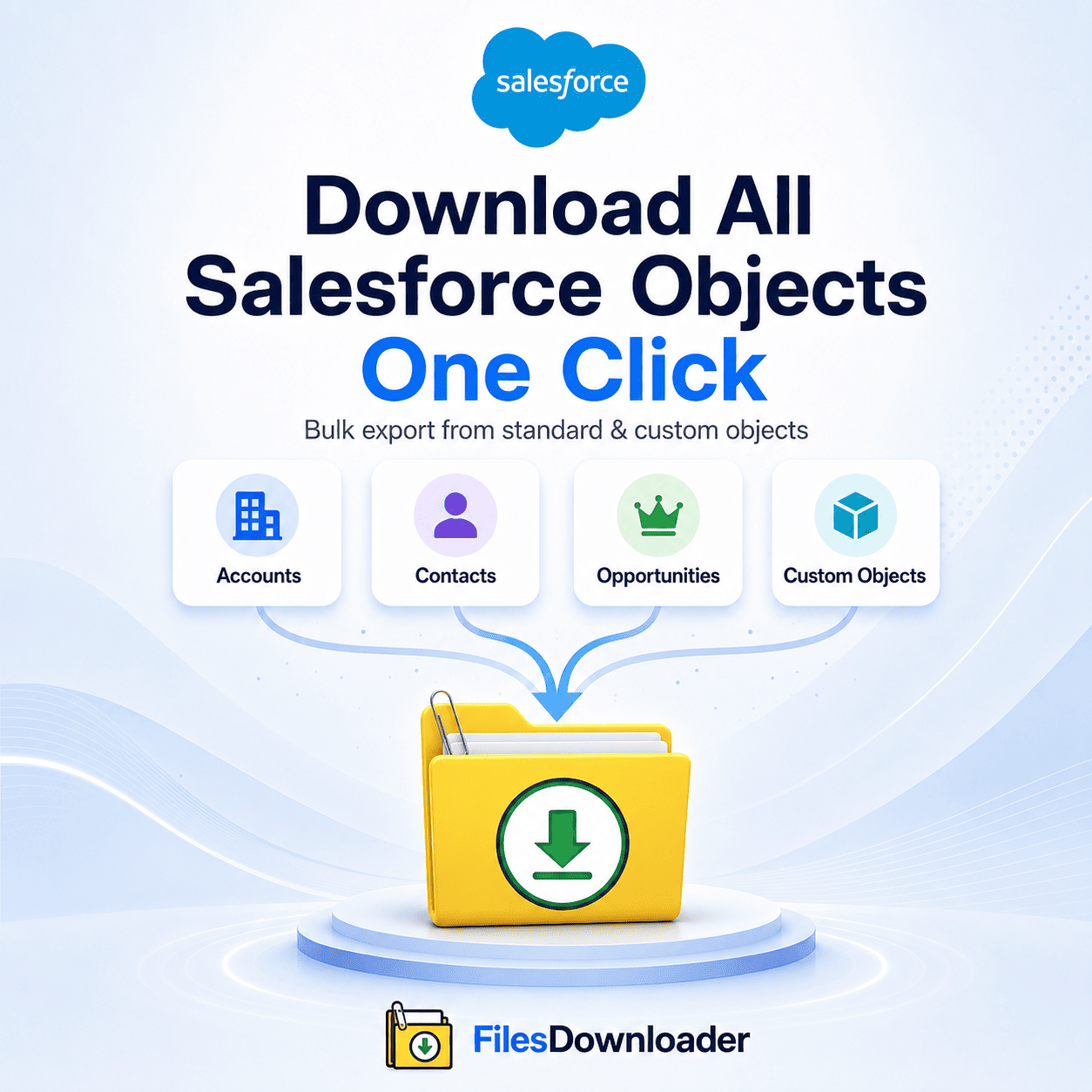


Download All Salesforce Objects with One Click
If you want to download all Salesforce objects in one click, you need a way to pull files and attachments—and metadata (owner, object type, record association, and creation date)—across every standard and custom object in your org, without native export limits that force you into a manual sorting marathon. It’s worth clarifying the scope from the beginning: this covers files, attachments, and their associated file metadata but not the underlying object schema or configuration in Salesforce (Apex, flows, field definitions), which is retrieved using other tools like the Metadata API.
Thank you for reading this post, don't forget to subscribe!Native Salesforce File Exports: The Cost Question
Native export tools such as Weekly Data Export are fine for simple backup needs, but they do not satisfy the requirements of modern compliance, audits, and migrations:
The “treasure hunt zip file.” Native exports create generic, numbered zip archives and lose record relationships. You are left sifting through unstructured folders trying to match random alphanumeric IDs to Accounts, Opportunities, or custom objects.
No selective filtering. Need to find attachments for one audit year? Native tools require an all-or-nothing download—no object, date range, or owner filtering—wasting hours downloading files you don’t need.
Why Download All Salesforce Objects in One Click
Accuracy is important in modern data management. Forget the complex tools — export files directly from standard and custom objects with a dedicated file exporter:
[Standard & Custom Objects] → [Filter & Target Criteria] → [1-Click Bulk Export] → [Structured Local Storage]
A modern export utility retains important file context on extraction:
Original filenames — no random hash prefixes.
Folder structures mirror your local Salesforce object and record structure.
Record association — maintains relationships, parent IDs, and owner assignments.
Download All Salesforce Objects in One Click: Step-by-Step Instructions
Extracting mass files from standard and custom list views takes less than two minutes:
- Select your target view or object. Choose a Salesforce standard or custom list view to export from—Accounts, Contacts, or custom objects.
- Use custom filters. Filter and extract only the files that match your criteria, all in one go, so you only pull what you need for your audit or migration.
- Execute the export. One click to download all Salesforce objects — no manual batching or mapping required. You can also run a direct SOQL query export for custom query builds, querying ContentVersion objects directly for the latest data on the fly.
Native Export vs. Dedicated Files Downloader
| Capability | Salesforce Native Export | files downloader |
|---|---|---|
| File Organization | Disorganized multi-part zip files | Maintains file names and folder structures |
| Filtering | No filtering | SOQL filters and targeted list views |
| Metadata | Deleted from files | Owner, object type, and record link retained |
| Manual Overhead | High | One-click download of all objects |
Great for System Backups, Clean Migrations, and Audits
Structural integrity means you don’t have to re-map or manually clean up data after import, whether you’re moving to a new CRM or archiving legacy files to SQL Server or Excel after export.
Comprehensive File Format Support
No proprietary limitations—files downloader supports all file types: PDFs, images (.jpg, .png), docs, spreadsheets, and CAD files—all exported in their exact original format.
Overcoming Storage and Query Constraints
If you exceed a file storage limit threshold, Salesforce charges premium rates for extra storage. Extracting files off-platform reduces storage use while maintaining compliant, long-term archives. For large-volume extracts, SOQL query export strategies that target ContentVersion records directly help you avoid UI timeouts.
The ability to download all Salesforce objects with a single click does not add a new compliance risk to your audit or migration process, because the export runs natively within Salesforce and respects your existing permission sets and sharing rules.