


Salesforce Parent Child File Export: Master The Ultimate Guide for Data Teams and Admins
If your team is receiving a File Storage Limit Exceeded warning, you know the ensuing panic. Native data options turn admins into “Zip File Scavengers” searching thousands of unstructured documents scattered across random folders. In case you need a targeted Salesforce parent child file export, the native tools will leave you hanging with disconnected record IDs and missing file context.
Thank you for reading this post, don't forget to subscribe!If you can’t keep relational hierarchies, pulling files attached to Accounts, Opportunities or custom child objects is a painful manual chore. You want a solution that will spit out the real files but maintain the complete object lineage.
The Downfalls of Native Salesforce File Management
Salesforce: CRM data extraction only, no bulk document extraction. The big pain with standard tools is complex data downloads:
No Selective Filtering: Export all or export none, with higher storage costs and wasted bandwidth.
Broken Record Associations: When you export normally, all the metadata associated with Broken Record Associations is removed, making it almost impossible to map files back to the original objects.
Rigid architecture: The native exports do not allow detailed Salesforce Parent Child File Export.
If you are looking to efficiently Salesforce Parent Child File Export the out of box ways will cost you hours of manually sorting data after the export.
Parent-Child File Relationships: A Horror Story
The ContentVersion and object junction architecture will support any file attached to a record. Native tools don’t keep track of the parent record names when you pull child files from them (invoices under Opportunities, contracts under Accounts, etc.)
Instead, you get obscure alphanumeric strings. That folder structure done manually can take days for audits or migrations .
How to Simplify Your Parent Child File Export Process in Salesforce
You need a relational export tool that does not require mapping. Whether you are exporting a SOQL Query or picking items from standard list views, your export tool has to automatically handle the underlying relational logic.
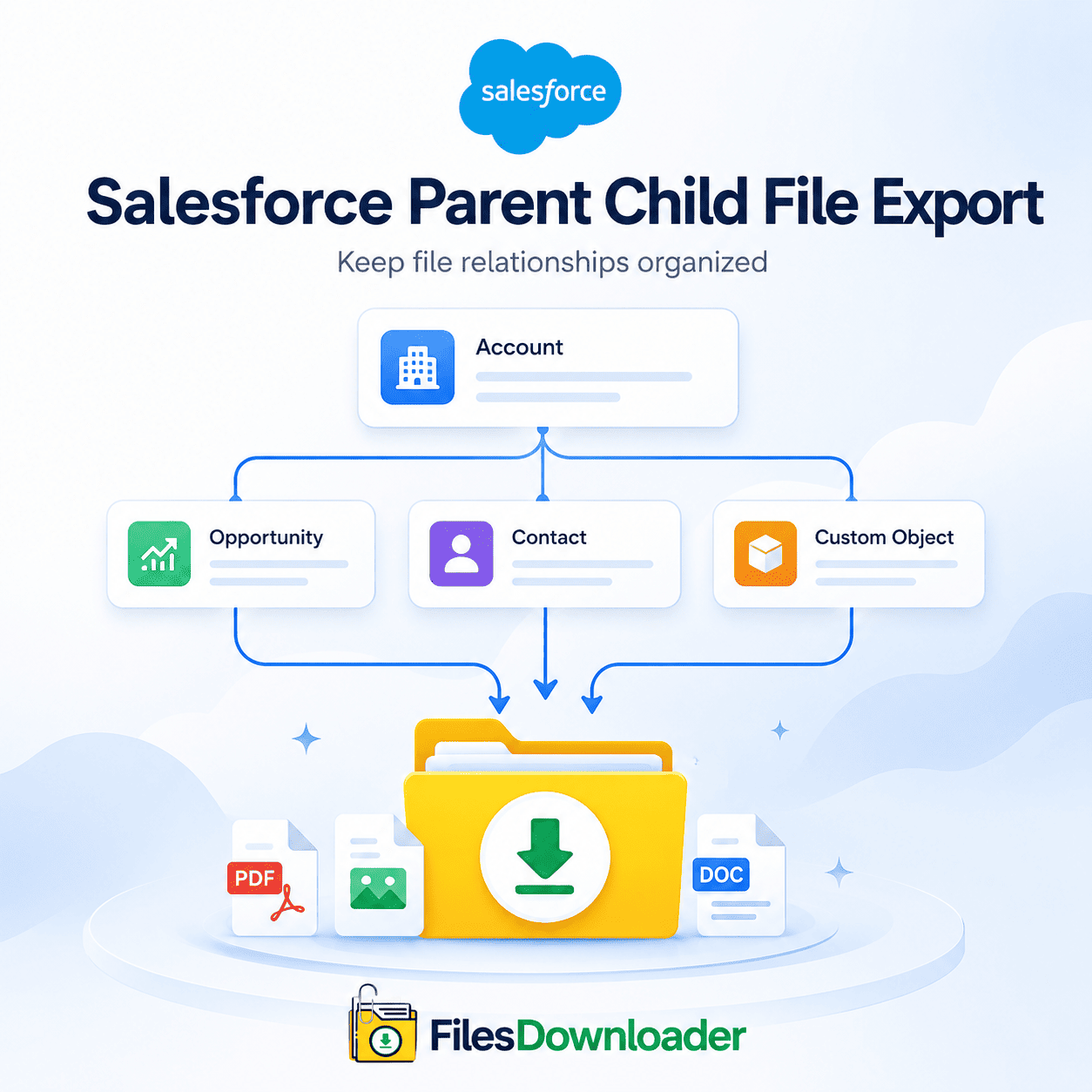
Account (Parent) – Opportunity (Child)
ContentDocument / ContentVersion Files
Direct Salesforce parent child file export enables admins to retain all relational context without custom scripts or complicated ETL configurations.
Salesforce Parent Child File Export Made Easy – Custom Criteria Based
Why download all the files in your organization if you only need a few? With targeted extraction you filter and extract only those files that match your criteria in one step.
By filtering at the parent or child level, your downstream databases like SQL Server or Excel get clean, structured data with zero bloat.
Files Downloader: Quick and Accurate File Extraction
Files Downloader is the must have file exporter for Salesforce admins and data teams who want speed, accuracy and zero data loss. The fastest way to export files from Salesforce without complex tools or code.
Essential Skills
Export Mass Files & Attachments from Any List View – Supports Standard and Custom List Views for Easy Bulk Action.
Object-Wide Bulk Extraction: Export Salesforce objects in bulk from standard and custom objects in few clicks.
SOQL Export Query: For the most recent data, run your own SOQL Query Export to target specific record relationships. Customize and run your own SOQL Query Export.
Structure & Metadata Preservation: Export with metadata (e.g. owner, object type, record association) and keep original file names and folder structures.
Universal format support: Get files and attachments from Salesforce in the format you like. Supports all file types: PDF, images (.jpg,.png), docs etc.
Downstream compatibility: Salesforce data can be exported to structured output files, and then imported into SQL Server or Excel.
Bulk File Export – Primary Use Cases
1. Clean system migrations and backups
Considering moving away from Salesforce to another platform? Or are you just backing up your important files? Files Downloader is great for clean migrations, audits and system backups. It strongly ties each document back to its original owner and to its parent object.
2. Fix “File Storage Limit Exceeded” error
No need to pay for costly add-on file storage modules. Store historic documents in secure local or cloud storage. Retain all historical mapping.
3. Streamlining Compliance and Auditing
Auditors don’t want a raw dump. They want to review some records for some periods of time. Select individual objects & fields for accurate on-demand documentation. Simplify downloading complex data.
How to Export Parent Child Files in Salesforce Step by Step
Files Downloader: Complete Salesforce parent child file export in 4 easy steps:
Choose Your Object or View: Choose a parent object from a standard list view, custom list view, or custom query.
Set Your Filters: Find specific documents by searching object fields, file creation dates, or file extensions.
Export Structure: Parent-child folder structure is supported and files will automatically be placed under the correct record folders.
Click Export. Here’s your zip file ready to download, fully organized and named.
You no longer have to sort data manually, saving you time and preventing you from corrupt file associations again.
[Book a Free Demo] | [View Pricing] | [Install on AppExchange]