


The Quickest & Most Automated Method to Download Custom Object Attachments in Salesforce
Salesforce is a peerless CRM engine, but every Download Custom Object Attachments Salesforce Administrator eventually hits the wall: Native file management is painfully restrictive.
Thank you for reading this post, don't forget to subscribe!If you’ve ever had to manually extract hundreds of documents from custom objects, you know the frustration of the “Zip File Scavenger Hunt.” Salesforce’s native data export utilities chunk your downloads into random 512MB zip files, stripping context, scrambling metadata, and costing your team hours of manual sorting.
Whether you’re preparing for a clean data migration, performing a compliance audit or facing a strict File Storage Limit Exceeded warning, you’ll need a streamlined way to extract your data. This guide explains everything you need to know about download custom object attachments Salesforce teams rely on — no complex API scripts, no manual headaches.
Why is it hard to download custom object attachments in Salesforce native?
Native Download Custom Object Attachments Salesforce storage is based on complex backend architecture. You can use standard and custom objects to link with files using junction objects such as ContentDocumentLink and ContentVersion. If you do a native data export or a simple Data Loader operation, Salesforce pulls the raw binaries without the relational context.
Native Salesforce File Exports: The Core Pain Points
No selective filtering: Native tools will make you export all the files in your organization, or nothing at all. Download Custom Object Attachments Salesforce or stage cannot be separated out individually.
Lost metadata & associations: Native exports rename files to obscure ID strings, losing record association, object type and owner information.
Storage warnings and throttling: After you get a notification that you have exceeded your file storage limit, your storage costs will skyrocket. However, manually downloading files to free space is time consuming.
Incompatible Data Pipeline Exports: Salesforce files natively exported and imported into external systems such as SQL Server or Excel are unstructured and require extensive data cleaning and re-mapping.
How To Download Custom Object Attachments In Bulk Salesforce
Smart data teams prefer direct, list-view driven file exporters rather than battling with multipart zip files and missing metadata. This is how you can simplify your workflow in one fell swoop:
[Filter List View / SOQL Query] ---> [Choose Files] ---> [One-Click Export with MetaData]
1. Filter and Extract Files in One Step
Why spend days sifting through unstructured data downloads? From your current workflow you can filter and pull out only the files that match your exact criteria. By targeting specific objects and fields in this way you instantly skip the irrelevant records and get just the assets you actually need.
2. Export Bulk Files Straight from Standard & Custom List View
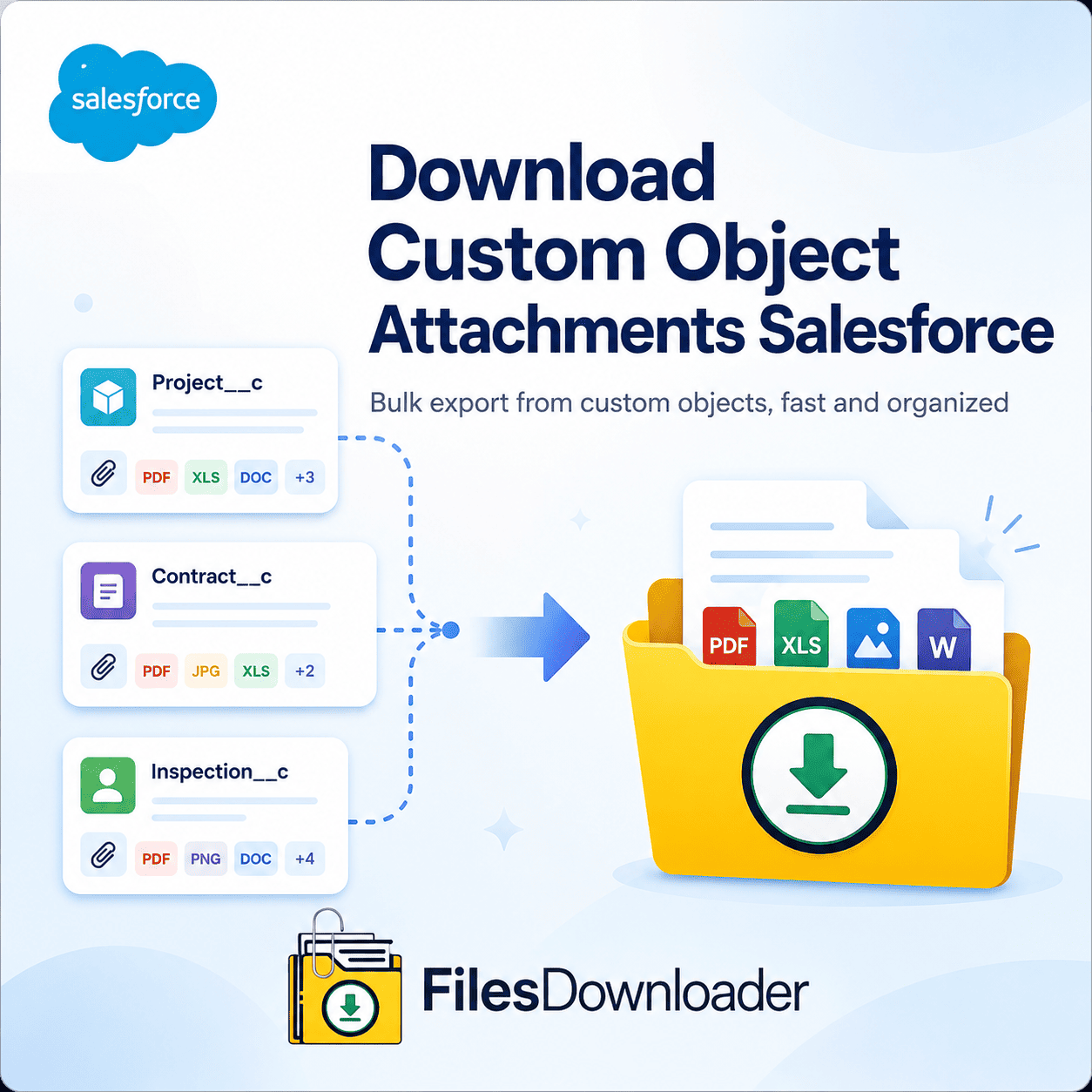
Whether your files are stored in standard Accounts and Opportunities or in proprietary Download Custom Object Attachments Salesforce you can perform bulk downloads with ease.
Our exporter supports standard views as well as custom list views. Just go to your object view of choice, select your target records and hit export.
Main benefit: A must-have file exporter for Salesforce admins and data teams looking to save hundreds of hours of manual work each quarter.
Advanced File Extraction: SOQL Query Export
For complex enterprise requirements, list views may not provide enough granular control. That’s where direct query targeting comes in.
Get Instant Access to the Latest Data Custom SOQL
When you have to Download Custom Object Attachments Salesforce If you want to export Salesforce records based on dynamic criteria (created dates, specific record types or child relationships), running a SOQL Query Export is the fastest path forward.
Maintaining File Integrity, Folder Hierarchies, and Metadata
The biggest problem with pulling files out of an enterprise isn’t getting the file off the cloud, it’s keeping the context.
Preserve Metadata and Original File Names
If you Download Custom Object Attachments Salesforce. Losing the record owner or file title creates a compliance nightmare. Salesforce records rely on With modern extraction tools, metadata such as owner, object type, and record association is automatically maintained with each item.
And the files retain their original file names and extension formats (.pdf, .jpg, .png, .docx, etc.) instead of scrambled system IDs.
Downstream Systems Folder Structure Preservation
After exporting, exporting files in structured, predictable folder hierarchies makes importing Salesforce data into SQL Server or Excel much easier.
Clean Migrations: Move assets directly into AWS S3, Azure Blob or local network drives without re-keying relationships.
System Backups: Keep a copy of your online Salesforce schema offline for compliance archives.
Smooth Audits: Deliver well-organized folders directly to internal or external auditing teams.
Key Features At a Glance
| Feature | Export Native Data | File Exporter Enterprise |
| Custom Object Support | Bulk All-or-Nothing | Selective by Object & Field |
| Metadata Preservation | Stripped / Scrambled IDs | Saved ( Owner, Object, Record) |
| File Formats | Multi-part Zip Files | Original File Names & Extensions |
| Filter Options | None | List Views & SOQL Query Export |
| Setup Required | High Complex Python/Data Loader | No mapping required / One-click |
[Book a Free Demo] | [View Pricing] | [Install on AppExchange]