
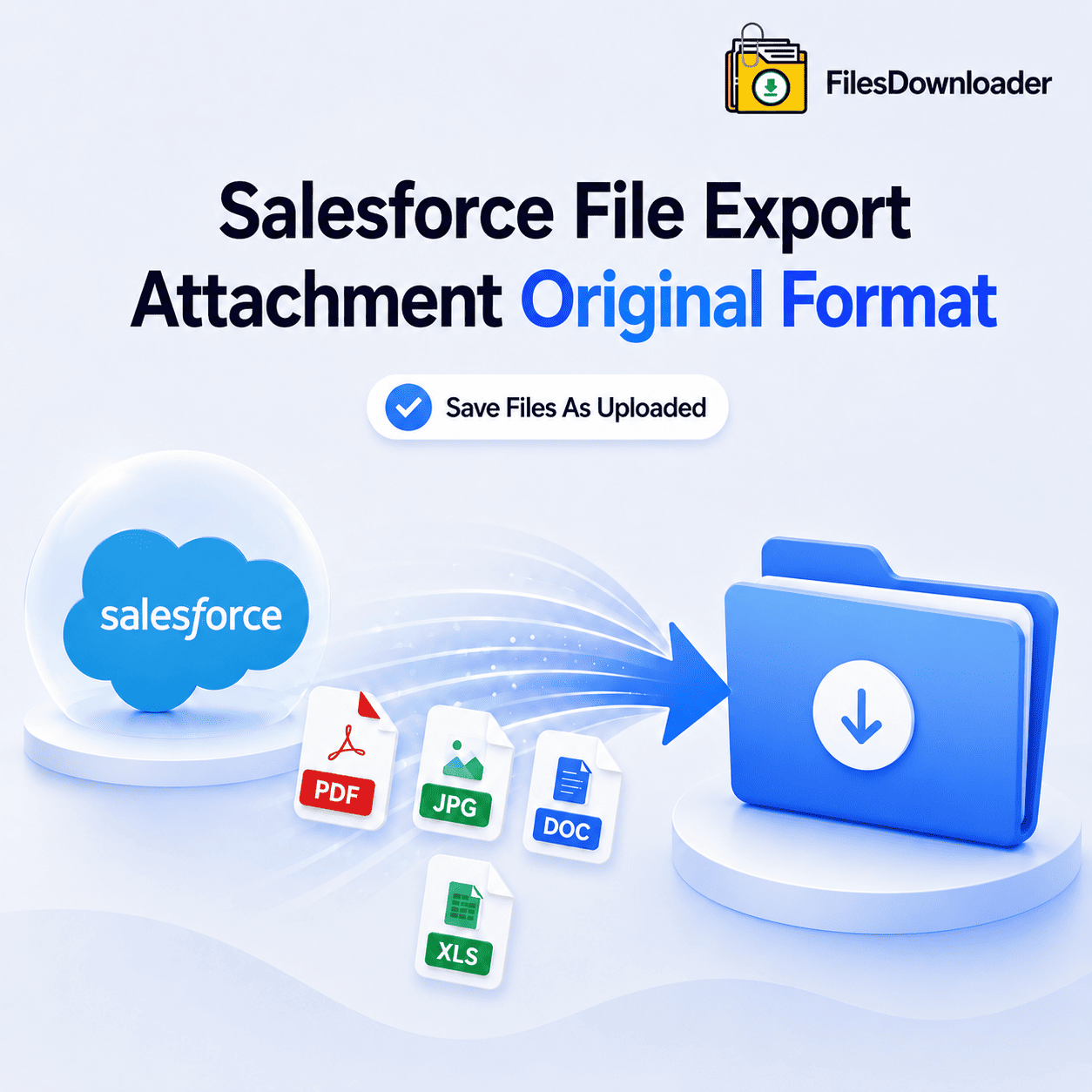


Salesforce File Export Attachment Original Format: Save Files As Uploaded
All Salesforce admins know the drill. You need one report, one contract, one image — but you’re clicking into record after record and downloading files one by one. This is the “Zip File Scavenger Hunt” and why there is a dedicated Salesforce File Export Attachment Original Format tool.
Thank you for reading this post, don't forget to subscribe!Native Salesforce was just not built to pull files down in bulk. There’s no “download all from this list view” button. There’s no native way to filter by object, date, or record type before exporting. So teams either custom code, hire a developer, or spend hours manually doing it. All of that is no longer necessary.
Why Native Salesforce Cannot Export Bulk Files
Attachments and files in Salesforce are stored as ContentVersion and ContentDocument records and not as simple folders you can browse. That’s great for data integrity, but painful when you really need the files themselves. Standard Salesforce File Export Attachment Original Format ignore files, and Data Loader wasn’t built with binary content in mind.
Add in the risk of File Storage Limit Exceeded warnings and the problem only gets worse. Orgs hoard files for years – PDFs, contracts, scanned IDs, marketing assets – until storage becomes a risk to business. Admins can’t responsibly clean house if they don’t know what’s stored where.
What Does a Real Salesforce File Export Attachment Original Format Tool Do?
A purpose-built exporter should feel like it is part of Salesforce, not a bolt-on workaround. Files Downloader distinguishes itself from a manual workaround script through structural clarity and automation.
One-Click Bulk Actions From Any List View
The tool supports both standard and custom list views, so you don’t have to stick to pre-defined objects. Export mass files and attachments from any list view — Accounts, Opportunities, or a custom object created by your team last quarter.
This means you download Salesforce File Export Attachment Original Format they were uploaded – no conversions, no corruptions, no guessing. It’s the quickest way to export Salesforce files without the headache of complicated ETL tools or custom Apex.
Built for Every File Type Your Org Uses
No matter if it’s PDFs, images (.jpg, .png), Word docs, spreadsheets, or anything else, the exporter works with all file types. You can export files in bulk from standard and custom objects in one unified run of Salesforce.
That’s why it’s a must-have file exporter for Salesforce File Export Attachment Original Format admins and data teams who can’t afford to babysit exports object by object. It fits perfectly with broader Salesforce data export and file management needs, rather than acting as a point solution on its own.
Targeted Precision via SOQL Query Export
Bulk is not blind. The SOQL Query Export allows you to create and execute your own query to retrieve exactly what you want and provides the latest data in real time. Instead of exporting everything and then sorting, you can filter and extract the files you need in one go.
This is what allows direct object and field selection to simplify complex data downloads. You’re not exporting the haystack to go find the needle — you’re exporting the needle.
Migrations, Audits, Backups: This Tool Pays For Itself
Bulk ContentVersion export isn’t just a nice-to-have for one-time cleanups. It is the core infrastructure for ongoing, business-critical work:
Clean Data Migrations: Move data to new environments without risking file loss or corruption.
Streamlined Audit Preparedness: Gather necessary documentation across specific timelines or parameters instantly.
System Backups: Maintain offline or cloud backups where every file must move intact and accounted for.
The tool retains critical metadata such as owner, object type, and record association during the process so that files are not just copied, they are preserved with full context. It also maintains original file names and folder structures during export, which is critical when reconciling thousands of records against a source system. No renames, flattens, or orphans happen along the way.
From Salesforce to Your Records of Record
Export your files and they are ready to use with no rework. The structure makes it easier to import Salesforce data into SQL Server or Excel after export, keeping your downstream systems clean from day one.
This approach saves teams time because they don’t need to sort through data manually at all. What once took a data team days of copy and paste is now a single action that can be repeated.
Built for Admins Who Don’t Have Time to Waste
All of these features exist because handling files manually doesn’t scale. Salesforce File Export Attachment Original Format are already handling security, automation, and user support — file exports shouldn’t take another afternoon.
That’s the real value proposition. It’s not just, “Export files.” It’s “Give back to admins and data teams the hours they would otherwise lose to scavenger-hunt-style manual downloads. Try Files Downloader today to experience smooth, uncorrupted, and perfectly organized storage extraction.
[Book a Free Demo] | [View Pricing] | [Install on AppExchange]