


The Ultimate Salesforce Data Export Guide: Export All Files, Attachments, and Records Without Metadata Loss
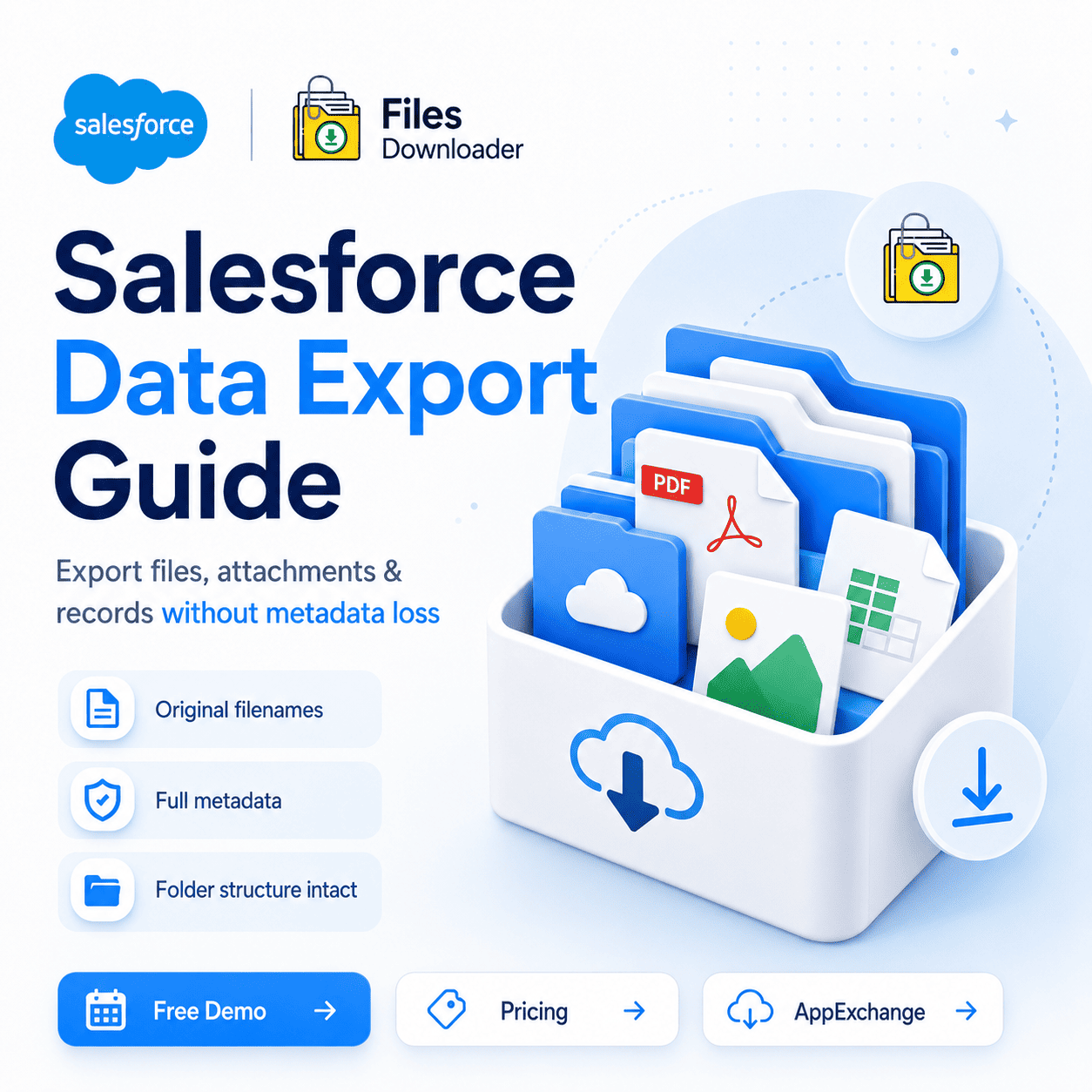
Every admin and data team that has ever tried a Salesforce data export knows the moment it goes sideways. The files have no context. Metadata is not available. Folder structures collapse into flat non-navigable ZIP archives. And the hours spent trying to reconstruct what the platform had already preserved, add up fast. Salesforce data export should be easy, clean and complete. But native tools make it anything but. Files Downloader will fix that. It provides the fastest, most reliable Salesforce data export experience on the market — with full metadata, original filenames, and folder structure intact from start to finish.
Thank you for reading this post, don't forget to subscribe!Why Native Salesforce Data Export Tools Break
Salesforce was built for data entry and CRM workflows, not for bulk file extraction. Every time a team tries to export Salesforce data with native tools, the same three failures inevitably appear.
The “Zip File Treasure Hunt”
Native Salesforce data export creates a bunch of ZIP archives with numbered names, scrambled filenames, and no folder structure. The ContentVersion does not have stored owner, object type, creation date, and record association inside Salesforce. Admins spend days manually rebuilding the context that the platform had preserved all along — a problem that should not exist in any serious Salesforce data export workflow.
The Problem of the Absence of Selective Filtering
There is no native way to run a targeted Salesforce data export. You cannot say: “Export only the PDFs attached to closed Opportunities in the Northeast region, created in the last 12 months.” Every native Salesforce data export is an all-or-nothing affair. When you have hundreds of custom objects in your org, that approach renders any intelligent, selective export impossible.
File Storage Limit Exceeded – The Price to Pay for No Export Strategy
When ContentVersion records pile up across every object in your org without a disciplined Salesforce data export and offload strategy, the File Storage Limit Exceeded error is inevitable. Salesforce charges file storage separately from data storage, meaning records silently eat up your allocation across Accounts, Cases, Opportunities, and custom objects simultaneously — with almost no warning before you hit the limit.
How Files Downloader Solves Every Salesforce Data Export Problem
Files Downloader is a Salesforce AppExchange application purpose-built for admins and data teams that require a reliable, complete Salesforce data export tool. It reads ContentDocument, ContentVersion and ContentDocumentLink natively — providing full bulk export control across all standard and custom objects where files have piled up.
Bulk Export From Any List View in One-Click
Files Downloader works with both standard and custom list views as they exist in your org today. Every object that has files and attachments — Accounts, Contacts, Opportunities, Cases, and every custom object your org has built — is available through its existing list view. Open any list view, apply your filters and trigger a complete Salesforce data export in one step – you don’t need to rebuild your existing workflow or call a developer.
No matter how big or complex your org has grown, this is the fastest way to complete a Salesforce data export without using complex third-party tools.
All Files Exported in Their Exact Original Format
Files Downloader downloads each file exactly as Salesforce stored it – in its original format, with its original filename, within its original folder structure. This is different from native Salesforce data export tools that rename or convert files during extraction.
PDFs are still PDFs
Images remain .jpg or .png
Word documents remain .docx
Nothing is compressed into an unreadable archive or renamed with a system generated ID
It supports all file types – PDFs, images (.jpg, .png), docs, spreadsheets and more. For teams importing Salesforce data export results into SQL Server or Excel, uniform formatting saves hours of post-export reformatting and manual file matching.
All Salesforce Data Exports Keep Full Metadata
When files build up across multiple objects, metadata is everything. Files Downloader keeps all metadata for all Salesforce data exports:
Original file name — exactly as ContentVersion stored it, never replaced by a system ID
Owner and record association — who created the file and which record it belonged to
Object type context — so your exported folder structure maps directly back to where each file lived in your org
This metadata-aware approach makes Files Downloader the default Salesforce data export solution for clean migrations, compliance audits, and system backups where object context directly affects data quality.
SOQL Query Export: Exact Salesforce Data Export at Scale
Files Downloader’s SOQL Query Export is the most powerful Salesforce data export feature available today to admins and data teams who need exact control over what gets extracted. Write and run your own queries directly against ContentVersion and related objects — no developer needed, no Apex code, no waiting on a ticket.
Single Salesforce Data Export Step to Target Specific Objects and Fields
Instant access to the latest data Customise and run your own SOQL query directly inside the app. Filter your Salesforce data export using:
Type of object
Type of record
Date created
Status Owner
Any field your org is tracking
Pull just the files you want from the objects you want to target—in one step, without exporting everything first and sorting later. This is especially powerful when ContentVersion records are related to multiple objects throughout your org. Targeted SOQL query You control exactly which files are included in your Salesforce data export, so every run is scoped, intentional, and audit-ready.
Simplify Salesforce Data Export Operations for Multiple Objects
Most Salesforce orgs have files spread across Accounts, Opportunities, Cases and custom objects at the same time. Files Downloader simplifies complex data export operations from Salesforce by targeting specific objects and fields every time. An Opportunity-level export will not “accidentally” pull in unrelated Case attachments or files from anywhere else in your org.
Built for Every Role That Relies on Salesforce Data Export
Files Downloader is not a generic file management tool with a Salesforce connector tacked on. It is a must-have tool for exporting Salesforce data for every role that works with files across both standard and custom objects.
Salesforce Admins use it to run targeted Salesforce data export operations from specific objects before hitting File Storage Limit Exceeded thresholds.
Data Teams use it to build clean, metadata-intact exports from targeted objects for SQL Server, Excel and BI platforms.
Migration Specialists trust it to maintain original file names and folder structures during org-to-org or platform migrations
Developers and Architects use it to validate ContentVersion records against specific objects before and after major org changes
It works seamlessly with Salesforce data export and file management workflows – saving time by eliminating the manual sorting that follows every unmanaged bulk export.
All the Scenarios When Exporting Salesforce Data Becomes Crucial
Export audit of pre-migration Salesforce data from all standard and custom objects before platform cutover
Storage offload quarterly All meta data for each file in export
Salesforce data export of specific objects for audit trails and regulatory review driven by compliance
Full org backup with ContentVersion metadata preserved for disaster recovery and system restore
Files Downloader provides the same clean, repeatable, metadata-intact Salesforce data export foundation for every scenario — no matter how large or complex your org has grown or how many ContentVersion records have accumulated.
Export files with full metadata intact. Maintain the existing folder structures that refer back to where each file existed in your Salesforce org. Re-import cleanly into your destination org, Google Drive, SharePoint, SQL Server or any staging environment. What took days of manual work, now takes minutes.
[Book a Free Demo] | [View Pricing] | [Install on AppExchange]