

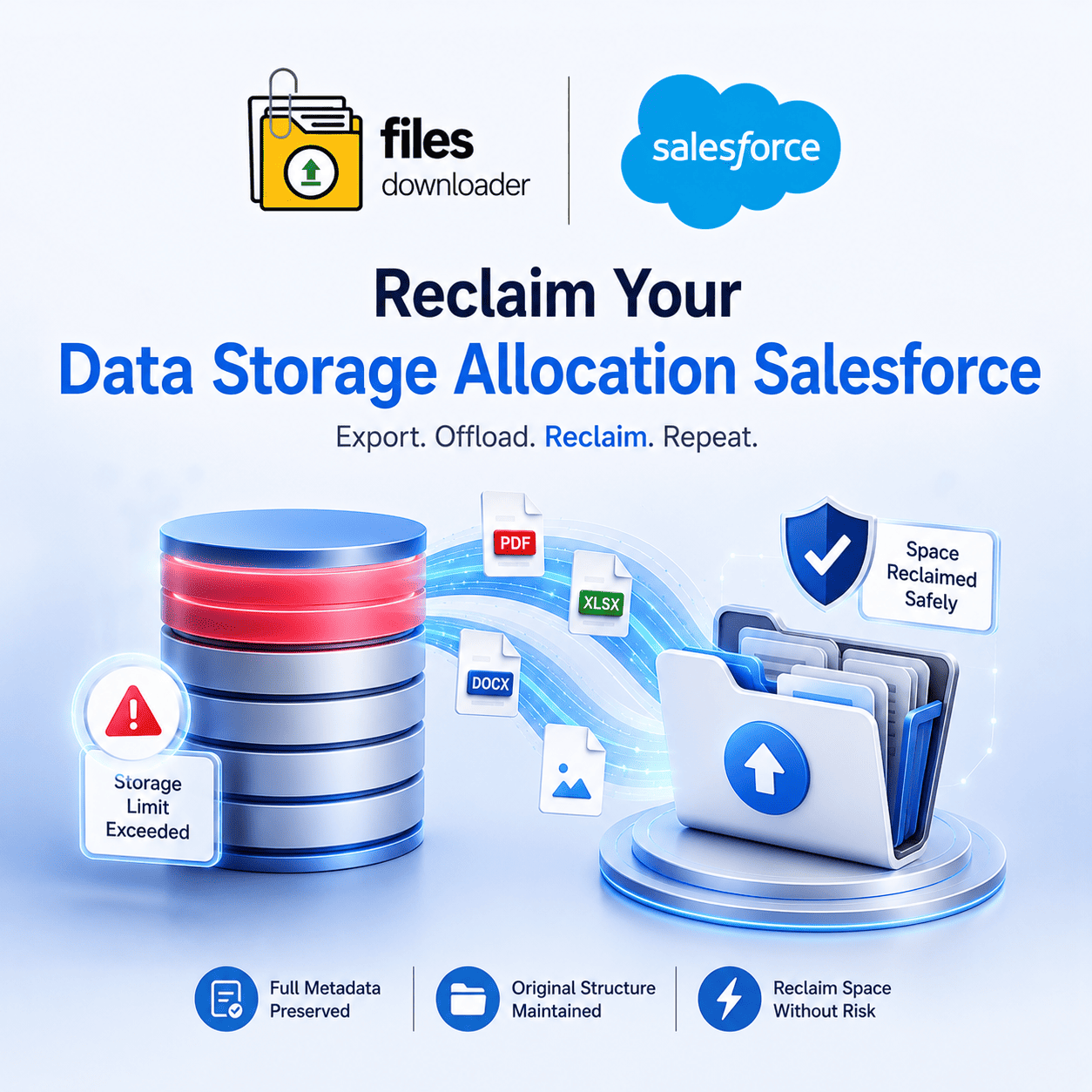


Data Storage Allocation Salesforce: How Admins Reclaim Space Without Losing a Single File
Data storage allocation Salesforce assigns to each org fills up faster than most teams anticipate. Attachments, documents, ContentVersion records, and images accumulate across thousands of records — silently, continuously, without warning. By the time the File Storage Limit Exceeded alert appears, the data storage allocation Salesforce has provided is already exhausted and the pressure to act immediately is real. Buying more storage is expensive. Deleting files without a proper export is risky. Files Downloader gives you the third option: bulk export every file you need to offload — with full metadata, original filenames, and folder structure intact — so you can reclaim data storage allocation Salesforce is holding without losing anything that matters.
Thank you for reading this post, don't forget to subscribe!Why Data Storage Allocation Salesforce Provides Is Never Enough
Salesforce’s data storage allocation is edition-based and user-count-based. It sounds sufficient at signup. It rarely stays that way. Here’s why data storage allocation Salesforce grants gets consumed faster than orgs plan for.
The Silent Accumulation No One Tracks
Every file uploaded to a Salesforce record — every email attachment, every portal document, every ContentVersion record from an integrated tool — draws from the same data storage allocation Salesforce set at the account level. There’s no built-in file expiry. There’s no automatic archival. Storage fills up record by record until the File Storage Limit Exceeded threshold is crossed mid-project.
The “Zip File Scavenger Hunt” Makes Offloading Painful
The natural response to a full storage allocation is to export and remove files. But native Salesforce export tools make that harder than it should be. Exports arrive as unstructured zip archives — no original filenames, no folder logic, no record associations. Admins trying to reclaim data storage allocation Salesforce has consumed end up with unusable file dumps that nobody can navigate or verify.
No Selective Filtering Means No Strategic Offloading
Reclaiming data storage allocation Salesforce orgs need freed up requires precision — the ability to target only the files safe to archive without disturbing active records. Native export tools don’t support that. You get all files or no files. There’s no way to say “export only legacy Case attachments from 2021 and 2022” and reclaim just that allocation. Without selective filtering, storage management becomes guesswork.
How Files Downloader Takes Back Your Data Storage Allocation Salesforce Is Wasting
Files Downloader is a purpose-built Salesforce AppExchange tool that gives admins precise, structured, metadata-intact control over file exports. It turns data storage allocation Salesforce management from a reactive scramble into a disciplined, repeatable process.
Export From Any List View to Target the Biggest Storage Drains
Files Downloader works with both standard and custom list views exactly as they exist in your org. Open any list view, apply your filters, and trigger a mass export in one step. You get bulk file and attachment exports from any list view across standard and custom objects — instantly, without modifying your existing workflow.
This gives you direct, targeted control over data storage allocation Salesforce is consuming. Export only the ContentVersion records attached to archived Accounts. Export only closed Case documents past a set date. Export only a specific custom object’s attachments. One scoped action — real storage reclaimed.
Download Files in Their Exact Original Format
Files Downloader downloads files and attachments from Salesforce in their exact original format — no conversion, no compression, no system ID replacing the original filename. PDFs stay PDFs. Images stay .jpg or .png. Word documents stay .docx.
It supports all file types: PDFs, images (.jpg, .png), docs, spreadsheets, and more. For teams importing Salesforce data into SQL Server or Excel after recovering data storage allocation Salesforce had consumed, format consistency eliminates hours of post-export reformatting that native exports require.
Preserve Full Metadata Through Every Storage Offload
Losing metadata during a storage offload defeats the purpose of the exercise. Files Downloader preserves:
- Original file name — exactly as stored in Salesforce, never replaced by a system-generated ID
- Owner and record association — who created the file and which Salesforce record it belongs to
- Object type context — so exported folder structures map directly back to your Salesforce data model
Every file you move to recover data storage allocation Salesforce has filled remains traceable, searchable, and re-importable — whether it lands in SharePoint, Google Drive, SQL Server, or a local archive.
Use SOQL Query Export to Pinpoint Exactly What’s Consuming Your Allocation
For admins who need surgical precision in identifying and reclaiming data storage allocation Salesforce orgs have exhausted, Files Downloader’s SOQL Query Export interface is the most powerful tool available. Write and execute your own queries against ContentVersion and related objects — no developer required.
How SOQL Query Export Identifies the Highest-Volume Storage Records
Access the latest data instantly by customizing and running your own SOQL query directly inside the app. Filter by file size, creation date, object type, owner, or any custom field your org tracks. Extract only the files relevant to your data storage allocation Salesforce offloading plan in a single step — no exporting everything and sorting afterward.
ContentVersion records are the single largest contributor to data storage allocation Salesforce consumption in most enterprise orgs. A targeted SOQL query lets you identify and export those records first — maximizing the storage you reclaim per export run.
Target Specific Objects and Fields — Leave Active Data Untouched
In most Salesforce orgs, storage-heavy files are distributed across Accounts, Opportunities, Cases, and custom objects simultaneously. Files Downloader lets you simplify complex data downloads by targeting specific objects and fields. Export runs stay scoped, intentional, and safe — no active records disturbed, no accidental data loss.
The Tool Every Role Uses to Manage Data Storage Allocation Salesforce Orgs Depend On
Files Downloader isn’t a generic file tool with a Salesforce connector bolted on. It’s a must-have file exporter for every role involved in managing data storage allocation Salesforce assigns.
- Salesforce Admins use it to systematically offload files before File Storage Limit Exceeded errors block project execution
- Data Teams use it to structure clean exports for SQL Server, Excel, and BI platforms with zero post-export reformatting
- Migration Specialists rely on it to preserve original file names and folder structures during org-to-org or platform transitions
- Finance and Ops Teams use it to control storage costs by offloading files to lower-cost external platforms before purchasing additional allocation
It works perfectly with Salesforce data export and file management workflows — and saves time by eliminating the manual data sorting that follows every bulk export.
Files Downloader for Every Data Storage Allocation Salesforce Scenario
Proactive quarterly storage audit. Emergency offload after a File Storage Limit Exceeded error. Pre-migration cleanup before a platform consolidation. Systematic archiving to keep data storage allocation Salesforce consumption below threshold permanently. Files Downloader gives every scenario a clean, repeatable, metadata-intact export foundation.
Export files with full metadata preserved. Maintain original folder structures. Re-import cleanly into SharePoint, Google Drive, SQL Server, or any long-term archive. What used to take days of manual preparation now takes minutes.
[Book a Free Demo] | [View Pricing] | [Install on AppExchange]